Fire NOC for restaurants in India — when needed, documents, renewal
Fire NOC for Indian restaurants — when applicable by area and storey, the 11-document checklist, equipment requirements, state renewal cadence, and the inspection script.
Last updated 9 Aug 2026
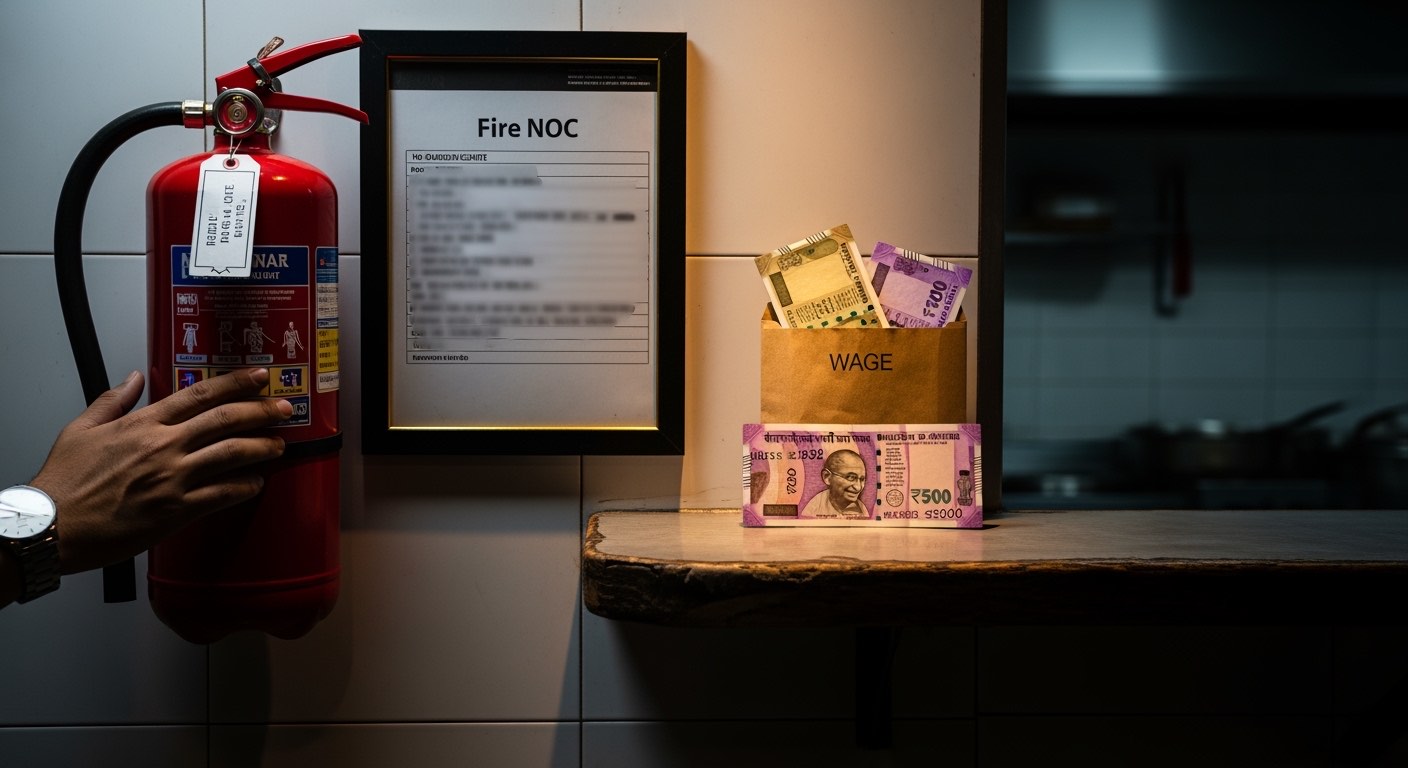
About this piece. The fire NOC (No Objection Certificate) is the document that proves a restaurant's premises meets state fire-safety norms. It's required for FSSAI licensing in many states, often for trade-licence renewal, and for the building owner's commercial-property insurance. The rules sit under state fire-service legislation read with the National Building Code (NBC) Part 4. This piece walks the operator through when a fire NOC is needed, the document checklist, what an inspection looks for, and the renewal cadence.
When a fire NOC is required — the area + storey threshold
Fire-safety NOC obligations are state-specific but follow a common structure. The triggering parameters are usually:
- Built-up area of the establishment
- Building height (number of storeys above ground)
- Occupancy class (restaurant = mercantile or assembly under NBC)
- Cooking method (commercial kitchen with LPG/PNG/charcoal triggers higher scrutiny)
The general thresholds operators encounter most often:
| Area / storey | Fire NOC needed? |
|---|---|
| < 200 sq m on ground floor only | Often a self-declaration suffices; check state |
| 200–500 sq m or first floor | Provisional NOC + inspection |
| > 500 sq m or above 15m height | Full NOC mandatory |
| Any rooftop restaurant | Full NOC mandatory in most states |
| Any basement kitchen | Full NOC mandatory + ventilation clearance |
State fire-service rules (Maharashtra Fire Prevention and Life Safety Measures Act, Karnataka Fire Force Act, Delhi Fire Service Act, etc.) define the exact slabs. Verify with the state fire-service portal or rules; the structure is stable but specific area thresholds vary.
A separate distinction matters for new buildings vs occupied premises:
- Provisional NOC (during construction / fit-out)
- Final / occupancy NOC (after fit-out, before opening)
- Renewal NOC (annually or per state cadence)
For a restaurant taking over an already-built space, you typically need a fresh occupancy NOC even if the previous tenant had one — the use class may have changed (office to restaurant) and equipment changed.
The 11-document checklist
Documents required for fire NOC application (state variation applies):
| # | Document | Notes |
|---|---|---|
| 1 | Application form (state-specific) | Online portal in most states |
| 2 | Building plan approved by local authority | PDF + dimensioned |
| 3 | Structural stability certificate | From licensed engineer |
| 4 | Electrical wiring inspection certificate | Licensed electrical contractor |
| 5 | Fire-fighting equipment installation certificate | From OEM / installer |
| 6 | List of fire-safety equipment installed | With makes, models, capacities |
| 7 | Floor layout marked with exits, extinguisher positions | Engineer-prepared |
| 8 | Property document or rent agreement + landlord NOC | Latest |
| 9 | Trade licence | If already issued |
| 10 | Identity proof of applicant | PAN + Aadhaar |
| 11 | Fee challan / online payment receipt | After fee payment |
For high-rise or larger establishments, additional items are required: water-tank capacity certificate, sprinkler system certificate, fire-pump certificate, alarm system certificate, smoke-detector layout, emergency lighting layout.
Fire-safety equipment — the operator's minimum kit
Even small restaurants below the full-NOC threshold have a minimum equipment expectation. The list below is the practical floor for an Indian restaurant:
| Equipment | Minimum spec | Where |
|---|---|---|
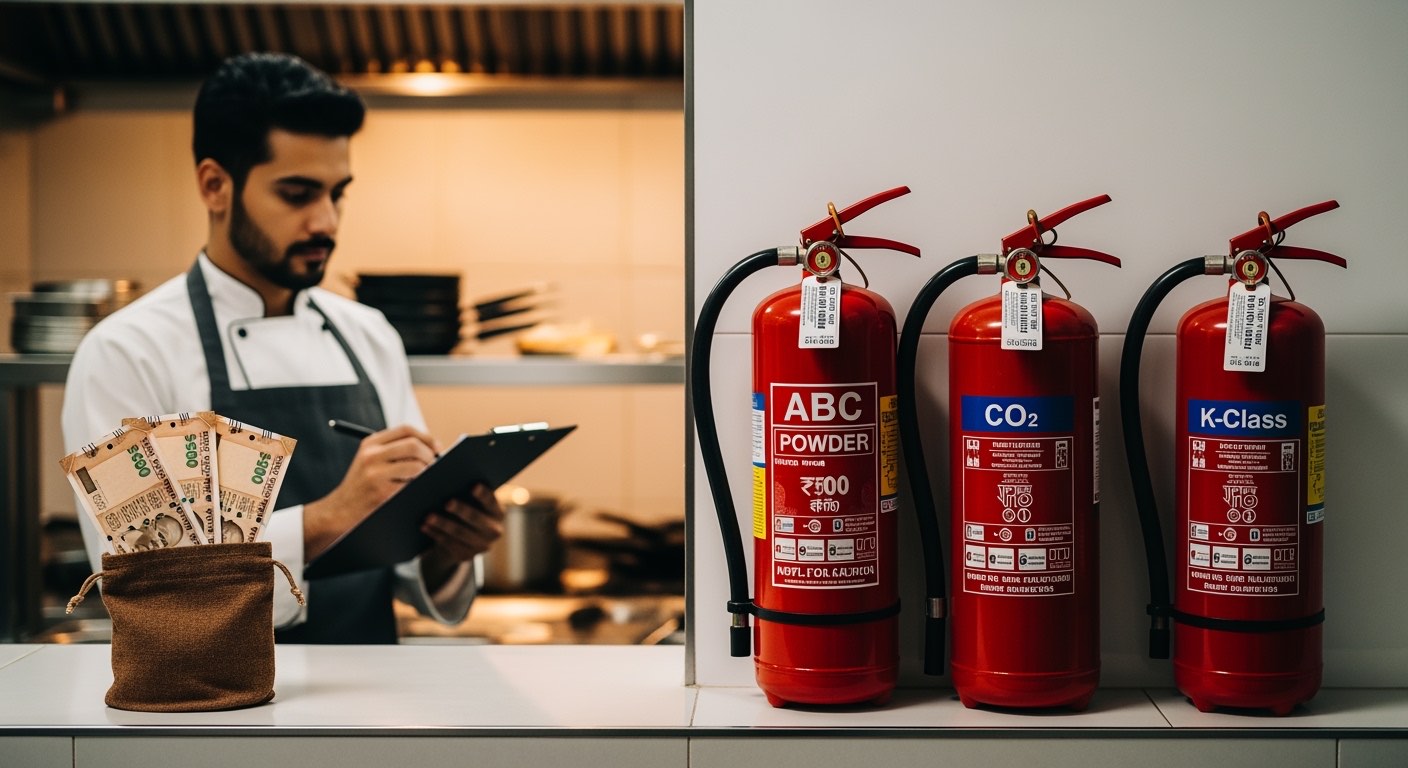
| ABC dry powder extinguisher (4 kg or 6 kg) | ISI marked | Per 100 sq m floor area; near every exit |
| CO2 extinguisher (4.5 kg) | ISI marked | Near electrical panel |
| K-class extinguisher (for cooking oil fires) | ISI marked | In commercial kitchen |
| Fire blanket (non-combustible) | Per kitchen | Near hob area |
| Smoke detector | UL/EN listed | Per state slab |
| Manual call point (alarm) | Per state slab | Near exits |
| Emergency exit signage (illuminated) | IS 12349 | Above every exit door |
| Emergency lighting | Battery-backed | Throughout |
| First aid box | Standard contents | At least one per outlet |
The K-class extinguisher is the one most underestimated in Indian commercial kitchens. ABC and CO2 extinguishers are not the right tool for a deep-fryer fire — they can spread the burning oil. K-class is engineered for cooking-oil fires; budget ₹3,500–₹5,500 per unit and install in the cooking line.
All extinguishers need annual refilling and pressure testing. AMC contracts with the installer typically run ₹250–₹500 per extinguisher per year for refill and inspection.
The inspection script
When the fire officer comes for inspection (typically within 15–30 days of application submission), the walk-through covers:
1. Entry / exit                    width, opening direction, panic-bar hardware
2. Exit signage                    illuminated, visible from any point
3. Exit corridors                  unobstructed, no storage in path
4. Staircase                       fire-rated, no obstruction, smoke-vent if enclosed
5. Kitchen ventilation             hood + ducting + grease trap status
6. LPG / PNG installation          regulator placement, pipe routing, valve access
7. Electrical panel                accessible, K-class or CO2 nearby, no obstruction
8. Extinguishers                   ISI mark, refill date, pressure, position
9. Fire alarm + smoke detectors    operational test
10. Sprinklers (if installed)      pressure check + flow test
11. Water tank                     capacity verification (state slab)
12. Public address / evacuation    audibility throughout outlet
13. Staff awareness                spot questions on evacuation drill
The two non-obvious failures we see most often:
- Storage in exit corridor. The corridor was clear when you were filming the AMC video; on inspection day there's a stack of soft-drink crates in it. Permanent rule: never anything in the exit path, ever.
- Extinguisher refill date expired. The annual refill lapsed by a month and the inspector flags it. Fix: AMC visit calendar + bound extinguisher log book.
Restaurant fires in India are most often kitchen-origin — chimney grease catching fire, LPG leak igniting, deep-fryer flashover. The fire NOC checklist tries to address each: K-class extinguisher for fryer, smoke detector for chimney, alarm + evacuation for the rest. Treat the checklist as life-safety design, not as paperwork — and the paperwork sorts itself.
State renewal cadences
| State | Renewal cadence | Renewal fee structure |
|---|---|---|
| Maharashtra | Annual (Form B) | Per area slab |
| Delhi | Annual | Per area slab |
| Karnataka | Annual or 3 years (option) | Per area slab |
| Tamil Nadu | Annual | Per area slab |
| Telangana | Annual | Per area slab |
| Gujarat | Annual or 3 years | Per area slab |
| Uttar Pradesh | Annual | Per area slab |
Renewal applications usually need updated copies of the equipment AMC, electrical re-test certificate (every 1–3 years depending on state), and a fee. The renewal inspection is usually lighter than the first issue but can pick up equipment lapses.
The T-60 renewal reminder rule applies — set the calendar 60 days before expiry, gather updated AMC and electrical certificates, file in week 4, follow up if needed in weeks 9–10.
Penalties and operating risks
Operating without a current fire NOC carries layered risk:
| Issue | Consequence |
|---|---|
| Application of penalty under state fire-service Act | Fine + closure notice possible |
| FSSAI renewal blocked | State licence renewal can require fire NOC |
| Trade licence renewal blocked | Municipal can require fire NOC |
| Insurance void | Fire-insurance claims can be denied if NOC was not current at incident |
| Aggregator delisting | Compliance scans can flag |
| Liability in case of incident | Personal liability of owner / directors |
The insurance dimension is the one operators most under-rate. A ₹3 crore fire claim being denied because the NOC lapsed three months earlier wipes out a year of margin and can end the business. Treat the NOC as an insurance pre-condition, not as a regulatory chore.
Building modifications and the NOC
Any modification to the kitchen layout, cooking line, electrical load, ventilation, or LPG/PNG installation should trigger a fresh look at the fire NOC. The principle: the NOC was issued for the configuration that existed at inspection; significant changes invalidate it.
What counts as significant:
- Adding tandoors, additional fryers, large-scale griddles
- Increasing seating capacity by 30 percent or more
- Adding floor area (mezzanine, expansion, terrace)
- Changing fuel from LPG to PNG or vice versa
- Splitting or merging service kitchens
Minor refurbishments (paint, furniture replacement, equipment swaps within the same envelope) don't require re-NOC. When in doubt, file an intimation to the fire department; cheap, easy, removes future ambiguity.

A worked timeline: fresh NOC for a new outlet
Day  -90  Submit fire NOC application (online portal)
Day  -85  Fee challan paid; acknowledgement received
Day  -75  Engineer files: building plan, structural cert,
              electrical cert, equipment list with makes
Day  -60  Equipment installed: extinguishers, K-class, smoke detectors,
              alarm, exit signage, emergency lighting
Day  -50  Provisional NOC processed
Day  -45  Site inspection scheduled
Day  -40  Inspection conducted
Day  -30  Final occupancy NOC issued
Day    0  Outlet opens

Year +1 (T-60 days from Year 1 expiry):
            Renewal application + updated AMC certificates
90 days end-to-end with no surprises is a realistic timeline for a clean application. Allow 120 days if you're in a state with paper-based fire department processes.
Where this fits in the compliance stack
The fire NOC is one of the safety-critical compliance items where the regulatory penalty is small but the operational stakes are large. It connects to:
- FSSAI licence — many states require fire NOC for FSSAI renewal
- Trade licence — municipal often requires fire NOC
- Property insurance — fire NOC is a precondition for valid claim
- Liquor licence — assembly-occupancy concerns require fire safety
- Outlet safety SOPs — daily evacuation drill, monthly equipment check
Get the NOC, schedule the AMC, walk the floor monthly, and the fire-safety layer is one of the cheaper parts of the compliance stack to keep clean.
Related on Restaurant Daily
One operator playbook a week, in your inbox.
Cash close, petty cash, payroll, compliance, unit economics — sent every Monday morning. No spam, no upsell drip. Unsubscribe in one click.
Sent from noreply@restaurantdaily.ai. We never share your address.
Related reading
Food handler health card for restaurant staff — FSSAI medical rule + flow
Food handler health card for Indian restaurant staff — FSSAI medical fitness rule under Schedule 4, test list, renewal cadence, joining-day workflow, and inspector-ready format.
Liquor license types for Indian restaurants — L-1 to L-19 explained
Liquor license types for Indian restaurants explained — L-1 to L-19 across states, eligibility, fees, daily ops obligations, and the operator's working comparison table.
Shop & Establishment Act for restaurants — registration, hours, holidays
Shop & Establishment Act registration for Indian restaurants — state-by-state hours, weekly off rules, leave entitlements, registers, fees, and renewal cadence.
CCPA service charge rules for Indian restaurants — daily ops impact
CCPA 2022 service charge guidelines for Indian restaurants — what's banned, what's allowed, the menu disclosure rules, complaint redressal, and the 5 daily-ops changes operators have to make.
DPDPA for Indian restaurants — what guest data triggers in 2026
DPDPA for restaurants in India 2026: what triggers it for WhatsApp, loyalty, CCTV, aggregator data. Consent, notice, breach response, and the operator's working compliance plan.