Franchise vs own restaurant in India — cost, control, payback
Franchise vs own restaurant in India compared on capex, royalty, control, payback, and exit. Honest operator-side maths for first-time owners deciding between routes.
Last updated 9 Aug 2026
About this piece. First-time operators with ₹40 lakh to ₹1.5 crore of capex sitting on the table almost always end up in the same conversation — "do I take a franchise or build my own brand?" The honest answer is "it depends on what you're optimising for", but most of the writing online doesn't give you the maths to decide. This piece does. Numbers are operator-side ranges drawn from publicly disclosed FDD-equivalent disclosures and India-context franchise circulars; verify the specific brand's current terms before committing.
The four axes that actually matter
Most franchise-vs-own debates collapse into "franchise = safer, own = cheaper" — which is wrong on both halves. The four axes that actually decide the right route are:
- Capex — what cash leaves your account before day one
- Operating control — how much of menu, supplier, pricing, and staff policy you can change without permission
- Time to break-even — when monthly cash inflows clear monthly outflows
- Exit value — what the asset is worth at month 36 if you walk
A franchise wins on axis 4 sometimes (a strong brand has an established secondary market) and loses badly on axis 2. An own brand wins on 2, often on 1, and is a coin-toss on 3 and 4. The decision is which two axes you weight most.
Capex — the franchise premium is real
A like-for-like comparison: a 50-cover QSR in a tier-1 metro, neutral location, leasehold improvements included, kitchen equipment included, working capital for 3 months.
| Cost head | Own brand (₹L) | Mid-tier franchise (₹L) | Premium franchise (₹L) |
|---|---|---|---|
| Brand fee / franchise fee | 0 | 8–15 | 20–50 |
| Fit-out (₹/sqft × 1,200 sqft) | 18–28 | 22–35 (brand-spec) | 30–55 (brand-spec) |
| Kitchen equipment | 12–18 | 15–22 (approved vendors) | 18–30 (approved vendors) |
| Initial inventory + supplies | 3–5 | 4–6 (brand SKUs) | 5–8 (brand SKUs) |
| Licences + deposits | 1.5–3 | 1.5–3 | 1.5–3 |
| Working capital (3 months) | 8–12 | 10–15 | 12–20 |
| Marketing launch | 1–3 | 0–2 (brand-funded) | 0–1 (brand-funded) |
| Total capex | 43.5–69 | 60.5–98 | 86.5–167 |
The franchise premium ranges from ₹15–25 lakh on a mid-tier brand to ₹40 lakh+ on a premium brand. The premium buys you a known menu, a known SOP stack, an approved supplier list, and — at the better-run brands — a proper area mentor for the first 90 days. Whether that is worth ₹15–40L is the question.
The royalty meter runs every month
Capex is the one-time number. Royalty is the lifetime number. A typical Indian franchise structure:
- Royalty: 5–8% of net sales, monthly
- Marketing fund: 2–4% of net sales, monthly
- Audit fee: ₹50,000–₹2,00,000 / year, lump sum
- Renewal fee at year 5: 30–50% of original franchise fee
For a ₹35 lakh/month outlet, that's ₹2.45L–₹4.2L going to the franchisor every month. Over 5 years, before any renewal fee, that's ₹1.47–₹2.52 crore on top of the original franchise fee.
Run the lifetime number against the asset value. If 5 years of royalty exceeds the cost of building your own brand from scratch — and very often it does — the case for franchise has to lean entirely on de-risking, not on cost.
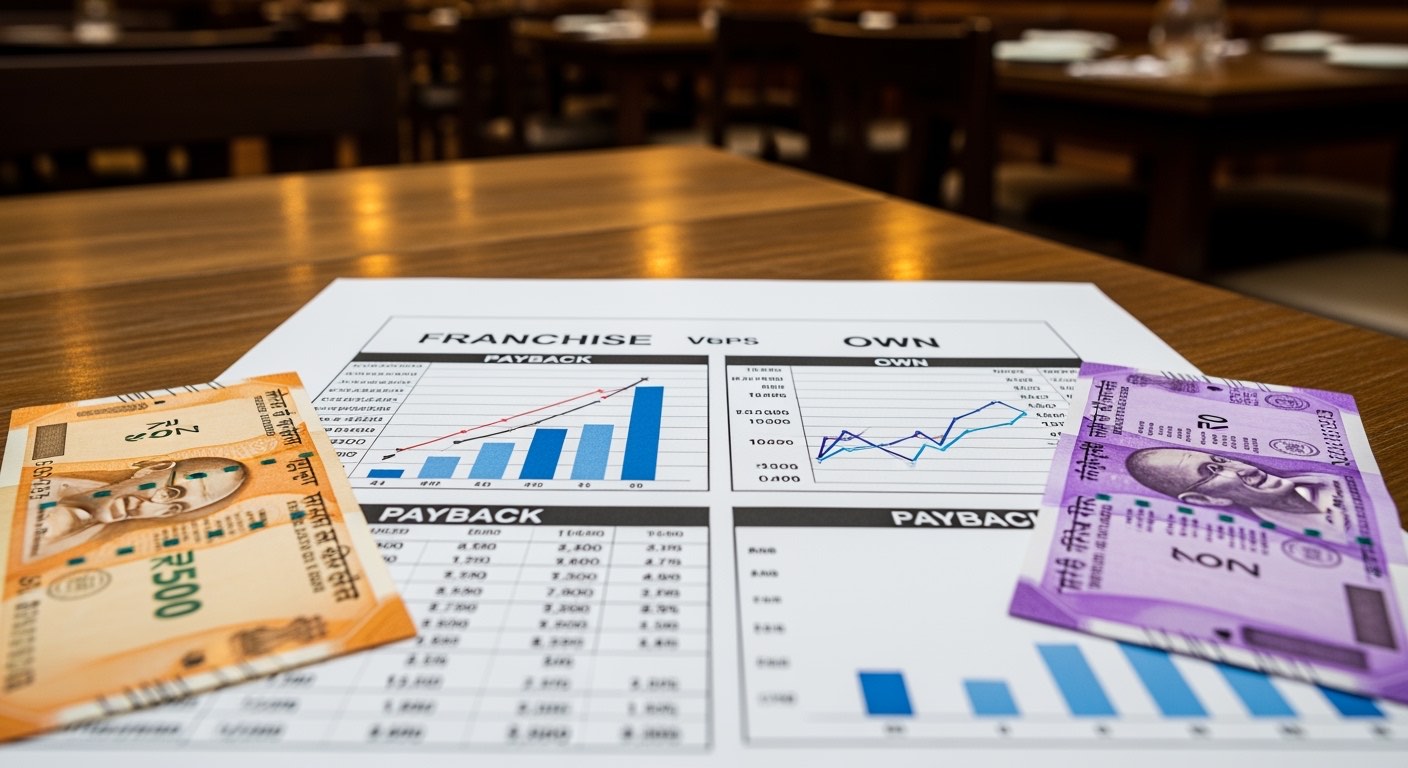
Control — what you can and can't change
Operational control on a franchise is narrower than first-timers expect. The standard restrictions in Indian franchise agreements:
- Menu — locked. New items require franchisor approval; local-taste pivots that work in tier-2 (Jain options, milder spice, smaller portions) require formal change requests that often don't get approved.
- Suppliers — approved-vendor list only. Even local vegetables sometimes have to come from a designated mandi vendor at brand-mandated grade.
- Pricing — anchored. You can run promotions within a band; you can't reposition the menu mid-cycle.
- Staff hiring — you hire, but training has to follow brand SOP. Some brands run mandatory paid training cycles at HQ that you fund.
- Hours — set by the brand. Closing early on a slow Tuesday usually triggers an audit comment.
Own brand has none of these. You can change the menu next week, switch suppliers tomorrow, run a 30% Tuesday discount because Wednesday's footfall data says it'll work. That flexibility is the real thing you give up for the franchise wrapper.
Payback — the number both routes converge on
A common myth: franchise pays back faster because the brand is known. The data does not support that. Across publicly disclosed franchise unit economics in India, payback for both routes lands in the 18–36 month range for a healthy single-outlet QSR in a tier-1 metro, with the spread driven by location and operator skill — not by franchise-versus-own.
| Scenario | Capex (₹L) | Monthly net cash (₹L) | Payback (months) |
|---|---|---|---|
| Own brand, decent operator | 50 | 1.8 | 28 |
| Mid-tier franchise, decent operator | 75 | 2.4 (brand pull) | 31 |
| Premium franchise, decent operator | 130 | 3.5 (brand pull) | 37 |
| Own brand, weak location | 50 | 0.8 | 63 |
| Mid-tier franchise, weak location | 75 | 1.5 (brand cushion) | 50 |
The franchise cushion shows up in the bad scenarios more than the good ones. A weak-location franchise pays back faster than a weak-location own brand because the brand pull lifts a bad site. A good-location operator clears payback on either route in roughly the same window — the franchise route just costs ₹25L more to get there.
Exit — what the asset is worth at month 36
This is where the picture inverts again. An independent restaurant at month 36 is worth roughly 0.5–1.5x trailing 12-month EBITDA if it sells at all — most don't, they wind down, return the deposit, and the operator walks. A franchise unit at the same point trades in the 1.5–3x EBITDA range because there's an established secondary market of franchisees looking to buy operating units.
The exit value gap is the underrated reason institutional family-office money tends to prefer franchise units. The downside scenario is bounded — somebody will always buy a healthy McDonald's or Burger King unit. The upside is capped, but the floor is solid.
When franchise is the right answer
Franchise wins decisively in three operator profiles:
- First-time, conservative, capital-rich. You have ₹1 crore, you'd rather pay ₹25L extra to outsource menu / supplier / SOP risk, you don't trust your own brand-building instinct yet.
- Investor-operator with a manager running the floor. You won't be on-site daily. A franchise SOP stack survives an absent owner better than an own brand.
- Tier-2 / tier-3 expansion behind a tier-1 success. You proved the model in a metro, you want to repeat it in 4 more cities — buying a franchise of a brand already known there beats opening unknown.
When own brand is the right answer
Own wins decisively in three other profiles:
- First-time, capital-tight, hands-on. You have ₹40L, you're going to be on-site every day, you'd rather take menu risk than royalty risk.
- You have a real brand instinct. You've cooked the food, tested it, have a clear point of view on what's missing in your micro-market. The franchise wrapper would dilute the thing that makes the bet interesting.
- You're optimising for optionality, not exit price. You want to be able to pivot the format in year 2 if the data tells you to. A franchise contract makes that legally hard.
A 3-question filter
If you're still on the fence, answer these three honestly.
- Will you be the operator on-site, or hiring a manager? On-site → tilt own. Manager → tilt franchise.
- Is your capex ceiling above or below the franchise premium? Above → either works. Below → own.
- Do you have a menu / brand idea that excites you, or are you primarily looking for a business? Excited → own. Looking for a business → franchise.
Two answers in one direction is a strong signal. Three is decisive.
Related on Restaurant Daily
One operator playbook a week, in your inbox.
Cash close, petty cash, payroll, compliance, unit economics — sent every Monday morning. No spam, no upsell drip. Unsubscribe in one click.
Sent from noreply@restaurantdaily.ai. We never share your address.
Related reading
Burger Singh franchise cost in India — operator-side breakdown
Burger Singh franchise cost in India — publicly available capex, royalty, royalty and payback numbers explained from an operator's side, with honest caveats.
Soft launch vs grand opening for restaurants in India — sequencing
Soft launch vs grand opening for restaurants in India — sequencing, media plan, when to switch. Operator-grade playbook covering the 21 days from quiet open to full visibility.
Food trial run before restaurant launch — friends & family protocol
Food trial run before restaurant launch in India — friends-and-family menu testing protocol, scoresheets, and what to actually fix between session 1 and opening night.
Small restaurant business plan India — free template for bank loan
Small restaurant business plan India — free template for bank loan + investor decks. 12-section structure with the numbers loan officers actually look at.
Equipment list for a new Indian restaurant — kitchen + FOH BOM
Equipment list for a new Indian restaurant — full kitchen + FOH bill of materials with vendor categories and indicative prices for a 50-cover casual dining.