Food trial run before restaurant launch — friends & family protocol
Food trial run before restaurant launch in India — friends-and-family menu testing protocol, scoresheets, and what to actually fix between session 1 and opening night.
Last updated 9 Aug 2026
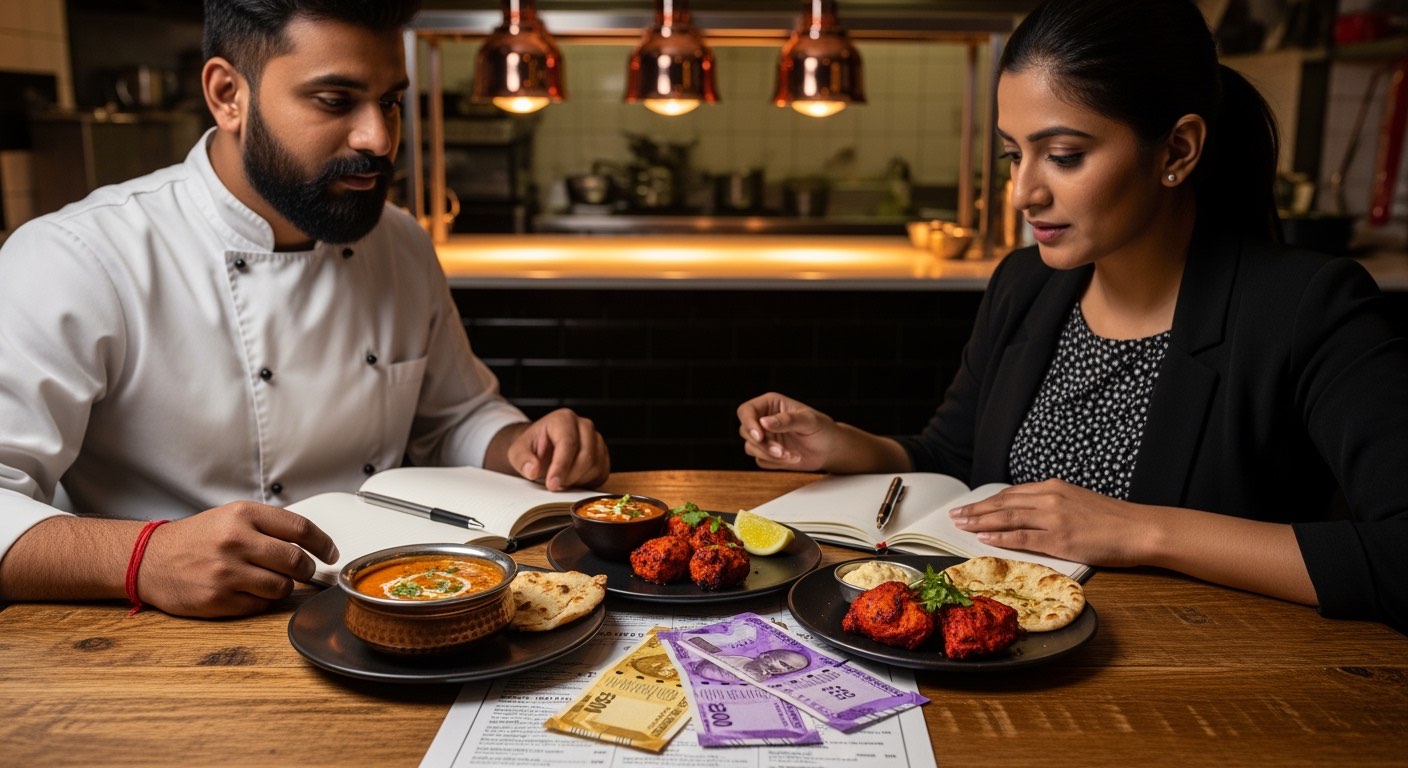
About this piece. A food trial run — the friends-and-family service before the soft launch before the grand opening — is the single most under-used tool in the Indian first-time-operator playbook. Done well, it cuts ₹2–4L of ramp-period waste and saves the brand from a 1.5-star Zomato review based on opening-week chaos. This piece is the protocol — three sessions, who to invite, what to score, what to fix between each. Print it, run it, ship a better restaurant.
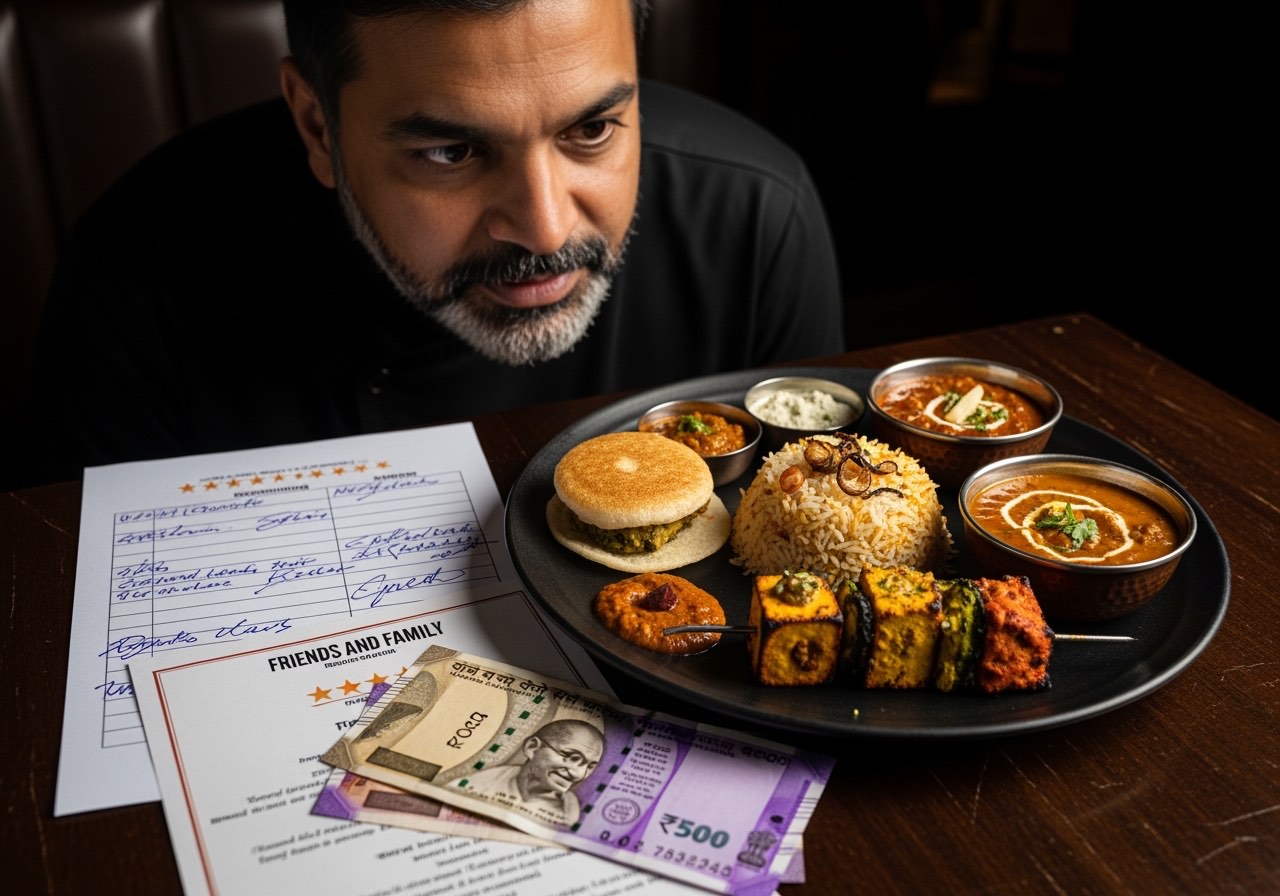
Why the trial run matters more than people think
Three things the trial run catches that no amount of recipe-card discipline catches:
- Plate-up time under load. A dish that takes 6 minutes when the chef cooks one takes 14 minutes when the line has 8 simultaneous tickets. You only learn that under real-feel volume.
- Real-customer ordering patterns. Friends and family will order from across the menu, including the items you didn't expect. The ones with low orders aren't necessarily bad — they're badly described, badly priced, or badly placed on the card.
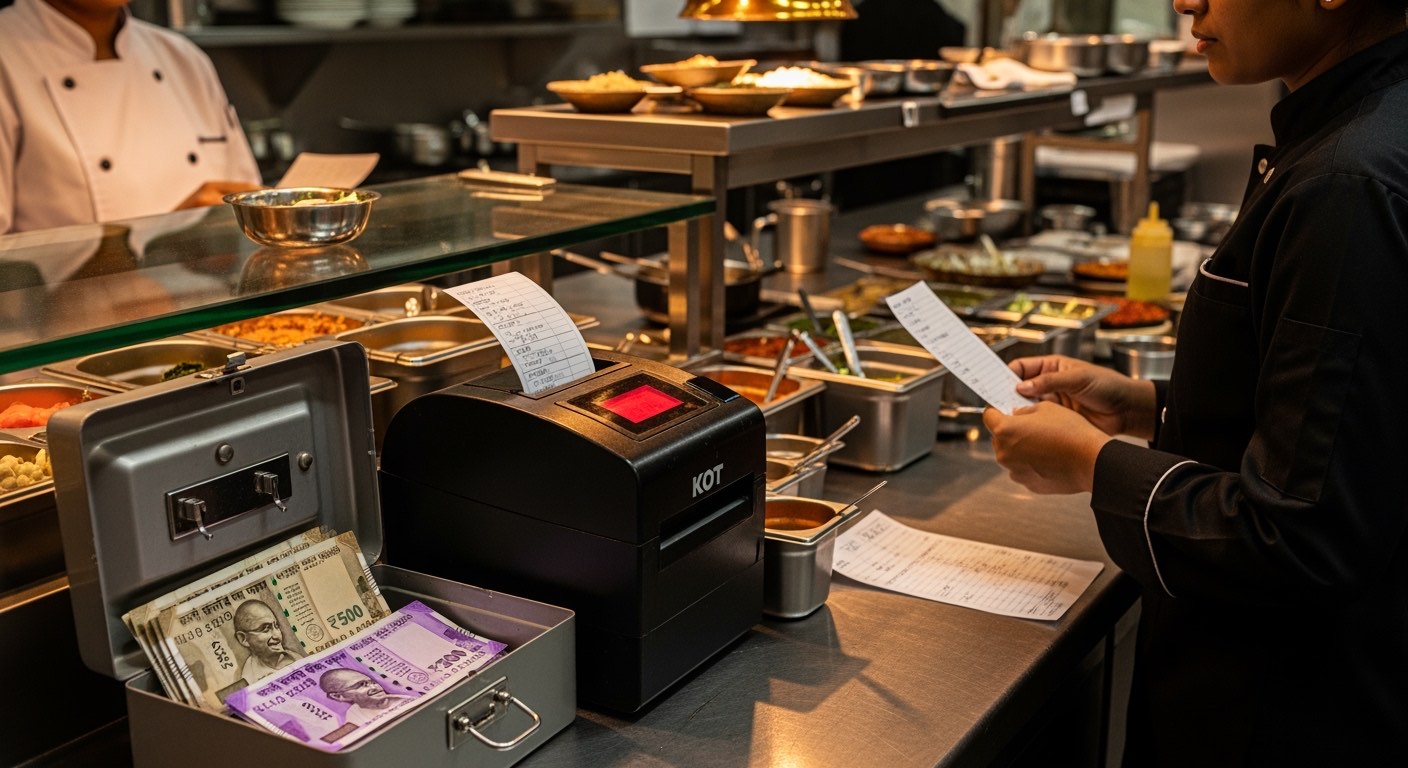
- Service flow gaps. Where does the FOH team get stuck? The pass? The KOT printer? Card-machine queue? Most of these are SOP-fixable in a week if you spot them in trial, expensive to fix once paying customers are in the door.
The 3-session structure
Three sessions, spaced 4–7 days apart, in the 14 days before grand opening.
| Session | Day | Guests | Capacity | Goal |
|---|---|---|---|---|
| 1 | T–14 | Family + close friends (12–18) | 30% | Stress-test the kitchen on a slow load; collect honest feedback |
| 2 | T–9 | Extended network (24–32) | 60% | Test ticket time at moderate load; FOH service flow |
| 3 | T–5 | Mixed including 4–6 strangers (paid trial) | 80% | Full-volume rehearsal; near-final menu + bill |
Session 3 is the highest-leverage one — it's the closest to opening night with real-feel pressure. Don't skip it.
Session 1 — the family table (T–14)
12–18 guests. Free meal in exchange for honest feedback. Owner + head chef both on-site.
Setup
- Full menu available; encourage spread across categories
- KOT system live; bills printed (not given for payment) to test integration
- Service team in uniform, full SOP
- Owner sits with guests; chef circulates between courses
Scoresheet for each guest (1-pager, printed)
| Aspect | Score 1–5 | Notes |
|---|---|---|
| Welcome + seating | ||
| Menu clarity | ||
| Order-taking accuracy | ||
| Time to first course | ||
| Time to main | ||
| Food quality (per dish ordered) | ||
| Plating presentation | ||
| Portion size | ||
| Server attentiveness | ||
| Bill clarity | ||
| Overall — would you come back paying? |
The only question that matters more than all the scores is the last one. "Would you come back paying full price?" If 50% of friends-and-family say no, the menu has a real problem and grand opening is too early.
What to fix between session 1 and 2
- Any dish scoring under 3.5/5 — cut, replace, or fix recipe
- Any service step where 30%+ guests reported confusion
- Any ticket-time issue above 30 minutes for mains
Session 2 — the extended network (T–9)
24–32 guests. Mix of friends, neighbours, professional contacts. Subsidised meal (₹100–200 token charge to test the bill flow).
Setup
- 2 seatings (e.g. 7pm + 8:30pm) to simulate two table turns
- Card payments enabled (test full payment flow including UPI)
- 2 service shifts overlap to mirror weekday-vs-weekend staffing
- Hidden observer (consultant or trusted operator friend) sits at one table for an outside view
What to test specifically
- Does the kitchen pass keep up at full ticket-pressure?
- Does the FOH team handle 2 simultaneous bill requests?
- Does the bar / beverage station bottleneck on cocktails (if applicable)?
- Are aggregator orders (run as test orders) handled in parallel without disrupting dine-in?
Scoresheet — same as session 1, plus:
| Additional aspect | Score 1–5 |
|---|---|
| Wait between courses | |
| Bill timing accuracy | |
| Card / UPI payment friction | |
| Aggregator order handling (if visible) |
What to fix between session 2 and 3
- Service-flow bottlenecks identified by the hidden observer
- KOT-to-pass communication gaps
- Any payment-flow issues
- Roster adjustments based on observed peak-hour pinch points
Session 3 — the full-volume rehearsal (T–5)
40+ guests including 4–6 paid strangers (post a "soft launch tasting menu — ₹500 per person" on local WhatsApp groups; the paid strangers are your real signal).
Setup
- 3 seatings if needed
- Full menu + bar + aggregator simultaneously
- Standard staffing — no extra hands "just for the trial"
- Standard pricing on the bill (with the discount applied at the end)
- Owner in observer mode, not service mode
What to test specifically
- Can the team handle a real-feel busy night without owner intervention?
- Does the kitchen line maintain quality at hour 3?
- Do bus-out and bus-in cycles for tables stay under 5 minutes?
- Are cash close, KOT reconciliation, and end-of-shift handover clean?
Scoresheet — focus on the strangers' feedback specifically. They're the only ones with no relationship bias.
Three paid strangers giving you 4+/5 on "would you come back paying full price?" is a stronger green light than 25 friends giving you 5/5.
What to fix between session 3 and grand opening
Five-day window. Categorise issues into:
- Critical (must fix before opening) — food safety, plate-up time > 25 mins for mains, bill errors, service complaints from strangers.
- Important (fix in opening week) — menu items underperforming, plating inconsistency, FOH script gaps.
- Nice-to-have (fix in month 1) — ambience tweaks, lighting, music volume, table layout adjustments.
The critical list must close to zero. Important list can stay open for week 1 with a clear owner per item. Nice-to-have list goes into the month-1 review.
The 6 things trial runs catch that nothing else does
- The "second-bite-down" problem — a dish that's great on first bite but doesn't sustain. Friends-and-family eating slowly catches this.
- The plating-doesn't-match-menu-description gap — "creamy curry with toasted nuts" arrives with no visible nuts. Fix the dish or fix the menu.
- The portion-mismatch problem — a starter portion bigger than the main, an "individual" dessert that easily serves two.
- The bill-line-item confusion — service charge added when not declared, beverage tax differing from food tax in a way that confuses the diner.
- The wait-staff script gap — when a guest asks "what's in this?" the answer is "let me check, sir" instead of a confident sentence. Train scripts.
- The exit experience — most service flows die at the bill. Trial runs catch the bill-to-door 4-minute lag that turns 5-star service into 3-star memory.
Cost of trial runs
Three sessions cost roughly:
| Session | Direct cost (₹) | Notes |
|---|---|---|
| 1 — Family (12–18) | 8,000–14,000 | F&B + part-time staff overtime |
| 2 — Network (24–32) | 16,000–28,000 | F&B + token charge offset |
| 3 — Full rehearsal (40+) | 25,000–45,000 | F&B + paid stranger discount |
| Total | 49,000–87,000 | Less ₹4–10K of token recovery |
Net cost: ₹40,000–₹80,000. Compare against ramp-period waste avoided (₹2–4L in food cost + service errors + bad early reviews) and the ROI is 4–8x. Most under-leveraged spend in pre-opening.
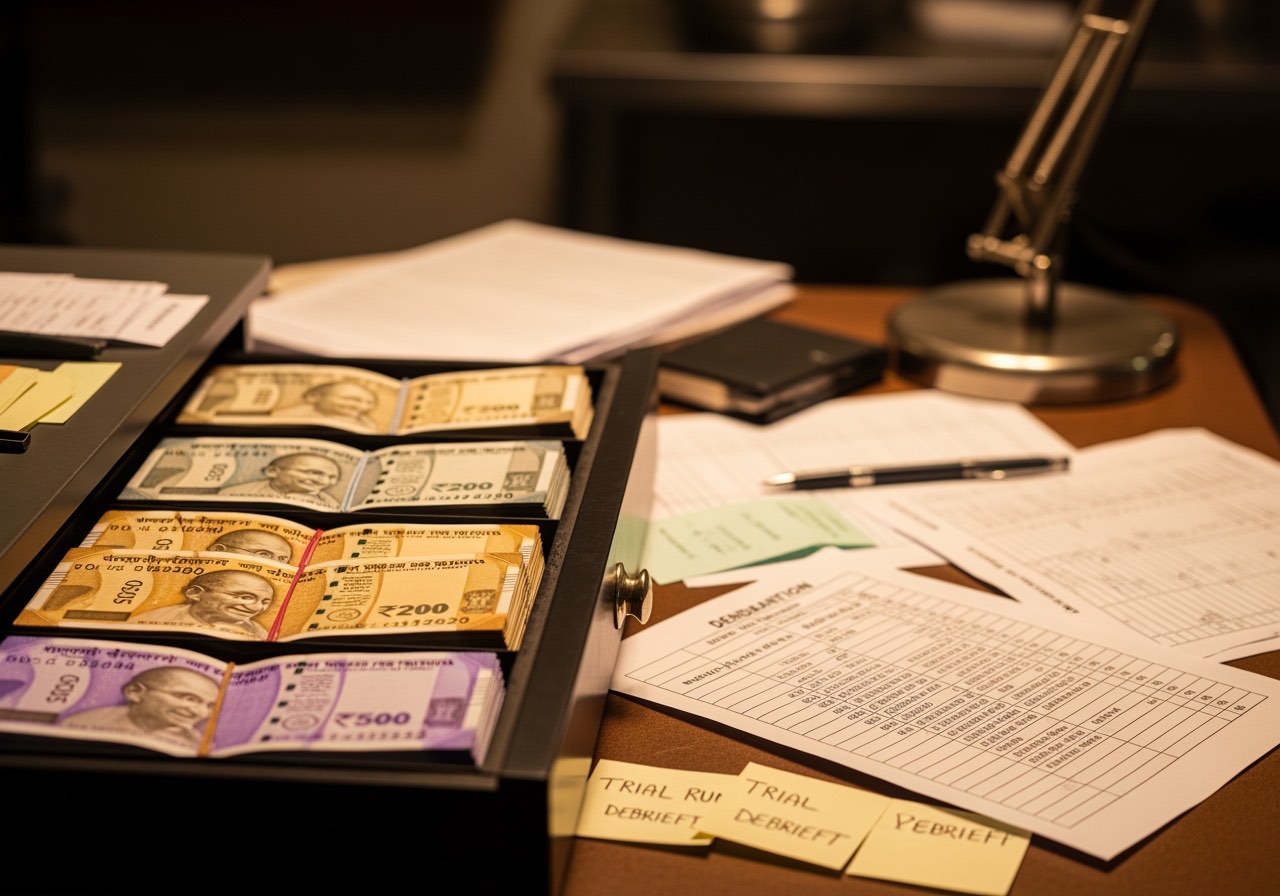
A trial-run roster template
For each session:
| Role | Headcount | Notes |
|---|---|---|
| Head chef | 1 | On line, full service |
| Sous chef / line | 2–3 | Per session 2/3 |
| KOT operator | 1 | Standard |
| FOH manager | 1 | Floor lead |
| Servers | 4–6 | Sessions 2/3 |
| Cashier | 1 | Real bills, real flow |
| Owner | 1 | Sessions 1+2 active, session 3 observer |
| Hidden observer | 1 | Session 2 only |
Related on Restaurant Daily
One operator playbook a week, in your inbox.
Cash close, petty cash, payroll, compliance, unit economics — sent every Monday morning. No spam, no upsell drip. Unsubscribe in one click.
Sent from noreply@restaurantdaily.ai. We never share your address.
Related reading
Soft launch vs grand opening for restaurants in India — sequencing
Soft launch vs grand opening for restaurants in India — sequencing, media plan, when to switch. Operator-grade playbook covering the 21 days from quiet open to full visibility.
Small restaurant business plan India — free template for bank loan
Small restaurant business plan India — free template for bank loan + investor decks. 12-section structure with the numbers loan officers actually look at.
Equipment list for a new Indian restaurant — kitchen + FOH BOM
Equipment list for a new Indian restaurant — full kitchen + FOH bill of materials with vendor categories and indicative prices for a 50-cover casual dining.
Cloud kitchen vs dine-in restaurant in India — capex, ops, exit
Cloud kitchen vs dine-in restaurant in India compared on capex, ops cycle, margin structure, brand value, exit. Operator-grade decision framework for first-time owners.
Restaurant location scouting checklist for India — what to test
Restaurant location scouting checklist for India — footfall, F&B density, parking, hood/exhaust feasibility, lease pitfalls. The 38-item operator-grade test.