5 gaps that show up by Friday of week one — month one as a new restaurant operator
Five gaps a new Indian restaurant operator hits by Friday of week one — float drift, parallel WhatsApp threads, advances in heads, expiry stock, owner-P&L lag — and what to put in place.
Reviewed by Gaurav Rao (founder review pending pre-publish).
Last updated 9 Aug 2026
About this piece. I'm Gaurav, founder of Restaurant Daily. Before building the product I spent 18 months looking at how new restaurant operators get tripped up in their first month — through operator interviews, NCR WhatsApp groups, and franchisee networks. This piece collects the five gaps that show up most often. None of them are dramatic. All of them compound by month three.
Why month one is structurally hard
A first-time operator inherits — or stands up — five systems on day one: cash, staff, stock, compliance, and customer ops. By Friday of week one, three of the five are running on judgement (yours), and the other two are running on the previous owner's habits (or nothing). The gaps below are what falls through that crack.
I'm framing each as what you'll observe and what to put in place by end of week one — not as horror stories, because the horror stories are specific and yours will be different.
Gap 1 — Float drift inside the cash drawer
What you'll observe. Day three: you ask the cashier what the float is. You get three answers in the same week — ₹2,000, ₹3,000, "whatever's in the drawer right now". The petty-cash voucher stack has handwritten amounts and a few without an amount at all.
Why it's a gap. Without a fixed imprest float, reconciliation has no reference number. Variance becomes invisible. (Detail in the imprest-float piece.) Public benchmarks put unrecovered cash leakage at SMB restaurants between 3% and 8% of revenue (Crisil F&B SME 2023 + NRAI 2024). The single biggest contributor is float drift.
By Friday of week one. Pick the float number. Stick the label inside the drawer. Tell the cashier on Monday. Reconcile to that number every shift.
Gap 2 — Three WhatsApp groups, no DSR
What you'll observe. Sales numbers come in via WhatsApp from the cashier ("aaj 28,400"). Manager sends a separate WhatsApp at midnight with stock issued. The shift supervisor sends a third WhatsApp with attendance + advances paid. Three threads, no consolidated daily sales record.
Why it's a gap. A DSR (Daily Sales Record) is the audit trail for everything downstream — GST filing, owner P&L, variance investigations. When it lives across three WhatsApp threads, four things break: numbers don't match across sources, you can't query history, the data isn't survivable beyond 7 days (WhatsApp media auto-deletes), and your accountant ends month-end with a screenshot collage.
By Friday of week one. One DSR, one format, one place. Notebook, Google Sheet, or an app — pick one and kill the parallel threads. Tell the team: "WhatsApp is fine for chatter; the DSR is the record."
Gap 3 — Salary advances logged in heads (not on paper)
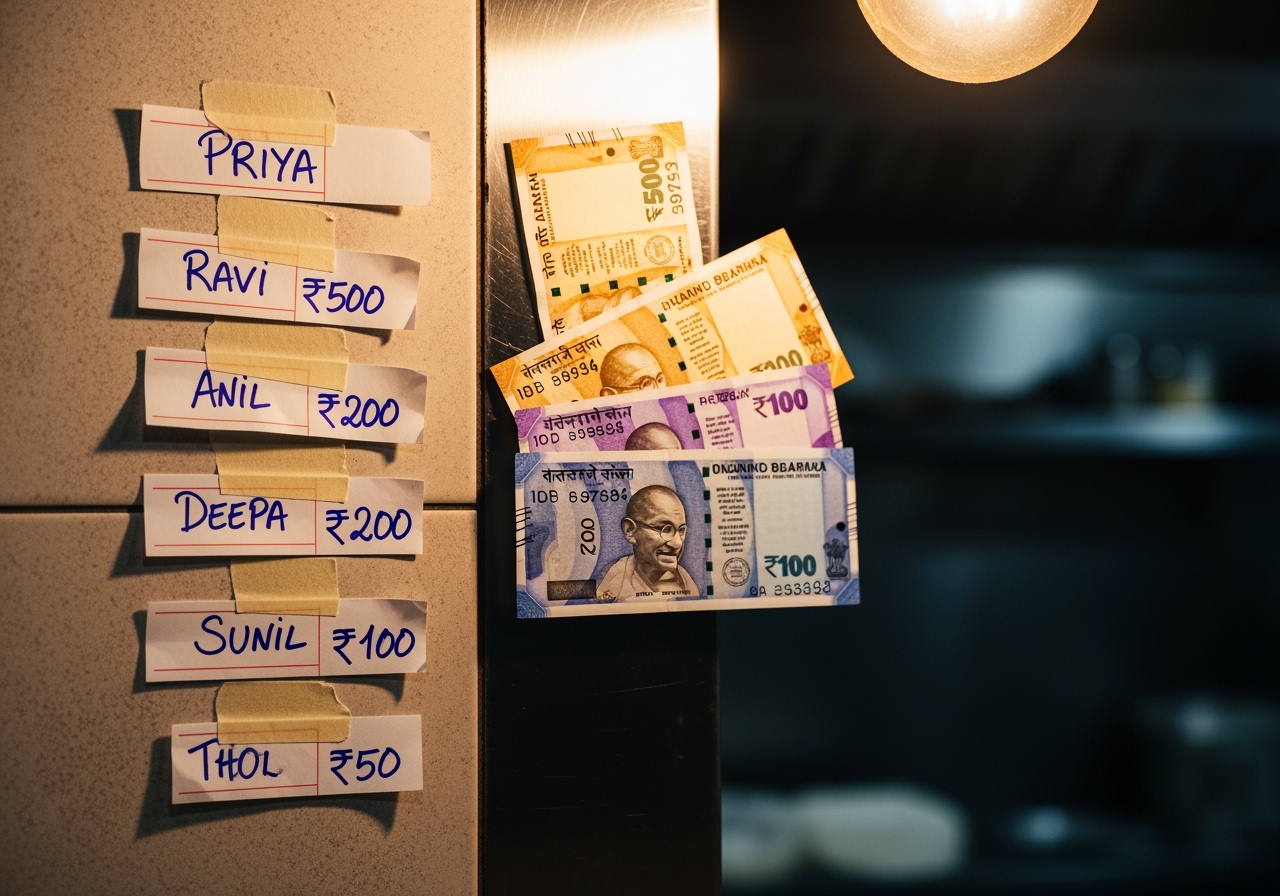
What you'll observe. Day five. A waiter asks for an advance against next salary. You give it. By day twelve, three more advances are out, you remember two of them, and the muster roll has no record. Payday is twenty days away.
Why it's a gap. Salary advances are the most common source of payday disputes at small restaurants. The dispute is almost never about the amount — it's about whether the advance happened at all, or what it was against. When advances live in heads, the staff member remembers fewer and the owner remembers more, and the gap surfaces on payday as ill-will.
By Friday of week one. A salary advance ledger. One row per advance: date, amount, against-whom-signed-it, expected payback shift. Pen and paper is fine. The act of writing it down — and having the staff member sign — is 80% of the value. Crisil SME labour-cost benchmarks suggest 6–9% of monthly payroll moves through informal advances at SMB outlets; an unrecorded 8% is a payroll-month spent firefighting.
Gap 4 — Expiry stock not on anyone's radar
What you'll observe. Day eight. You open the dry-storage rack to look for something else and notice three packs of expired masala behind the new stock. Nobody noticed. The previous owner — or the franchisor's standard setup — had no FIFO label discipline.
Why it's a gap. Expired stock is a triple loss: the ingredient cost, the FSSAI compliance risk, and the customer-trust risk if it makes it to a plate. FSSAI inspectors look for FIFO-label discipline specifically because it correlates with the rest of the hygiene posture. From the FSSAI Food Safety Display Boards standard, date-labelling and FIFO rotation are explicitly part of "good manufacturing practice" for licensed outlets.
By Friday of week one. Five-minute Friday stock walk. Owner does it personally for the first month, then delegates with a sign-off log. FIFO-label every container that doesn't have one. Anything expiring in the next 14 days gets a red sticker.
Gap 5 — No owner P&L by end of week two
What you'll observe. Day fourteen. You ask the franchisor / accountant / Excel for "how am I doing financially". The answer is in the form of last month's CA-prepared P&L. It's six weeks out of date. You don't actually know whether this week made money.
Why it's a gap. Owner P&L lag is the single most common reason small restaurant operators react to problems too late. By the time the accountant's monthly P&L lands, you've already done another month of the same. The fix isn't a fancy P&L tool — it's a 5-line weekly margin check:
Weekly revenue            ₹X
- Food cost (CoGS proxy)  ₹X    (target ≤ 32%)
- Labour cost             ₹X    (target ≤ 22%)
- Rent + utilities (1/4)  ₹X
= Operating margin        ₹X    (target ≥ 12%)
Targets are NRAI 2024 benchmarks for single-outlet QSR. Yours will vary by format; the discipline of measuring weekly is what matters.
By Friday of week one. Decide where this lives. Pen-and-paper on a kitchen wall, a Google Sheet, or an app. Decide who fills it (owner, not the accountant; this is a management number, not a tax number).
What ties the five gaps together
Each gap, on its own, costs 1–3% of revenue. Stacked, they cost 8–15% — which is the difference between a single-outlet restaurant breaking even and clearing ₹3–5L of operator income per month.
None of them require software. All of them require a fixed format and a daily ritual. The ritual is what makes month two easier than month one. The format is what makes the ritual transferable when you hand the till over to a manager in month six.
What to do this week (if you're in month one right now)
Pick one of the five. Not all five. The one that's most painful by Friday. Put the simplest possible fix in place by Sunday. Repeat next week for the next gap.
If you'd rather have all five in one place, that's roughly what Restaurant Daily does — but the loop is the point. The product is one way to run it; a disciplined notebook is another.
One operator playbook a week, in your inbox.
Cash close, petty cash, payroll, compliance, unit economics — sent every Monday morning. No spam, no upsell drip. Unsubscribe in one click.
Sent from noreply@restaurantdaily.ai. We never share your address.
Related reading
Opening your first restaurant in India — month-0-to-12 operator playbook
What a first-time Indian restaurant operator should have running by the end of each month, from pre-launch to month 12. Composite operator playbook, NRAI + Crisil benchmarks, format-first.
Soft launch vs grand opening for restaurants in India — sequencing
Soft launch vs grand opening for restaurants in India — sequencing, media plan, when to switch. Operator-grade playbook covering the 21 days from quiet open to full visibility.
Food trial run before restaurant launch — friends & family protocol
Food trial run before restaurant launch in India — friends-and-family menu testing protocol, scoresheets, and what to actually fix between session 1 and opening night.
Small restaurant business plan India — free template for bank loan
Small restaurant business plan India — free template for bank loan + investor decks. 12-section structure with the numbers loan officers actually look at.
Equipment list for a new Indian restaurant — kitchen + FOH BOM
Equipment list for a new Indian restaurant — full kitchen + FOH bill of materials with vendor categories and indicative prices for a 50-cover casual dining.