Imprest cash float for Indian restaurants — the formula and the mistake that costs ₹2,000/month
How to size your restaurant's imprest cash float using the F = D × p × s formula, three worked examples, and the floating-float mistake that quietly drains margin.
Reviewed by Gaurav Rao (founder review pending pre-publish).
Last updated 9 Aug 2026
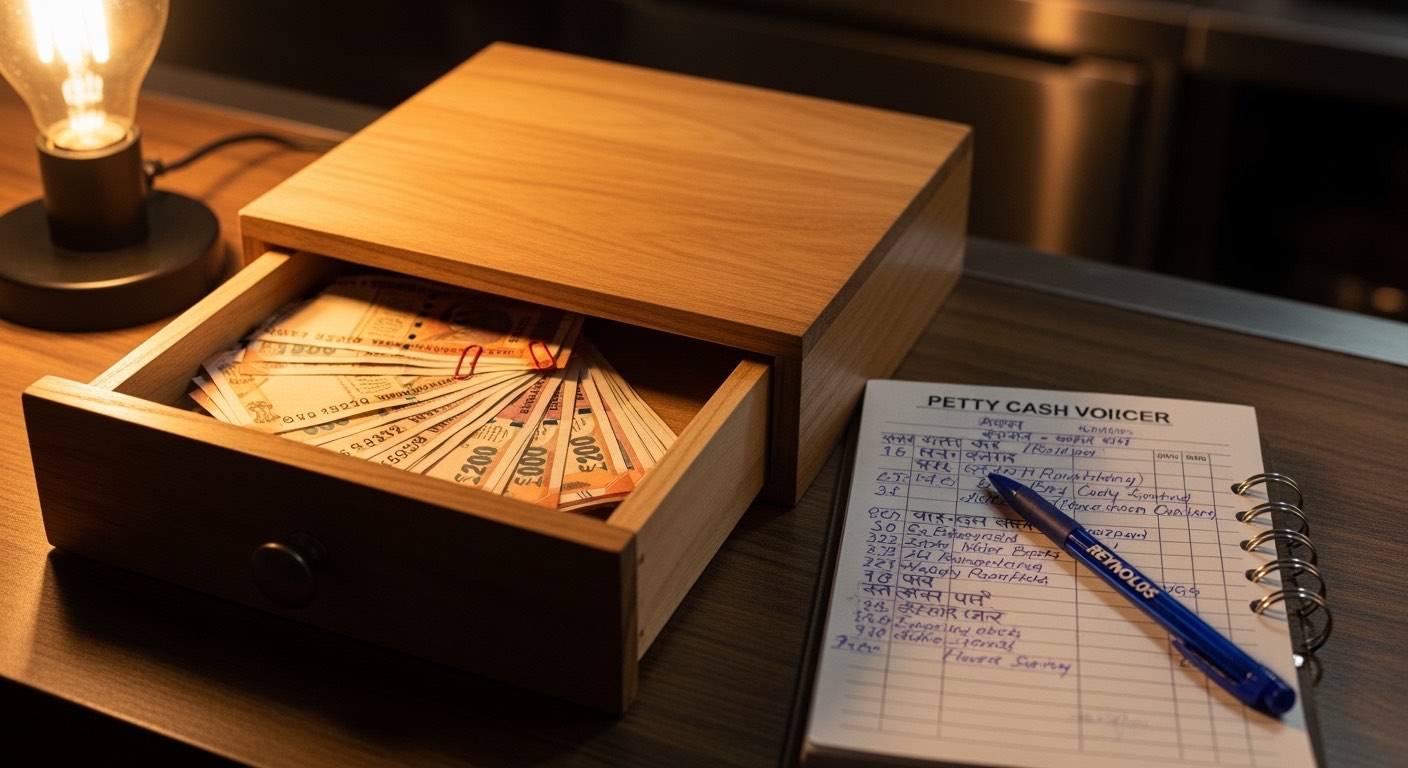
About this piece. I'm Gaurav, founder of Restaurant Daily and a franchise operator in NCR. I write a weekly note on the daily-ops things that take up time in Indian restaurants. This week — imprest float. Most operators run one without ever calling it that, and most run one that's the wrong size for their volume.
What "imprest" means in restaurant terms
The imprest system is older than restaurants. It's the rule used in every cash-handling business since the 19th century: keep a fixed working float of cash. Spend from it. Top it up by the exact amount spent, against vouchers. Never let the float drift up or down without a paper record.
Translated into restaurant Hindi-English: "shift ke shuru mein cashier ko ₹3,000 do. Jo bhi PCV bhare, uska total minus karke bachha hua amount + vouchers = ₹3,000 hona chahiye, hamesha."
The two halves of that sentence are doing all the work:
- The cashier starts every shift with the same float. Not yesterday's leftover. Not "whatever was in the drawer". A fixed number.
- At any moment of the shift, cash + voucher chits in the drawer = the float. That's the daily check. If it doesn't, something is missing or unrecorded.
If you're not running this rule, you don't have an imprest float. You have a cash drawer.

How to size your float — the only formula you need
There are three numbers that matter:
F = D × p × s
Where:
F= float size (₹)D= average daily petty-spend (₹/day)p= peak factor (1.5 for steady outlets, 2.0 for festive/event-heavy)s= shift coverage (1 if one cashier covers the day; 1.3 if there's a handover mid-shift)
For a typical 30–50-cover NCR QSR, the NRAI India Food Services Report 2024 summary puts daily petty-spend across cash + UPI in the ₹1,500–₹2,500 range. Apply the formula:
| Outlet shape | D | p | s | F (float) |
|---|---|---|---|---|
| Steady single-shift QSR | ₹1,800 | 1.5 | 1.0 | ₹2,700 |
| Two-shift dinner-heavy | ₹2,200 | 1.5 | 1.3 | ₹4,290 |
| Festive / event catering | ₹2,200 | 2.0 | 1.3 | ₹5,720 |
Round to the nearest ₹500 for ease of denominations. The float number is the number you stick on the wall behind the till and never change without writing down why.
Operators we've spoken to in NCR WhatsApp groups oscillate between ₹2,000 and ₹5,000 floats with no apparent logic. Some run too lean — the cashier ends up topping up from his own pocket and chasing reimbursement, a process leak. Most run too rich — dead capital sitting in a drawer, and a wider hole to spot if there's leakage.
The mistake that costs ~₹2,000/month — the floating float
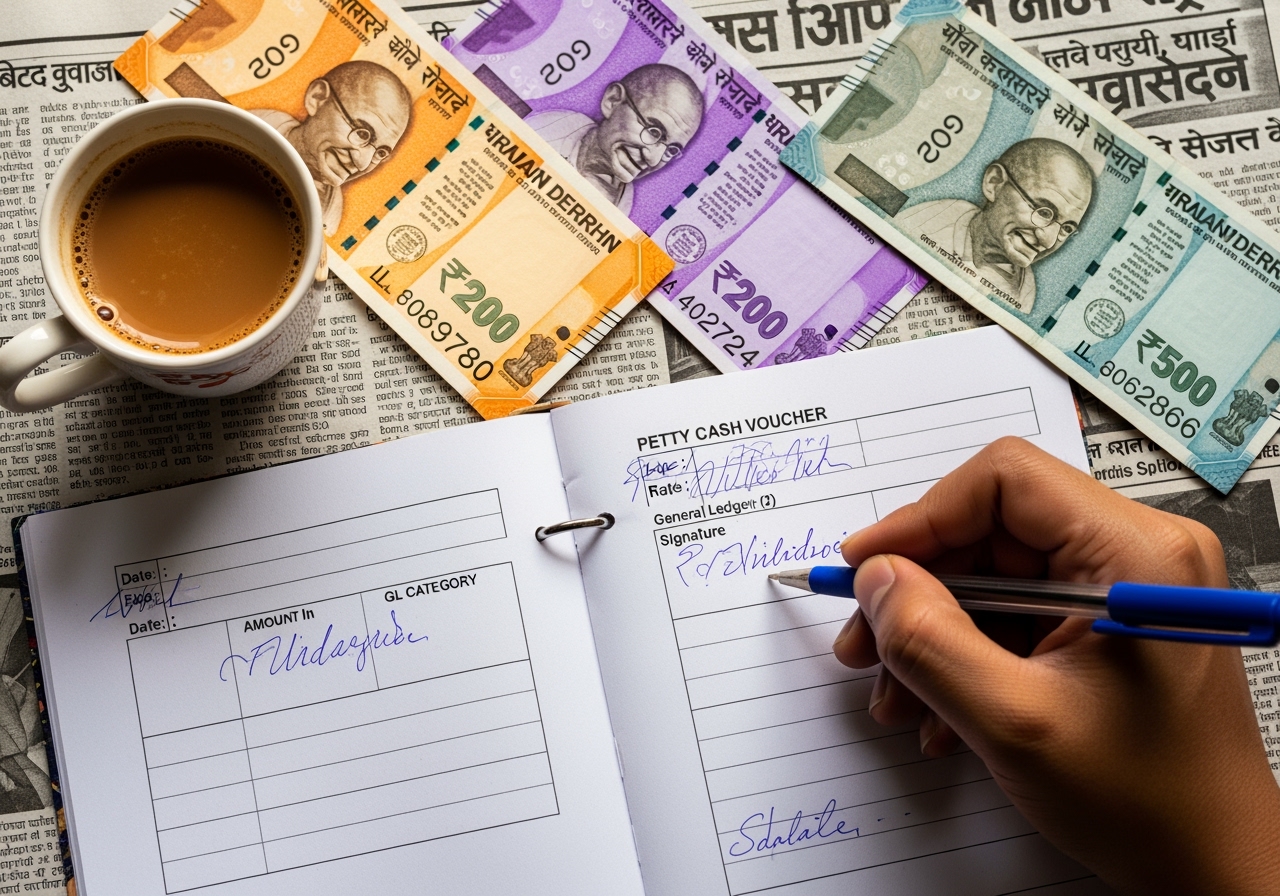
The single most common imprest mistake in Indian SMB restaurants is what I'll call the floating float: the working cash level drifts day-to-day. ₹3,200 at open Monday, ₹2,800 at open Tuesday, ₹3,500 at open Wednesday. The cashier — and often the owner — has a vague sense that "there's enough cash for vouchers" but no fixed reference.
When the float floats, three things happen:
- You can't reconcile in 60 seconds. Reconciliation requires a fixed expected number to compare against. Without it, every shift becomes a forensic exercise.
- Small variances become invisible. A ₹40 daily drift is below the noise floor of "vague sense of enough cash". Over 30 days that's ₹1,200. Over a year, ₹14,600.
- Top-ups become discretionary. "Float seems low, here's ₹500" replaces "we spent ₹X on PCVs, here's ₹X back". The audit trail breaks.
Public benchmarks put unrecovered cash leakage at Indian SMB restaurants between 3% and 8% of revenue — see the 2023 Crisil F&B SME margin study and the 2024 NRAI report. For a ₹35L/year outlet that's ₹1.05L–₹2.8L annually leaking somewhere. The floating float is one of the four largest contributors to that range. ₹2,000/month is the low end of what the discipline-fix recovers.
How to fix it in 4 steps — no software change required
If you have a floating float right now, do this in the next week.
- Pick the float number. Apply the
F = D × p × sformula above, or just pick the round number above your last 14 days' biggest petty-spend day, plus 50%. Write it on a small label stuck to the inside of the cash drawer. - Reset on Day 1. At open on the chosen Monday, count out exactly the float amount in mixed denominations. Anything over goes into a deposit envelope. Anything under, top up from operating cash.
- The cashier's daily reconciliation is one line. End of shift: count cash + sum the voucher chits in the drawer. The result must equal the float. If not, write the variance + a one-line reason on the back of the day's PCV bundle.
- Top up only against vouchers. The next morning, the cashier hands the bundle of voucher chits to the manager/owner. The manager/owner counts them, replaces them with cash equal to their total. Float is back to its number. Vouchers go to the books.
Three weeks of this and the float discipline is muscle memory. Reconciliation becomes a 60-second routine. Variance, when it appears, is visible the same day, not at month-end.
Where this fits with the rest of daily ops
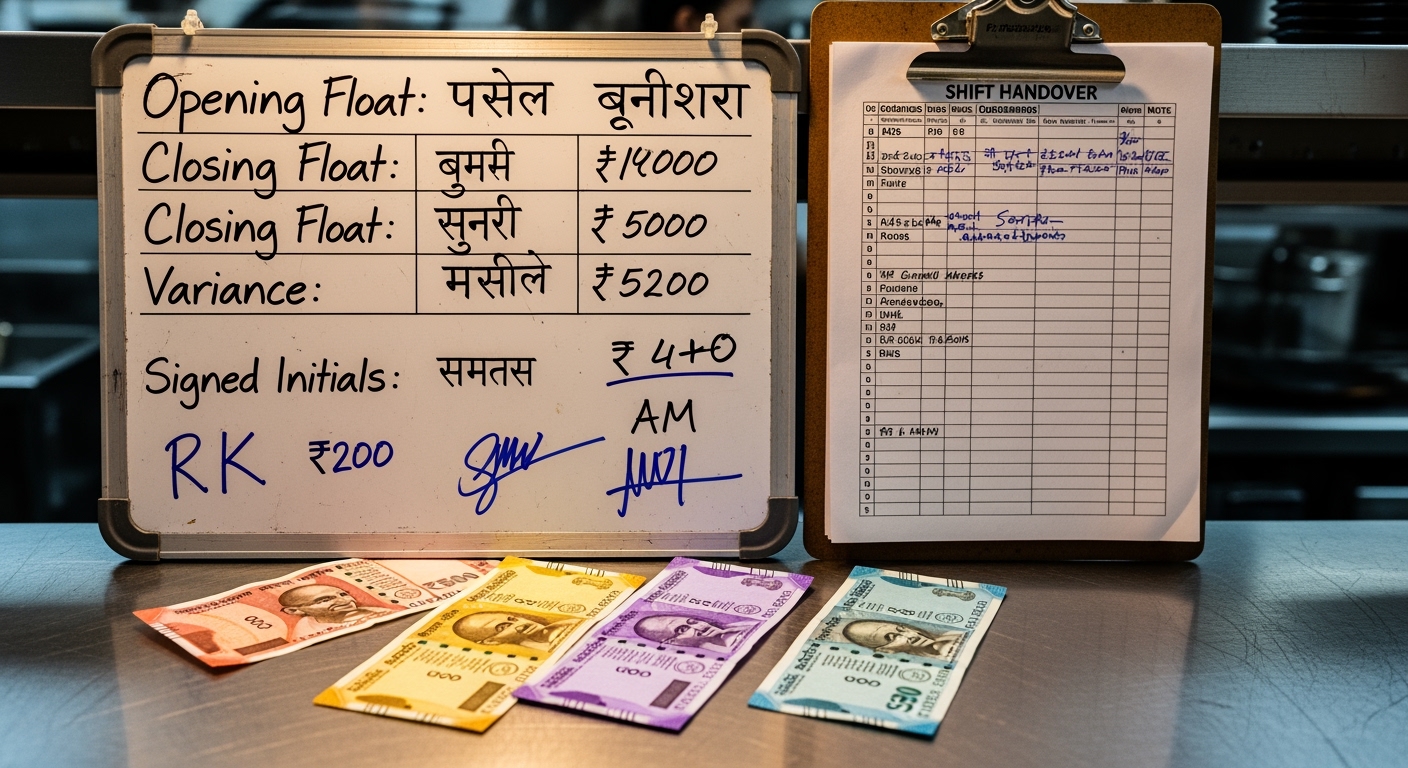
Imprest discipline is one of three habits that close a daily-ops loop:
- Imprest float — keeps cash drawer reconcilable in 60 seconds (this piece)
- Daily cash close — reconciles cash + UPI + card vs Petpooja end-of-day in 5 minutes (upcoming P1 hub)
- Petty voucher review — owner reviews the week's voucher categories every Sunday (upcoming spoke)
Each one is independently useful. Stack all three and you have an end-to-end daily-ops process that survives a tired cashier at 11pm. That's the loop our product, Restaurant Daily, automates — but the loop is the point. The product is one way to run it; a disciplined notebook is another.
What to do this week
If you take one thing away: pick your float number this Saturday. Use the formula or use the rule of thumb. Stick the label inside the drawer. Tell the cashier on Monday morning. Reconcile to that number every shift this week.
If you do that, the leakage signal becomes visible by next Friday. From there, every other improvement is easier.
One operator playbook a week, in your inbox.
Cash close, petty cash, payroll, compliance, unit economics — sent every Monday morning. No spam, no upsell drip. Unsubscribe in one click.
Sent from noreply@restaurantdaily.ai. We never share your address.
Related reading
Shift ke end mein cash kaise count karein — staff checklist (Hindi)
Shift ke end par cash count karne ka simple checklist — denomination, vouchers, POS Z-report, variance reason. Hindi-English mein, tired cashier ke liye.
Daily cash reconciliation restaurant — POS, drawer, deposit (India)
Daily cash reconciliation for Indian restaurants — three-way tie between POS Z-report, drawer count, and bank deposit, with thresholds and a printable form.
Restaurant cash close process — end-of-day reconciliation playbook (India)
The restaurant cash close process used by disciplined Indian outlets — 7 steps from drawer count to bank deposit, variance thresholds, and the 60-second nightly check.
Restaurant cash management software India — 6 options compared (2026)
Restaurant cash management software in India compared — Petpooja, Posist, Khatabook, Vyapar, Restaurant Daily, manual Excel — pricing, features, support, fit.
Denomination sheet restaurant cash count — Excel template + how to use it
Free denomination sheet for Indian restaurant cash counts — Excel + printable PDF, with auto-totals, variance row, and the right way to count a drawer in 2 minutes.