Restaurant cash close process — end-of-day reconciliation playbook (India)
The restaurant cash close process used by disciplined Indian outlets — 7 steps from drawer count to bank deposit, variance thresholds, and the 60-second nightly check.
Last updated 9 Aug 2026
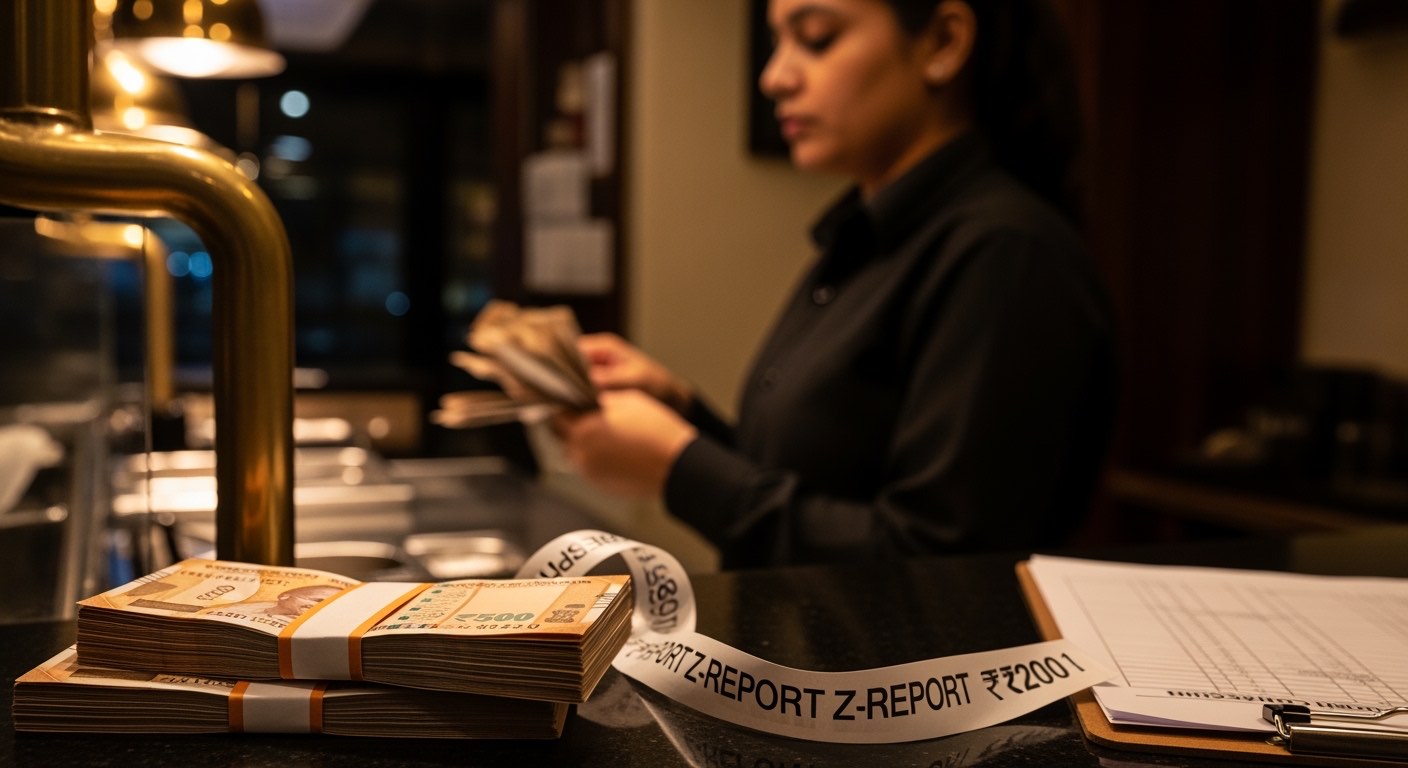
About this piece. Most Indian single-outlet restaurants close cash by feel. Cashier counts the drawer, manager glances at the POS total, somebody mutters "thoda kam hai" and everyone goes home. This is the missing playbook — the 7-step nightly close that turns the cash drawer into a number you can defend on Tuesday morning when the variance question lands.
What "cash close" actually means
Cash close is not the same as cashing up. Cashing up is counting the drawer. Cash close is the process that ends with one number — net cash for deposit — that ties to the POS, the petty-cash float, the UPI/card settlement, and the day's discounts and refunds, with every variance explained on paper.
If your nightly process produces a number but no explanation when the number is off, you don't have a close — you have a count.
The operators in NCR I've spoken to who run a clean close usually take 8–12 minutes per night. The ones who don't end up spending 40 minutes on Saturday morning unwinding the week. The math on time-spent always favours the disciplined nightly close.
The 7-step end-of-day cash close
Run these in order. Skipping a step is fine — skipping the order is not.
| Step | What | Time |
|---|---|---|
| 1 | Lock the till — no more orders, no more drawer movements | 1 min |
| 2 | Print POS Z-report (mode-wise sales: cash, UPI, card, Swiggy/Zomato) | 1 min |
| 3 | Count drawer cash by denomination (use a denomination sheet) | 3 min |
| 4 | Sum petty cash vouchers in the drawer | 2 min |
| 5 | Reconcile: cash + vouchers should equal float + cash sales − cash refunds | 1 min |
| 6 | Move excess cash above the float into the deposit envelope | 1 min |
| 7 | File the day's PCV bundle, sign off the close sheet | 2 min |
Total: 11 minutes if the float is fixed and the PCVs were filled at the time of payment, not at 11:30pm.
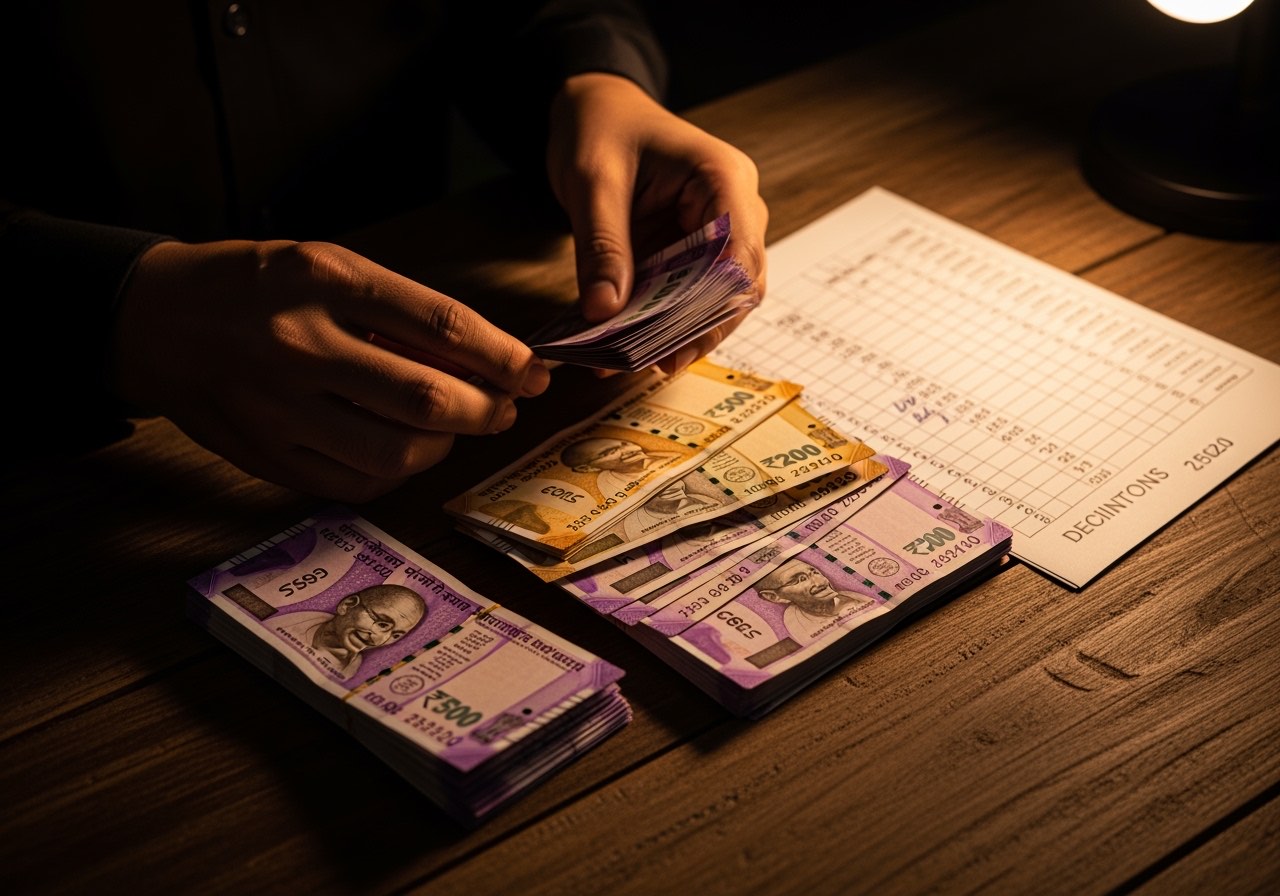
The reconciliation formula
The whole close sits on one identity:
Expected drawer cash = Opening float
                     + Cash sales (POS Z-report)
                     − Cash refunds
                     − Cash paid out via PCVs
If actual drawer cash equals expected, variance is zero. If not, variance = actual − expected. Threshold for "investigate now": ±₹100 for outlets doing under ₹40,000/day, ±0.25% of cash sales for larger outlets. Anything inside threshold gets logged. Anything outside gets a one-line reason on the close sheet before anyone leaves.
A typical 30-cover dhaba in a tier-2 city will run three to five "₹20 short" days a month and one or two "₹500 over" days a year. Both patterns deserve a note. The ₹20 shorts compound to ₹600/month if ignored. The ₹500 over usually means a refund was given without a POS entry — which is worse than the short, because it's an unrecorded sale.
What the close sheet looks like (one half-sheet)
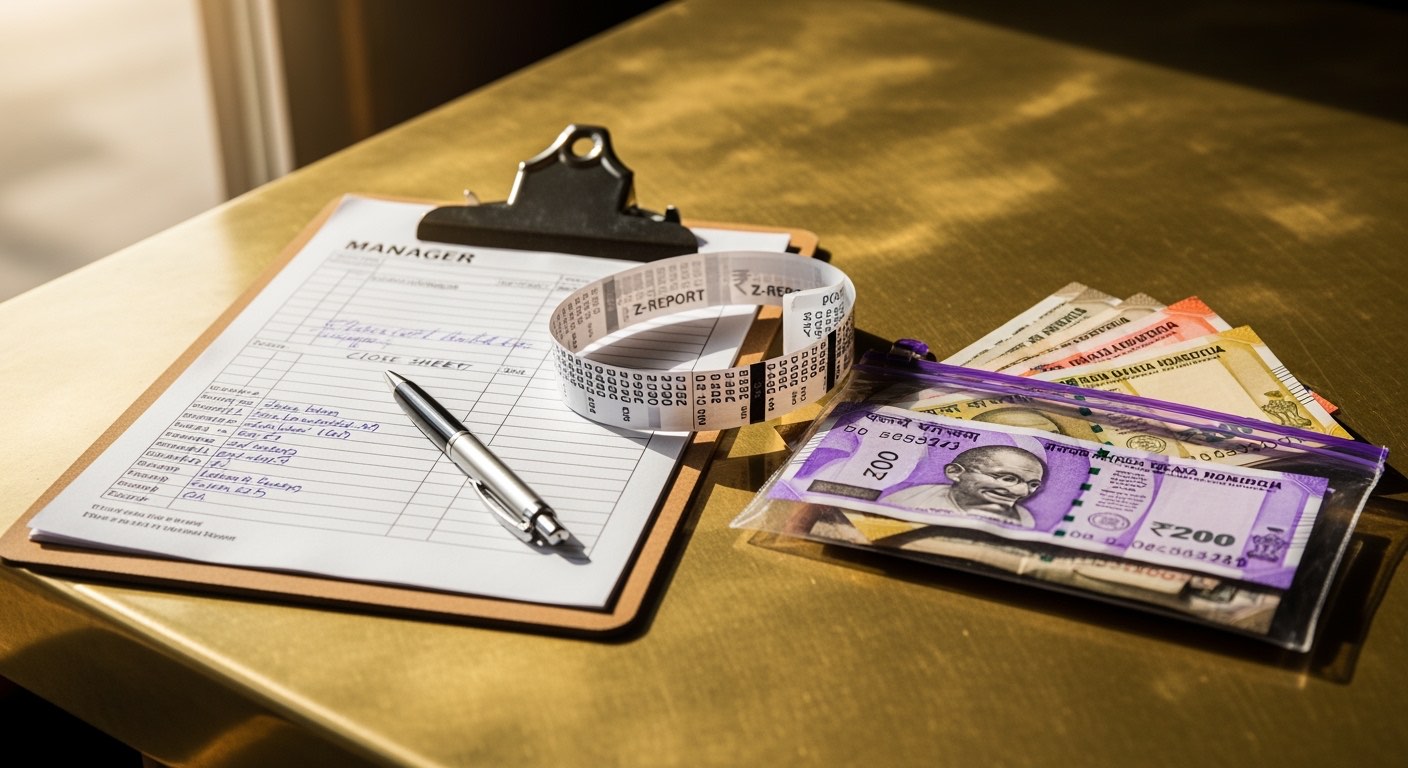
This is the form that goes in the manager's clipboard. Print it on A5, two-up on A4, fifty per pad.
┌────────────────────────────────────────────────────┐
│ DAILY CASH CLOSE — [outlet name]                   │
│ Date: __/__/____   Shift: ____   Cashier: _______  │
│                                                    │
│ A. Opening float                       ₹ ________  │
│ B. POS Z-report — cash sales           ₹ ________  │
│ C. POS Z-report — cash refunds         ₹ ________  │
│ D. Petty cash vouchers (sum + count)   ₹ ____ /__  │
│                                                    │
│ Expected drawer cash = A + B − C − D   ₹ ________  │
│ Actual drawer cash counted             ₹ ________  │
│ Variance (actual − expected)           ₹ ________  │
│                                                    │
│ Reason for variance:                               │
│ ___________________________________________        │
│                                                    │
│ Deposit envelope (actual − float)      ₹ ________  │
│ Float retained for next shift          ₹ ________  │
│                                                    │
│ Cashier sign: _______   Manager sign: _______      │
└────────────────────────────────────────────────────┘
That sheet is the audit artefact. Store it in a clipboard for 90 days, then bundle by month. If GST or Income Tax ever comes knocking, this is the trail that ties the bank deposit to the POS to the books.
The four numbers that must tie
By the time the manager signs the close sheet, four numbers from four different systems should reconcile:
- POS Z-report cash sales (what the till says you took)
- Drawer count − float + vouchers (what the cashier physically holds)
- Deposit envelope (what hits the bank tomorrow morning)
- DSR cash row (what gets entered in the day book)
If any two disagree by more than the variance threshold, the close is not done. Most operators stop at step 1 and 2 matching and assume the rest will follow. They don't, and that's where the month-end reconciliation pain begins.
Six common close mistakes (and the fix)
- Counting before printing the Z-report. The cashier counts ₹14,300, then sees the Z-report says cash sales were ₹15,100. The number gets adjusted to fit the report. Order matters: Z-report first, count second, never the other way round.
- Treating UPI failures as cash. Customer paid by UPI, transaction failed silently, customer left assuming success. That's a missing ₹420 the cashier will eat unless reconciliation catches it. Always cross-check UPI count against the payments app dashboard, not memory.
- Skipping the float reset. The cashier leaves ₹3,260 in the drawer "because the morning shift will need change". Now tomorrow's open isn't a fixed float and reconciliation has no reference. Always pull the deposit envelope first; refill the float to its label number.
- No PCV at all for sub-₹50 spends. "Bas ₹30 ka dhaniya tha." Multiplied across 60 spends a month, that's ₹1,800 of unrecorded outflow that breaks reconciliation. Every outflow gets a voucher. No exceptions.
- Refunds entered as discounts. A refund reduces both cash and sales. A discount only reduces sales. Mixing them up makes the GSTR-3B filing wrong. Train the cashier to use the refund button, not the discount button, when cash leaves the drawer for a customer.
- Single signature. Manager signs the close sheet; cashier doesn't. Or vice versa. Two-signature rule is the only thing that survives a payroll dispute three weeks later. Both sign. Always.
Where this fits in the daily-ops loop
The cash close is the load-bearing ritual of the day. Three pieces feed into it and one piece flows out:
- Imprest cash float — the fixed reference number (read the spoke)
- Petty cash vouchers — the audit trail for each outflow (read the format)
- POS Z-report discipline — the till's version of the day
- Bank deposit slip — the morning hand-off to the bank
When the close runs cleanly, the deposit slip is a 90-second job. When it doesn't, the deposit becomes a ₹1,000-too-much or ₹1,000-too-little event that the owner discovers from the bank statement next week.

What to do this week
If you don't currently run a 7-step close, pick three nights this week and run it manually. Print the close sheet (or copy the format above into a notebook). Keep the timing — Z-report first, count second, reconciliation third. By night three, the variance pattern will start to surface, and that pattern is what the close exists to make visible.
The discipline is the product. The form is the scaffold. Everything else — including Restaurant Daily — is just an automation of a loop you can run on paper tonight.
Related on Restaurant Daily
One operator playbook a week, in your inbox.
Cash close, petty cash, payroll, compliance, unit economics — sent every Monday morning. No spam, no upsell drip. Unsubscribe in one click.
Sent from noreply@restaurantdaily.ai. We never share your address.
Related reading
Daily cash reconciliation restaurant — POS, drawer, deposit (India)
Daily cash reconciliation for Indian restaurants — three-way tie between POS Z-report, drawer count, and bank deposit, with thresholds and a printable form.
Daily sales report restaurant Excel — free DSR template (India)
Free daily sales report Excel + Google Sheets template for Indian restaurants — 18 fields covering tender modes, GST splits, refunds, advances, and weekly rollup.
Shift ke end mein cash kaise count karein — staff checklist (Hindi)
Shift ke end par cash count karne ka simple checklist — denomination, vouchers, POS Z-report, variance reason. Hindi-English mein, tired cashier ke liye.
Cash variance in restaurant — 11 root causes and the fix for each
Cash variance in restaurants explained — 11 root causes from UPI failures to skim, with the diagnostic question and concrete fix for each. India operator-grade.
Imprest cash float for Indian restaurants — the formula and the mistake that costs ₹2,000/month
How to size your restaurant's imprest cash float using the F = D × p × s formula, three worked examples, and the floating-float mistake that quietly drains margin.