Restaurant till close checklist — printable 14-step end-of-day form
A 14-step restaurant till close checklist used by disciplined Indian outlets — printable A5 form covering cash, vouchers, POS, UPI, COD, and deposit envelope.
Last updated 9 Aug 2026
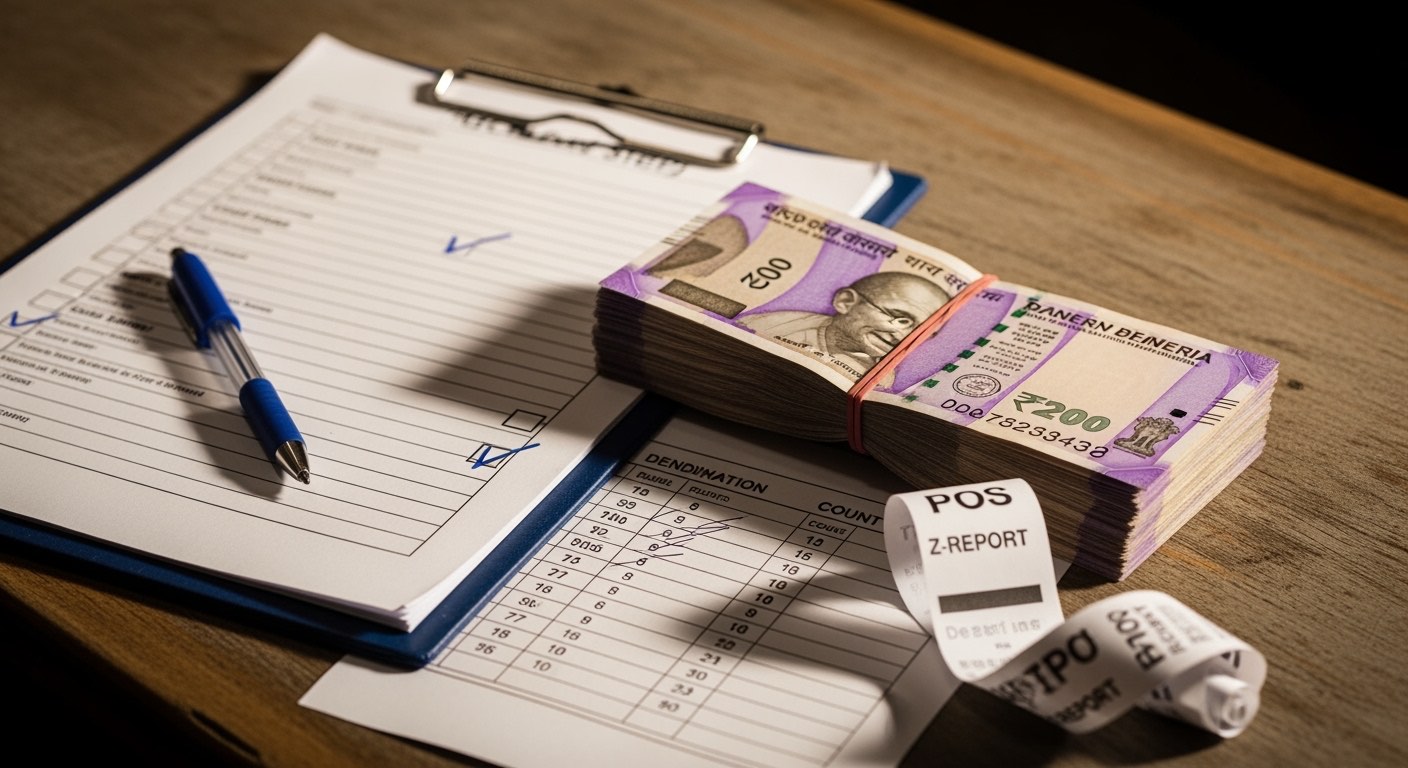
About this piece. A till close checklist is a forcing function. The form sits on the manager's clipboard, the cashier walks down it, and at the end there is a signed artefact you can defend in any conversation — variance, GST, payday, audit. This piece is the 14-step form most disciplined Indian outlets converge to, with the why behind each step.
Why a checklist beats a person
The cashier closing at 11pm has done 80 of these closes this year. The cashier closing at 11pm three months from now hasn't. The form is what makes the second cashier as good as the first. A till close checklist is staff turnover insurance.
A composite operator running a 50-cover NCR casual-dine put it like this: "When I had no checklist, every new manager took 3 weeks to close cleanly. With the form, day 4." The form does the remembering. The person does the work.
The 14-step till close — short form
Here is the full sequence at-a-glance. Detail and the printable form follow.
| # | Step | Who | Notes |
|---|---|---|---|
| 1 | Lock the till; refuse new orders | Cashier | Hard cut at close time |
| 2 | Print POS Z-report | Cashier | Print twice — one for clipboard, one for safe |
| 3 | Open UPI dashboard, note UPI total | Cashier | Cross-check, don't trust POS alone |
| 4 | Open card / EDC settlement, note card total | Cashier | Same logic |
| 5 | Note Swiggy/Zomato pre-paid + COD totals separately | Cashier | COD is cash, pre-paid is not |
| 6 | Count drawer cash by denomination | Cashier | Use denomination sheet |
| 7 | Sum petty cash vouchers in drawer | Cashier | Date-check; no voucher from yesterday |
| 8 | Compute expected drawer cash | Cashier | Float + cash sales − refunds − vouchers + COD |
| 9 | Compute variance; if outside threshold, halt + write reason | Manager | Two-eyes rule |
| 10 | Pull deposit cash; refill float to label number | Manager | Float reset, every shift |
| 11 | Seal deposit envelope; write date, amount, cashier name | Manager | Envelope is the bank's input |
| 12 | File voucher pad with day's bundle | Cashier | Date-stamped, rubber-banded |
| 13 | Sign close sheet — both cashier + manager | Both | Two-signature rule |
| 14 | Lock safe, walk the floor, lock up | Manager | Safe → kitchen → front → exit |
Average time: 11 minutes when nothing is off, 18 minutes on a variance night.
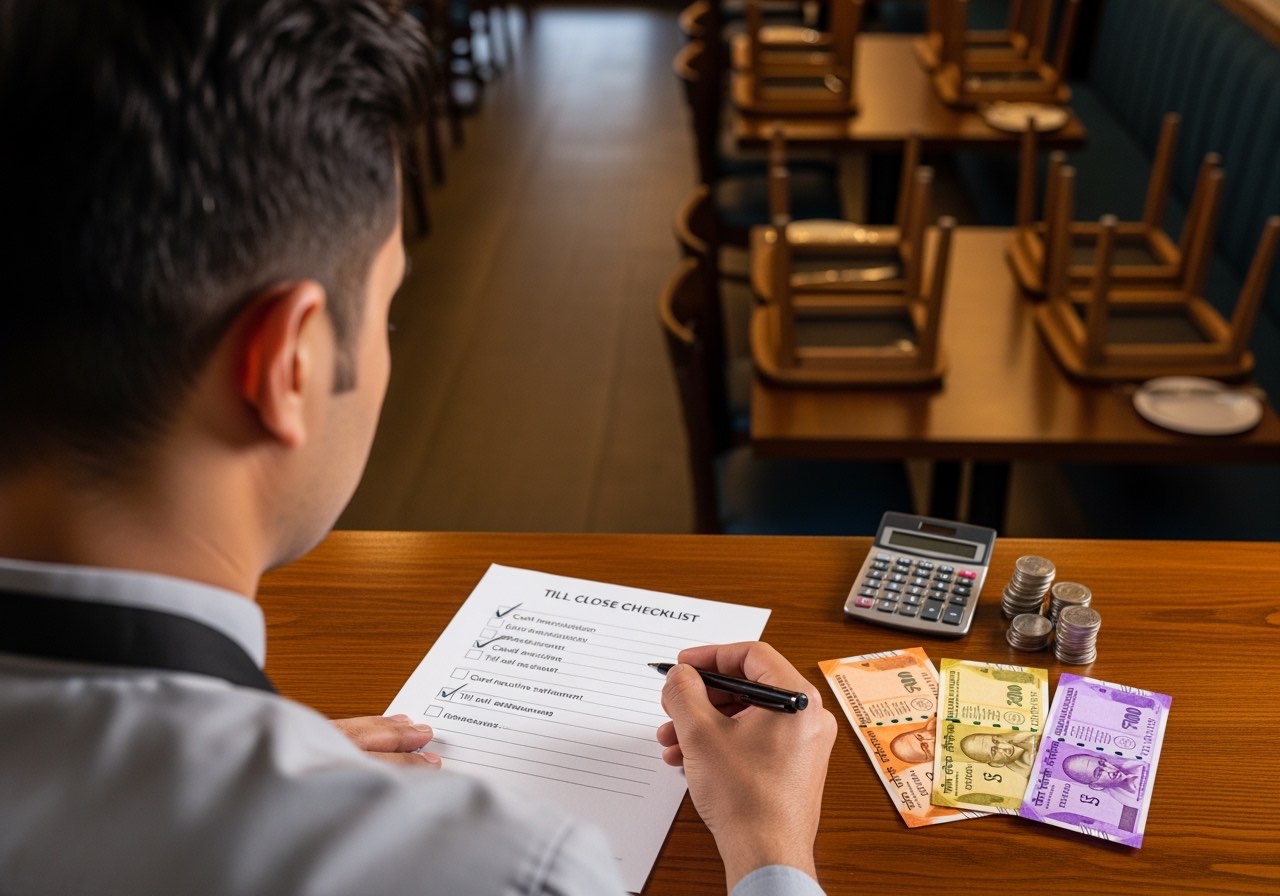
The printable form (A5, two-up on A4)
┌────────────────────────────────────────────────────────┐
│ TILL CLOSE — [Outlet]                                  │
│ Date: __/__/____  Shift: ____  Manager: _________      │
│                                                        │
│  1 □ Till locked, no new orders                        │
│  2 □ POS Z-report printed (2 copies)                   │
│  3 □ UPI dashboard total noted:    ₹ ________         │
│  4 □ Card/EDC settlement noted:    ₹ ________          │
│  5 □ Aggregator totals noted:                          │
│      Swiggy pre-paid ₹ ____   Swiggy COD ₹ ____        │
│      Zomato pre-paid ₹ ____   Zomato COD ₹ ____        │
│  6 □ Drawer counted (denomination sheet attached)      │
│      Drawer cash total:           ₹ ________           │
│  7 □ Vouchers summed:             ₹ ____ /  __ count   │
│                                                        │
│  8  Expected drawer cash:         ₹ ________           │
│      = Float + Cash Sales − Refunds − Vouchers + COD   │
│      Variance (Actual − Expected):  ₹ ________         │
│                                                        │
│  9 □ Variance reason (if outside threshold):           │
│      __________________________________________        │
│                                                        │
│ 10 □ Deposit envelope amount:     ₹ ________           │
│      Float retained:              ₹ ________           │
│ 11 □ Envelope sealed + labelled                        │
│ 12 □ Voucher pad filed                                 │
│ 13 □ Cashier sign: ______   Manager sign: ______       │
│ 14 □ Safe locked, floor walked, premises locked        │
└────────────────────────────────────────────────────────┘
Print 100. Tape one to the inside of the cashier's binder. Use a ballpoint, not pencil — pencil corrections are the audit's first red flag.
Step-by-step — what each line is actually for
Step 1 — Lock the till
A clean close is impossible if cash keeps moving. Hard cut. The last 3 customers who walk in at 10:58 will accept "kitchen closed" if the manager is calm and consistent. They won't accept it if some nights you say yes and other nights you say no.
Steps 2–5 — Tender mode totals
Every payment mode gets noted at its source, not at the POS only. Why: POS records what the staff entered, not what actually settled. UPI dashboards, card EDC slips, and aggregator portals are the source of truth for non-cash.
The five tender modes in 2026 India:
- Cash — drawer
- UPI — PhonePe / Google Pay / Paytm dashboards
- Card — EDC / settlement portal
- Aggregator pre-paid — settled in 7-day batches by Swiggy/Zomato
- Aggregator COD — cash, but the POS thinks it's Swiggy/Zomato revenue
Step 5 is the most-skipped step on most checklists. Skip it once and your drawer is "over" by the COD amount on COD days. Don't skip it.
Step 6 — Drawer count by denomination
Use the denomination sheet. Counting in piles without the sheet is how ₹50–₹100 errors creep in. Two minutes of structure beats two minutes of recount.
Steps 7–9 — Reconciliation
The arithmetic identity:
Expected drawer cash = Opening float
                     + Cash sales (POS)
                     − Cash refunds (POS)
                     − Petty cash vouchers
                     + Aggregator COD received
Variance = Actual − Expected.
Threshold for halt-and-explain: ±₹100 for outlets under ₹40,000/day; ±0.25% of cash sales for larger.
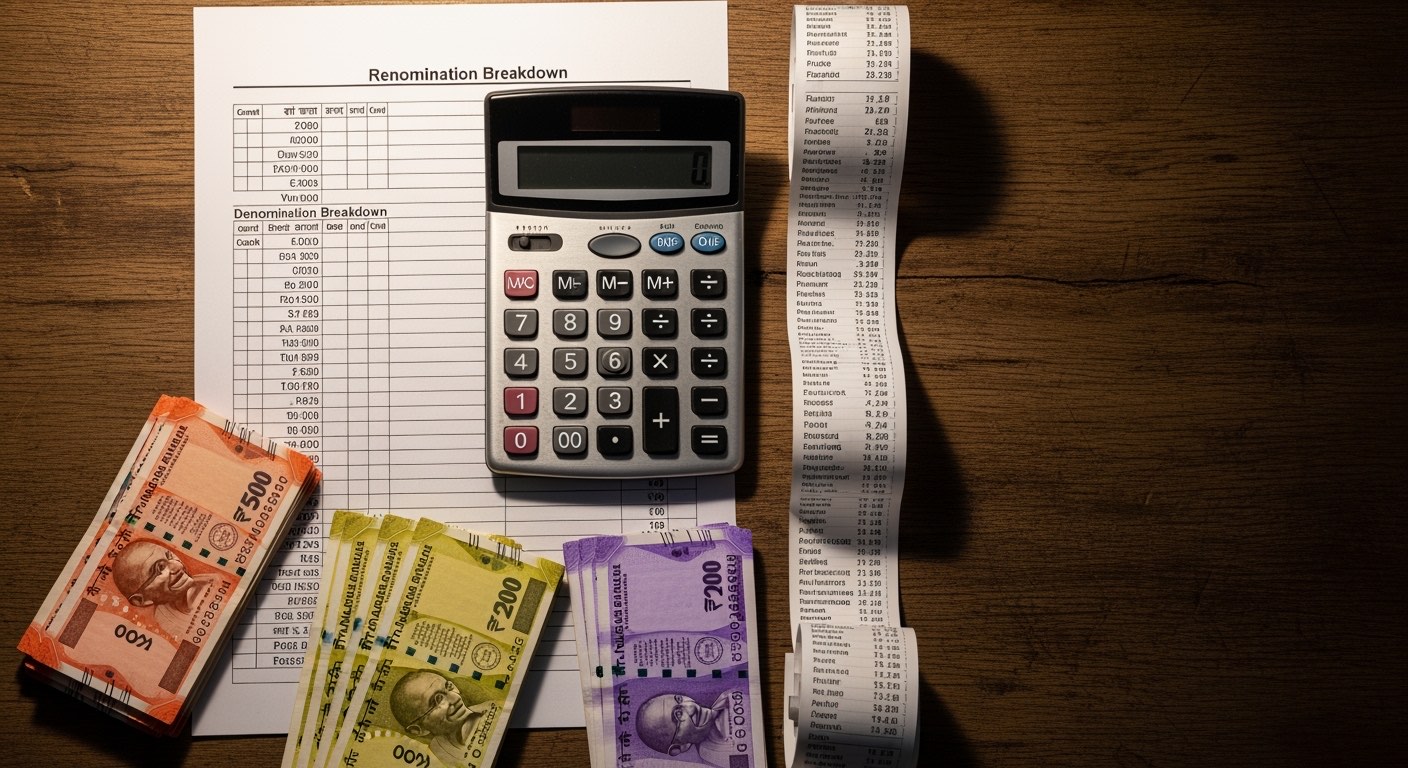
Step 10 — Deposit pull and float reset
This is the step that makes tomorrow's open clean. Pull everything above the float into the deposit envelope. Refill the float to its label number from the deposit cash if needed (you should already have the right denomination mix, but adjust now if not).
If the cashier leaves "extra change" in the drawer for tomorrow's morning shift, you've broken the imprest float and tomorrow's reconciliation will be wrong. Hard rule: drawer ends every shift at exactly the float number.
Step 11 — Deposit envelope seal
The envelope label needs four things:
Date:     __/__/____
Outlet:   _________
Cashier:  _________
Amount:   ₹ _______
That label is what the bank challan pulls from. If the deposit ever shows wrong on the bank statement, the labelled envelope is the artefact you reconcile against.
Steps 12–13 — Voucher file and signatures
Voucher pad gets rubber-banded with a cover sheet showing date + total + count. Goes in the day's drawer. Owner reviews the week on Sunday.
Two signatures. Cashier confirms what was counted. Manager confirms the close was witnessed. Without both signatures, the close sheet is a piece of paper from one person to themselves — same problem as a single-signed petty cash voucher.
Step 14 — Floor walk
Often skipped, often the source of next-morning problems. The walk:
- Safe locked, audibly tested
- Kitchen — gas off, exhaust off, fridges on, dry storage door shut
- Front — chairs up, lights off except security, AC off
- Exit — shutter down, lock + sealed lock photo to manager WhatsApp
The floor walk is 90 seconds. The fire NOC issues, gas leak, or "fridge was off all night" call you avoid by doing it consistently is incalculable.
What changes between single-outlet and multi-outlet
If you run more than one outlet, the till close checklist stays the same — but the rollup changes. Each outlet's signed close sheet and deposit envelope label become inputs to a multi-outlet flash report the area manager assembles by 10am next day. (Spoke piece on that coming under P4.)
A composite area manager with 5 outlets in NCR runs morning rollup at 9:30am: 5 close sheets, 5 deposit envelope amounts, 5 variance numbers. Anything that looks off gets a 10:15am call to that outlet's manager. The whole rollup takes 25 minutes a day. Visibility is daily, not weekly.
Where this fits in the daily-ops loop
The till close is the artefact-producing event of the day. It feeds:
- Daily Sales Record (DSR) — the day's consolidated sales row
- Bank deposit slip — tomorrow's deposit
- Variance log — the 30-day pattern
- Petty cash bundle — the month's voucher file
And it's fed by:
- Imprest float — the reference number (read)
- Petty cash vouchers — the outflow audit (read)
- POS hygiene — refunds, discounts, COD entered correctly
The whole loop is what Restaurant Daily automates. Without software, the loop still works — the form is the substitute for the software.
What to do this week
Print 50 copies of the form on Saturday. Brief the cashier and manager on Sunday morning. Run the form for one full week. By night four it's reflex; by night seven, the variance pattern is visible.
The form is the discipline. Everything else follows.
Related on Restaurant Daily
One operator playbook a week, in your inbox.
Cash close, petty cash, payroll, compliance, unit economics — sent every Monday morning. No spam, no upsell drip. Unsubscribe in one click.
Sent from noreply@restaurantdaily.ai. We never share your address.
Related reading
Denomination sheet restaurant cash count — Excel template + how to use it
Free denomination sheet for Indian restaurant cash counts — Excel + printable PDF, with auto-totals, variance row, and the right way to count a drawer in 2 minutes.
Cash deposit slip format restaurant — free fillable bank deposit template
Bank cash deposit slip format for Indian restaurants — fillable template covering denomination split, outlet code, cashier sign, and reconciliation back to DSR.
Cash drawer audit checklist — owner's 9-step surprise audit (India)
Owner's surprise cash drawer audit checklist for Indian restaurants — 9 steps to run unannounced in 12 minutes, with thresholds and dispute-proof artefacts.
Shift handover format restaurant — single-page form for cash, stock, complaints
A single-page shift handover format for Indian restaurants — covering cash, stock alerts, open complaints, comps, and pending tasks. Free printable template.
Daily sales report restaurant Excel — free DSR template (India)
Free daily sales report Excel + Google Sheets template for Indian restaurants — 18 fields covering tender modes, GST splits, refunds, advances, and weekly rollup.