Shift handover format restaurant — single-page form for cash, stock, complaints
A single-page shift handover format for Indian restaurants — covering cash, stock alerts, open complaints, comps, and pending tasks. Free printable template.
Last updated 9 Aug 2026
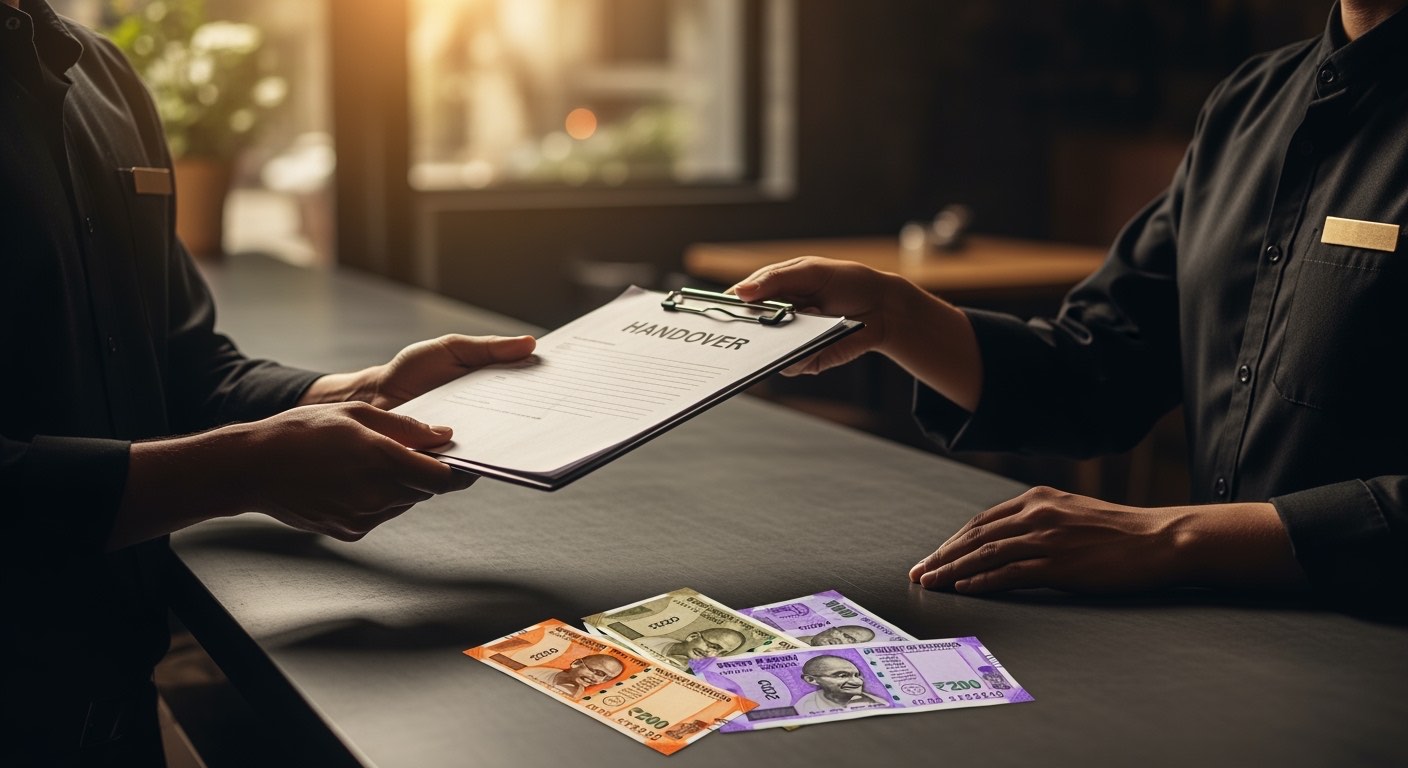
About this piece. Shift handover is the 5-minute conversation that decides whether the dinner shift inherits a clean kitchen and a known story — or walks into a mess they have to reconstruct. Most Indian restaurants do this verbally, in passing, while the morning manager leaves and the evening manager arrives. This piece is the single-page form that makes it stick on paper.
Why a verbal handover fails
The verbal handover problem isn't that managers forget. It's that the receiving manager hears half of what's said while clocking in, putting the bag down, and getting briefed by the cashier at the same time. Within an hour, "the AC tripped at 11am" has become "the AC has been off all morning", and the handover becomes the source of the next argument, not its prevention.
A signed single-page form solves three things at once:
- The outgoing manager has to think about what to write — the act of writing surfaces issues the verbal handover skipped.
- The incoming manager has a record they can refer to at 8pm when the same complaint walks back in.
- The owner has a paper trail when something goes wrong on the swing shift.
Composite operators across NCR who run shift handover on paper report the same arc — first two weeks feels bureaucratic, week three becomes reflex, week four the form prevents the first real incident.
The single-page format
Five blocks. One sheet. A4 portrait, printed in pads of 50.
┌────────────────────────────────────────────────────────┐
│ SHIFT HANDOVER — [Outlet]                              │
│ Date: __/__/____                                       │
│ Outgoing shift: ____ (manager: _______, time: __:__)   │
│ Incoming shift: ____ (manager: _______, time: __:__)   │
│                                                        │
│ A. CASH                                                │
│   Float on hand:        ₹ ________                     │
│   Last close variance:  ₹ ________  (date: ____)       │
│   Petty cash spent shift-to-date: ₹ ________           │
│   Cash awaiting deposit: ₹ ________                    │
│                                                        │
│ B. STOCK                                               │
│   Items running low (top 5):                           │
│     1. ______________  qty: ______                     │
│     2. ______________  qty: ______                     │
│     3. ______________  qty: ______                     │
│     4. ______________  qty: ______                     │
│     5. ______________  qty: ______                     │
│   Items expiring in 7 days:                            │
│     1. ______________   exp: ____  loc: ______         │
│     2. ______________   exp: ____  loc: ______         │
│   Last delivery received: ____________________         │
│                                                        │
│ C. OPEN COMPLAINTS / COMPS                             │
│   Customer complaints unresolved:                      │
│     1. _________________________________________       │
│     2. _________________________________________       │
│   Comps given today (count + total): ____ / ₹ ____     │
│   Refunds given today: ____ / ₹ ____                   │
│                                                        │
│ D. STAFF                                               │
│   Absent: _____________  Late: _____________           │
│   Salary advances paid today: ₹ ________               │
│   Issues to flag to next shift: ___________________    │
│                                                        │
│ E. EQUIPMENT / PREMISES                                │
│   AC □ ok  □ issue: ____________________               │
│   Fridge / freezer □ ok  □ issue: ___________          │
│   Gas / cylinder □ ok  □ low  □ change due             │
│   POS / printer □ ok  □ issue: ______________          │
│   Other (CCTV, exhaust, lights): ___________           │
│                                                        │
│ F. PENDING TASKS FOR NEXT SHIFT                        │
│   1. _________________________________________         │
│   2. _________________________________________         │
│   3. _________________________________________         │
│                                                        │
│ Outgoing sign: __________  Incoming sign: __________   │
└────────────────────────────────────────────────────────┘
Print 50. Tape one to the manager's binder. Brief both managers on the first Monday and reinforce on Wednesday.
Why these specific blocks
Each block exists because something it captures has, in real Indian restaurants, become an avoidable Friday-night problem.
A. Cash
The float and last variance need to travel between shifts. Without the variance number, the incoming manager doesn't know whether to count carefully or move quickly. With it, they walk in with the right level of suspicion.
Cash awaiting deposit is the biggest one — if the morning shift's deposit hasn't gone to the bank, the evening manager needs to know there's ₹15,000 of un-deposited cash in the safe and act accordingly.
B. Stock
The "top 5 low" is what stops the kitchen from running out of dhaniya, paneer, or chicken at 8pm and having a cashier dispatched mid-rush. The "expiring in 7" is the FSSAI hygiene watch — anything close to expiry rotates first.
A typical 30-cover Indian restaurant operator runs out of one critical ingredient mid-shift roughly twice a month. The handover form takes that to almost zero in 6 weeks.
C. Open complaints / comps
The customer who complained at lunch about cold food and was promised a free dessert if she comes back — that promise needs to live somewhere. Without the form, she comes back at 8pm, the evening cashier doesn't know, the comp doesn't happen, and one Google review later you've lost a regular.
Comps and refunds totals also matter for the close — the day's totals tie back to the close sheet's discount and refund lines.
D. Staff
Absences and late arrivals matter to the next shift's planning (who covers the station). Salary advances paid today need to update the advance ledger so the same staff member doesn't successfully hit two managers in one day.
E. Equipment
The AC, fridge, gas, POS — when one of these is degraded, the next shift needs to know on arrival, not when it fails completely at 7pm. A composite operator caught a slow-leaking gas cylinder on a handover form once because the morning manager noted "smell faint near range, possibly cylinder" — the evening manager walked in, called the vendor, replaced before service. That one note prevented a kitchen evacuation.
F. Pending tasks
The "I'll do it later" list. Bank deposit not yet done. Vendor payment promised. Owner asked for the supplier quote — it's pending. These are what slip when nobody is the named owner.
How the handover happens — the 5-minute meeting
The form makes the meeting useful. The meeting makes the form useful.
| Minute | What |
|---|---|
| 0–1 | Outgoing manager hands the filled form to incoming, walks through it |
| 1–2 | Incoming asks one clarification per block, marks any that need follow-up |
| 2–3 | Both walk to the cash drawer; outgoing shows float, last variance, deposit envelope status |
| 3–4 | Both walk through the kitchen — point at the low items, at the expiring items |
| 4–5 | Both sign. Form goes in the day's binder |
This is non-negotiable. If the outgoing manager has somewhere to be and skips the floor walk, half the value of the handover is lost. The signature is the artefact; the walk is the practice.
Three mistakes that wreck handovers
- Filling the form alone, then handing it over. The form is a conversation prop. Filling it without the receiving manager misses the point — they need to see you write the items, walk to them, and confirm.
- Treating "ok" as the default checkbox. A ticked "AC ok" without a glance at the AC is just paperwork. Audit randomly: pull a week of handover sheets, walk to the items checked "ok", confirm.
- No owner read-through. The handover sheets pile up in a binder. If the owner never reads the binder, the form becomes ritual. Sunday's owner-review of the week's sheets is what makes the form count.
Where this fits in the daily-ops loop
Shift handover is the bridge between two closes. It carries:
- From the morning close — float, variance, deposit, comps, complaints, stock state
- To the evening close — the same fields, updated, plus that shift's own additions
It interlocks with:
- Till close (14-step checklist)
- DSR (Excel template) — comps, refunds, advances pull through
- Petty cash voucher (format) — outflow trail
- Salary advance ledger (template coming)
What good looks like — three weeks in
By week three, a disciplined outlet has:
- 21 signed handover sheets in the binder
- Two or three "averted incidents" the team can recall (low gas caught early, returning customer comped correctly, low paneer prevented mid-rush stockout)
- The evening manager walking in with a 90-second briefing instead of a 20-minute reconstruction
- The owner's Sunday review surfacing 1–2 patterns (one staff member always late, one fridge with recurring issues)
That's the full payback. The form is small; the discipline it builds is large.
What to do this week
Print 50 copies on Saturday. Pick one shift change next Monday — say, the lunch-to-dinner handover — and run the form. Don't try all four shift changes day one.
By Wednesday it's reflex. By the following Monday, expand to the second shift change. Two weeks in, every shift change runs the form. The discipline holds even when Restaurant Daily is taken out of the picture; the form is the substitute.
Related on Restaurant Daily
One operator playbook a week, in your inbox.
Cash close, petty cash, payroll, compliance, unit economics — sent every Monday morning. No spam, no upsell drip. Unsubscribe in one click.
Sent from noreply@restaurantdaily.ai. We never share your address.
Related reading
Denomination sheet restaurant cash count — Excel template + how to use it
Free denomination sheet for Indian restaurant cash counts — Excel + printable PDF, with auto-totals, variance row, and the right way to count a drawer in 2 minutes.
Cash deposit slip format restaurant — free fillable bank deposit template
Bank cash deposit slip format for Indian restaurants — fillable template covering denomination split, outlet code, cashier sign, and reconciliation back to DSR.
Daily sales report restaurant Excel — free DSR template (India)
Free daily sales report Excel + Google Sheets template for Indian restaurants — 18 fields covering tender modes, GST splits, refunds, advances, and weekly rollup.
Restaurant till close checklist — printable 14-step end-of-day form
A 14-step restaurant till close checklist used by disciplined Indian outlets — printable A5 form covering cash, vouchers, POS, UPI, COD, and deposit envelope.
Restaurant cash management software India — 6 options compared (2026)
Restaurant cash management software in India compared — Petpooja, Posist, Khatabook, Vyapar, Restaurant Daily, manual Excel — pricing, features, support, fit.