Salary advance format India — letter + ledger template (restaurant)
Free salary advance format for Indian restaurant staff. Request letter, owner ledger, recovery schedule, and the labour-law cap that stops the cycle going wrong.
Last updated 9 Aug 2026

About this piece. Restaurant staff take salary advances 3–6× the rate of office staff. Schools, weddings, medical, festive — there's always a reason. Most owners say yes verbally, hand over cash, and write nothing down. Three months later the ledger is murky, the staff member is angry about deductions, and the owner is ₹14,000 short. This piece gives you the request letter, the ledger template, and the labour-law cap that keeps the system humane and clean.
Why advances are inevitable in restaurants
Restaurant staff sit in a wage band where:
- Monthly salary is ₹12,000–₹25,000
- Savings are minimal — most live month-to-month
- Spending events (school fees, festival, medical) routinely cross ₹5,000–₹15,000
The advance is the bridge between the spending event and the next salary day. Refusing every advance request loses you good staff. Saying yes to every request without a system loses you money. The middle path is a documented advance system with a recovery cap.
The system in 5 lines
- The staff member writes a request — date, amount, reason, recovery preference.
- Owner reviews against the cap (no more than 1 month's net salary outstanding at any time).
- Owner cuts cash / UPI; staff member signs a receipt.
- Recovery happens via fixed instalments on the next 1–3 salary cycles.
- Ledger row closed when balance hits zero.
The whole thing takes 5 minutes per request and 30 seconds per recovery. Less than the cost of getting it wrong.
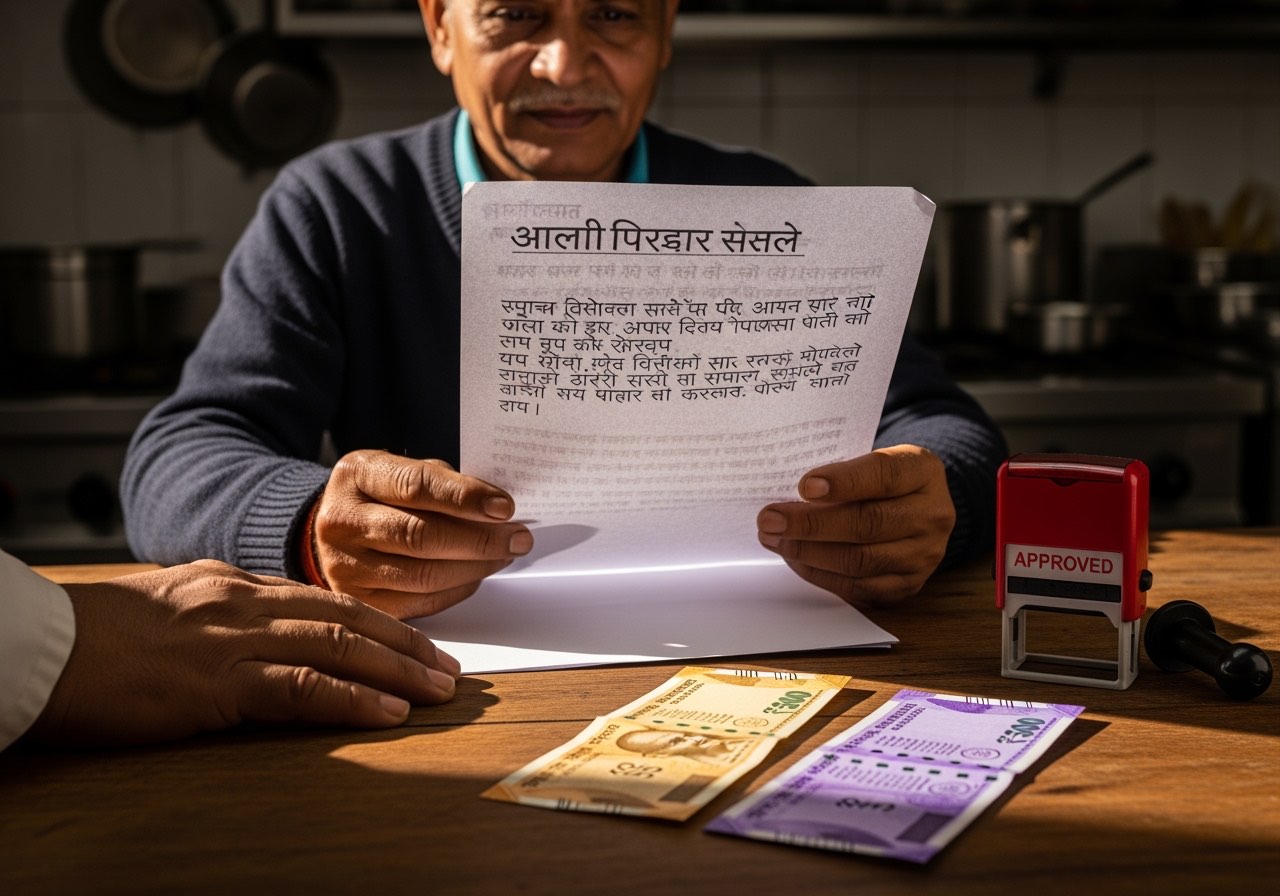
The request letter (one half-sheet, available in English/Hindi)
┌─────────────────────────────────────────────────────────────┐
│  SALARY ADVANCE REQUEST                                      │
│  वेतन अग्रिम आवेदन                                            │
│                                                              │
│  To:    Owner / Manager                                      │
│         [Outlet name]                                        │
│  Date:  ____ / ____ / 2026                                   │
│                                                              │
│  Sir / Madam,                                                │
│                                                              │
│  I, ___________________________ (Employee ID: __________)    │
│  request a salary advance of ₹________ (Rupees                │
│  __________________________ only) for the following          │
│  reason:                                                     │
│                                                              │
│  □ Medical          □ Education / school fees                │
│  □ Family event     □ Travel home                            │
│  □ Festival         □ Other: ________________________       │
│                                                              │
│  I request recovery in:  □ 1 instalment   □ 2 instalments    │
│                          □ 3 instalments                     │
│                                                              │
│  I confirm that this advance, when added to any              │
│  outstanding advance, does not exceed one month's net        │
│  salary.                                                     │
│                                                              │
│  Staff signature: __________________  Date: __________       │
│  Owner approval:  __________________  Date: __________       │
│                                                              │
│  Amount paid: ₹__________  Mode: □ Cash  □ UPI               │
│  Receipt no:  __________  PCV ref: __________                │
└─────────────────────────────────────────────────────────────┘
The reason checkboxes do real work — they prevent the awkwardness of having to verbalize "kyun chahiye". They also let the owner spot patterns (the third "festival" advance from the same staff in 6 months is a different conversation).
The owner's advance ledger (one row per advance)
Maintain in Excel or a physical register, one row per advance event, columns:
| Date | Staff name | EmpID | Amount | Reason | Instalments | Per-instalment ₹ | Cycle 1 | Cycle 2 | Cycle 3 | Outstanding |
|---|---|---|---|---|---|---|---|---|---|---|
| 14-Jun-26 | Ramesh K. | EMP-007 | 6,000 | Festival | 2 | 3,000 | 3,000 | 3,000 | — | 0 |
| 22-Jun-26 | Priya S. | EMP-012 | 4,000 | Medical | 1 | 4,000 | 4,000 | — | — | 0 |
| 03-Jul-26 | Anand T. | EMP-019 | 12,000 | School fees | 3 | 4,000 | 4,000 | 4,000 | 4,000 | 0 |
Sort by staff name. Run a per-staff outstanding total before approving any new advance.
The recovery cap — the rule that stops the spiral
Two caps, applied together:
Cap 1 — Outstanding limit. Total outstanding advance for any staff member at any time ≤ 1 month's net salary. Above that, refuse the new request or restructure recovery.
Cap 2 — Per-cycle deduction limit. Recovery deducted in any single salary cycle ≤ 25% of net salary. This is consistent with the Payment of Wages Act, 1936 unauthorized deduction limit.
Why both:
- Cap 1 stops cumulative debt building beyond what one month's wages can absorb.
- Cap 2 stops a desperate request being recovered in one painful chunk that leaves the staff member with no money for rent.
Without these, you end up in the worst case: staff member owes ₹38,000 to the outlet, can't quit because of the debt, can't earn enough to pay it back, hates the job. Bad for both sides.
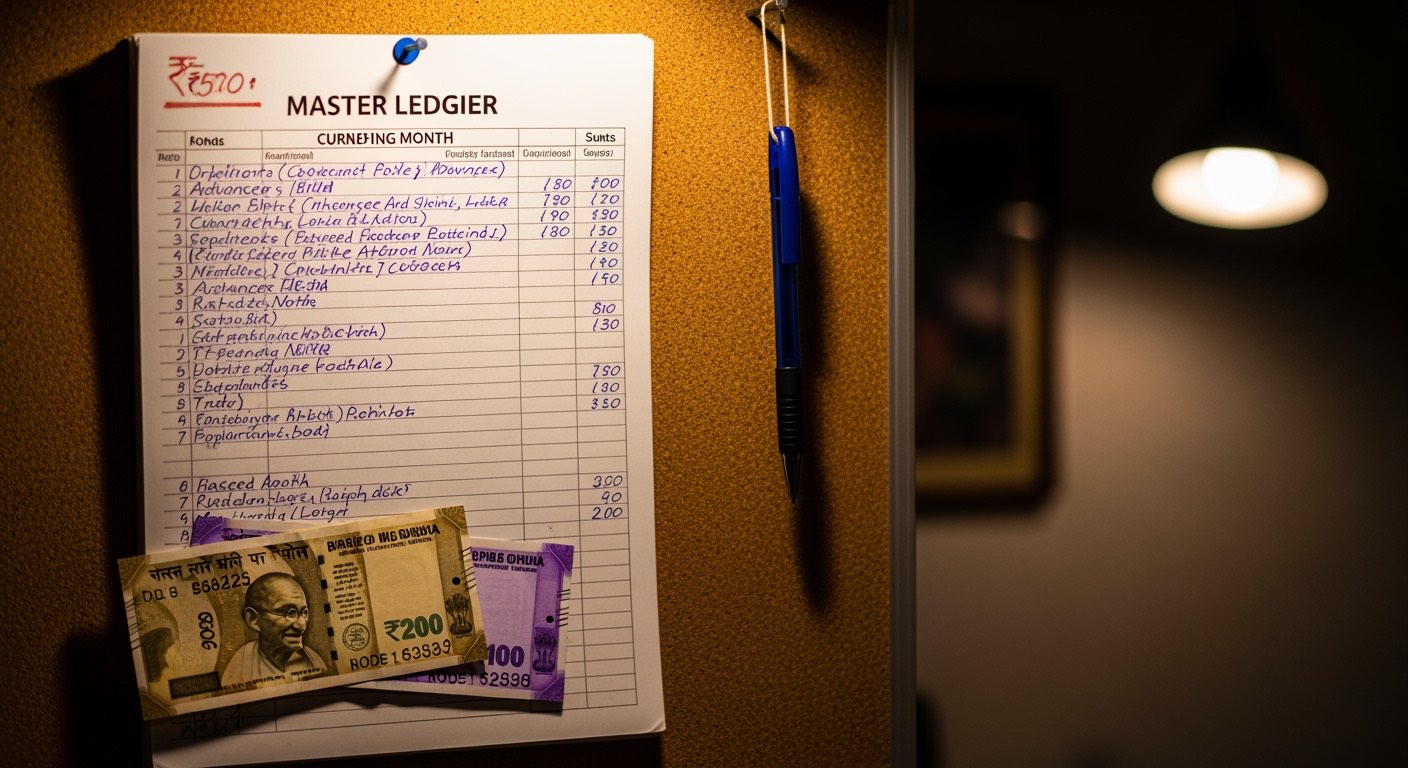
Recovery on the salary slip
The advance recovery must show as a separate deduction line on the salary slip — not bundled into "other deductions" or netted silently against gross. The minimum required line:
Less: Advance recovery (advance dated 14-Jun-26, instalment 1 of 2) ₹3,000
Two reasons:
- The staff member sees exactly which advance is being recovered. No disputes.
- If labour-law audit ever questions the recovery, the salary slip is your defence.
What if the staff member quits with an advance outstanding?
Three scenarios:
Scenario A — quits with notice and offers to settle. Compute outstanding, deduct from final salary + any earned-but-unpaid wages. If final salary doesn't cover, net the gratuity (only after all statutory minima are paid). If still short, the residual is a write-off.
Scenario B — quits without notice and disappears. You have a signed advance receipt. You have no enforcement path that's worth the legal cost for amounts < ₹50,000. Write off after 90 days.
Scenario C — outlet terminates the staff member. Regardless of cause of termination, you cannot recover an advance through final-settlement deduction below the minimum wage threshold for the days worked. The advance becomes a write-off if final settlement can't fund it without dropping below floor.
The unwritten rule: the advance system is an instrument of trust, not a debt-collection tool. Treat the occasional write-off as a cost of operating in a wage band where staff genuinely need bridging cash.
Patterns to watch for in the ledger
Run a per-staff advance frequency report quarterly. Flags:
| Pattern | What it might mean |
|---|---|
| Same staff, 3+ advances in a quarter | Personal financial stress; consider a one-time consolidation |
| Always max amount, always 1-instalment recovery | Likely a parallel employer (moonlighting) — staff is using your advance + their other wages |
| Advance taken, then quits within 30 days | Treat as a fraud signal; raise the bar for next time |
| Multiple staff requesting same week | Festival or local event — bunch the cash flow planning |
These are conversations to have, not ledger flags. The ledger gives you the data; the conversation prevents the next bad outcome.
A 6-month rollout
If you're starting from "we just give advances when asked":
| Month | Action |
|---|---|
| 1 | Print the request letter pad. Tell staff: "From next week, every advance needs this form." |
| 2 | Open the ledger. Record every advance, including any verbal historical balances. |
| 3 | Apply the 25% per-cycle deduction cap on recoveries. |
| 4 | Apply the 1-month outstanding cap on new approvals. |
| 5 | Generate the first quarterly per-staff advance report. |
| 6 | Hold one 5-minute check-in with any staff member who's hit 3+ advances; offer a one-time consolidation if needed. |
By month 6, the system is invisible. Staff trust it. Owner is in control. Cash is accounted for.
Related on Restaurant Daily
One operator playbook a week, in your inbox.
Cash close, petty cash, payroll, compliance, unit economics — sent every Monday morning. No spam, no upsell drip. Unsubscribe in one click.
Sent from noreply@restaurantdaily.ai. We never share your address.
Related reading
Tip pool distribution in Indian restaurants — fair models + CCPA rules
How Indian restaurants should distribute tips and service charge in 2026: 4 pool models compared, CCPA 2022 service-charge rules, and a defensible per-staff formula.
PF and ESI eligibility for restaurant staff — India 2026
PF and ESI eligibility for Indian restaurant staff in 2026. Headcount thresholds, wage ceilings, voluntary registration, and the cost of getting the timing wrong.
Attendance register PDF for restaurants — daily, weekly, monthly templates
Free attendance register PDF templates for Indian restaurants — daily, weekly, monthly formats. Print-ready, S&E Act-compliant, with the discipline that keeps it current.
Restaurant payroll software India — 7 tools compared (2026)
Restaurant payroll software India compared: KekaHR, GreytHR, RazorpayX Payroll, Zoho People, Petpooja Payroll, Restaurant Daily, manual. Pricing, fit, gaps.
Salary slip format for restaurant staff — free Excel + PDF (India 2026)
Salary slip format for restaurant staff in India — what every slip must show, free Excel + PDF templates, and the small-print that makes it audit-proof.