Tip pool distribution in Indian restaurants — fair models + CCPA rules
How Indian restaurants should distribute tips and service charge in 2026: 4 pool models compared, CCPA 2022 service-charge rules, and a defensible per-staff formula.
Last updated 9 Aug 2026
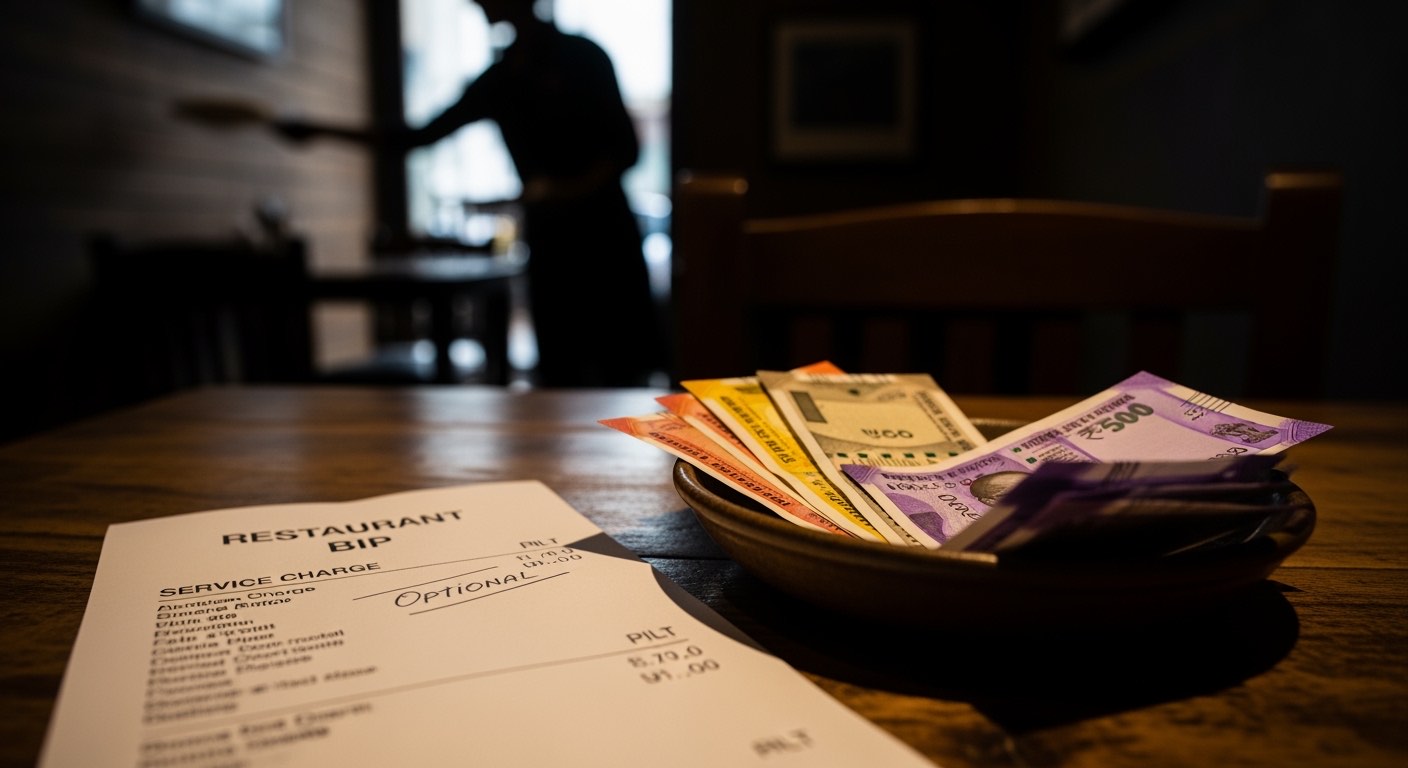
About this piece. Tip and service-charge handling sits in the awkward space between law (CCPA 2022 guidelines), industry practice (40 years of pooled tip cultures), and staff equity (front-of-house vs back-of-house). Most Indian restaurants run a tip pool by feel and lose good kitchen staff to the resulting unfairness. This piece walks through what the law allows, four pool models with worked examples, and a per-staff formula you can defend to the cook who plates the food but never sees a customer.
What changed in 2022 — the CCPA guidelines
In July 2022, the Central Consumer Protection Authority issued guidelines on service charge. The four operative rules for restaurants:
- Service charge cannot be added automatically to the bill. Adding it as a default and removing only on request is prohibited.
- The customer must be informed that service charge is voluntary.
- Service charge cannot be added to the food bill before GST is computed (this prevented restaurants from inflating GST base via service charge).
- Restaurants cannot refuse service to a customer who declines the service charge.
The guidelines apply to service charge — the percentage line item the restaurant adds. They don't apply to tips — discretionary amounts the customer chooses to leave.
The CCPA rules don't say how to distribute the collected service charge among staff. They only govern how it's collected. Distribution is a contractual matter between employer and staff.
Service charge vs tip — the operator distinction
| Dimension | Service charge | Tip |
|---|---|---|
| Who initiates | Restaurant adds line | Customer voluntarily leaves |
| Default status | Must be opt-in (CCPA 2022) | Voluntary by definition |
| Goes to | Pooled distribution per restaurant policy | Same — but typically all-staff pool or per-server |
| Tax treatment | Income of restaurant; distributed to staff is staff income | Staff income directly |
| GST | Charged on top, GST applies | Outside GST base |
The accounting trail differs. Service charge enters the books as revenue and exits as a distribution expense. Tips don't enter the books at all in cash-tip culture, but should if recorded via card.

The four common distribution models
Model 1 — All-staff equal split
Total pool / total staff working that shift. Everyone gets the same.
Pros: Simple. Removes FOH/BOH tension. Easy to explain.
Cros: Demotivates servers who actually drove the tip. A captain who upsold ₹4,000 of wine gets the same share as the helper who washed plates.
Model 2 — FOH-only pool
Service charge / tips distributed only among front-of-house — servers, captains, cashiers.
Pros: Aligned with customer intent (the tip rewards visible service).
Cons: Creates a two-class staff system. Kitchen morale collapses over time. High kitchen churn.
Model 3 — Weighted pool by role
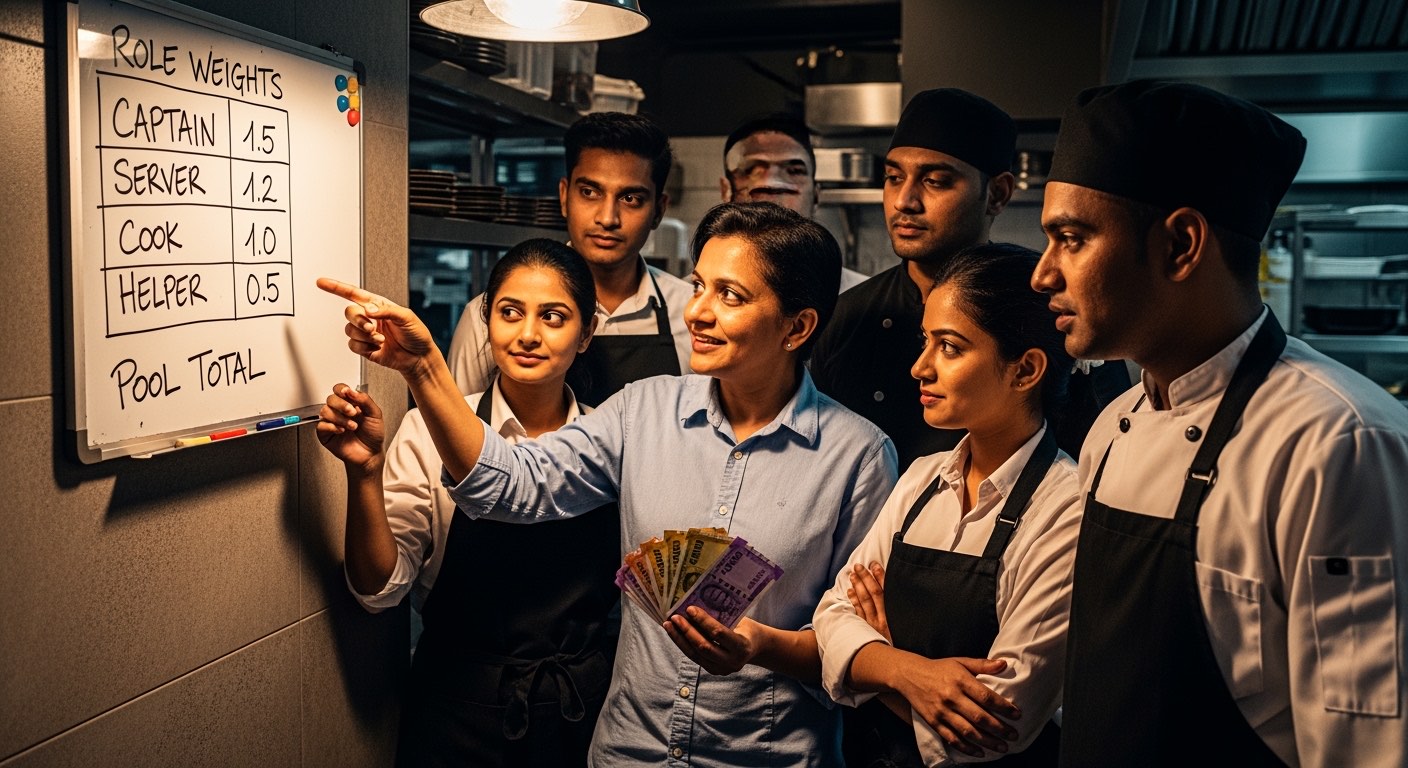
Each role has a points weight; pool distributes by points.
| Role | Weight |
|---|---|
| Captain / steward | 1.5 |
| Server / waiter | 1.2 |
| Cashier | 1.0 |
| Cook / chef | 1.0 |
| Kitchen helper / cleaner | 0.5 |
Pros: Rewards effort and customer-facing role without disenfranchising kitchen.
Cons: Requires a written policy + per-shift point summing. More administrative load.
Model 4 — Hybrid (FOH base + BOH share)
70% of pool to FOH (weighted within FOH), 30% to BOH (weighted within BOH).
Pros: Best of both — aligns with customer intent, doesn't punish kitchen.
Cons: The 70/30 split needs a written rationale, otherwise BOH staff perceive it as arbitrary.
A worked example — 1 dinner shift, ₹2,800 service charge collected
Shift roster: 1 captain, 2 servers, 1 cashier, 1 cook, 1 helper. Total 6 staff.
Under Model 1 (equal split):
| Role | Share |
|---|---|
| Captain | ₹467 |
| Server × 2 | ₹467 each |
| Cashier | ₹467 |
| Cook | ₹467 |
| Helper | ₹467 |
Under Model 3 (weighted pool):
Captain weight    = 1.5
Server weight × 2 = 1.2 × 2 = 2.4
Cashier weight    = 1.0
Cook weight       = 1.0
Helper weight     = 0.5
Total weights     = 6.4

Distribution per weight point = 2,800 / 6.4 = ₹437.50
| Role | Weight | Share |
|---|---|---|
| Captain | 1.5 | ₹656 |
| Server | 1.2 | ₹525 |
| Server | 1.2 | ₹525 |
| Cashier | 1.0 | ₹437 |
| Cook | 1.0 | ₹437 |
| Helper | 0.5 | ₹219 |
Under Model 4 (70/30 split, weighted within each side):
FOH pool = 70% × 2,800 = ₹1,960
  Captain (1.5) + 2 servers (1.2) + cashier (1.0) = 4.9 weight points
  Per point = 1,960 / 4.9 = ₹400

BOH pool = 30% × 2,800 = ₹840
  Cook (1.0) + helper (0.5) = 1.5 weight points
  Per point = 840 / 1.5 = ₹560
| Role | Share |
|---|---|
| Captain | ₹600 |
| Server × 2 | ₹480 each |
| Cashier | ₹400 |
| Cook | ₹560 |
| Helper | ₹280 |
Note: In Model 4, the cook's share is higher than the cashier's — because BOH is a smaller pool. The hybrid rewards being indispensable to your side of the kitchen, not just position.
The policy document — one page, signed by all staff
A defensible policy includes:
- Definition — what's pooled (service charge, card tips, cash tips left at the till — but typically NOT cash tips left directly on the table for a specific server).
- Model — which of the four (or your variant).
- Calculation frequency — daily, weekly, or fortnightly.
- Payout method — added to next salary, paid weekly in cash, paid via UPI.
- Eligibility — does a staff member who worked 4 hours of a 12-hour shift get a full share or pro-rated?
- Pro-ration formula — usually hours worked / standard shift hours.
- Exclusions — manager, head chef, owner family — typically excluded.
Get every staff member to sign acknowledgment. Re-issue if you change the model.
Three rules nobody talks about
Rule 1 — Service charge cannot be netted against wages. If your gross wage policy says ₹15,000/month and service charge yields ₹3,000/month per staff, you can't pay ₹12,000 wage + ₹3,000 service charge = ₹15,000 "total". The wage floor is the wage; service charge is on top.
Rule 2 — Distributed service charge is income for the staff member. Above the minimum threshold (typically ₹2.5L/year), it's taxable. If you distribute via salary slip, TDS applies. If you distribute in cash, you've put the staff member into informal income — fine for some, problematic for others.
Rule 3 — Distributed amount is not part of wages for PF/ESI base. Both Acts exclude "tip" and "service charge distributions" from wage definition (subject to scheme-specific provisos). Don't accidentally inflate your PF/ESI base by routing service charge through gross.
The tax treatment — clean version
For the restaurant:
- Service charge collected enters as income on the P&L.
- Service charge distributed exits as employee benefit / staff cost.
- Net effect on outlet P&L: zero (if 100% distributed).
For the staff member:
- Distributed service charge is other income if paid separately from salary.
- Or it appears as a line on the salary slip (cleaner option) and is taxed as part of salary.
The clean path: route distribution through the salary slip as a separate line, TDS where applicable, fully documented.
What to do this quarter
- Audit your current distribution practice. Is there a written policy? If not, that's the first artefact.
- Pick a model. Hybrid (Model 4) is the most defensible for restaurants > 10 staff. Equal split (Model 1) works for < 5 staff outlets.
- Document and circulate. One page. Signed.
- Audit the bill. Confirm service charge is opt-in compliant per CCPA 2022.
- Run distribution through payroll, not separately in cash. Cleaner audit trail, fewer disputes.
The end goal: no staff member is unclear about why they got the share they got. That's the only test that matters.
Related on Restaurant Daily
One operator playbook a week, in your inbox.
Cash close, petty cash, payroll, compliance, unit economics — sent every Monday morning. No spam, no upsell drip. Unsubscribe in one click.
Sent from noreply@restaurantdaily.ai. We never share your address.
Related reading
PF and ESI eligibility for restaurant staff — India 2026
PF and ESI eligibility for Indian restaurant staff in 2026. Headcount thresholds, wage ceilings, voluntary registration, and the cost of getting the timing wrong.
Salary advance format India — letter + ledger template (restaurant)
Free salary advance format for Indian restaurant staff. Request letter, owner ledger, recovery schedule, and the labour-law cap that stops the cycle going wrong.
Restaurant payroll software India — 7 tools compared (2026)
Restaurant payroll software India compared: KekaHR, GreytHR, RazorpayX Payroll, Zoho People, Petpooja Payroll, Restaurant Daily, manual. Pricing, fit, gaps.
Attendance register PDF for restaurants — daily, weekly, monthly templates
Free attendance register PDF templates for Indian restaurants — daily, weekly, monthly formats. Print-ready, S&E Act-compliant, with the discipline that keeps it current.
Muster roll format for restaurants in India — free Excel + PDF (Form 25)
Free muster roll format for Indian restaurants — Form 25 Excel + printable PDF templates. Daily attendance, OT hours, statutory layout that passes labour audit.