PF and ESI eligibility for restaurant staff — India 2026
PF and ESI eligibility for Indian restaurant staff in 2026. Headcount thresholds, wage ceilings, voluntary registration, and the cost of getting the timing wrong.
Last updated 9 Aug 2026
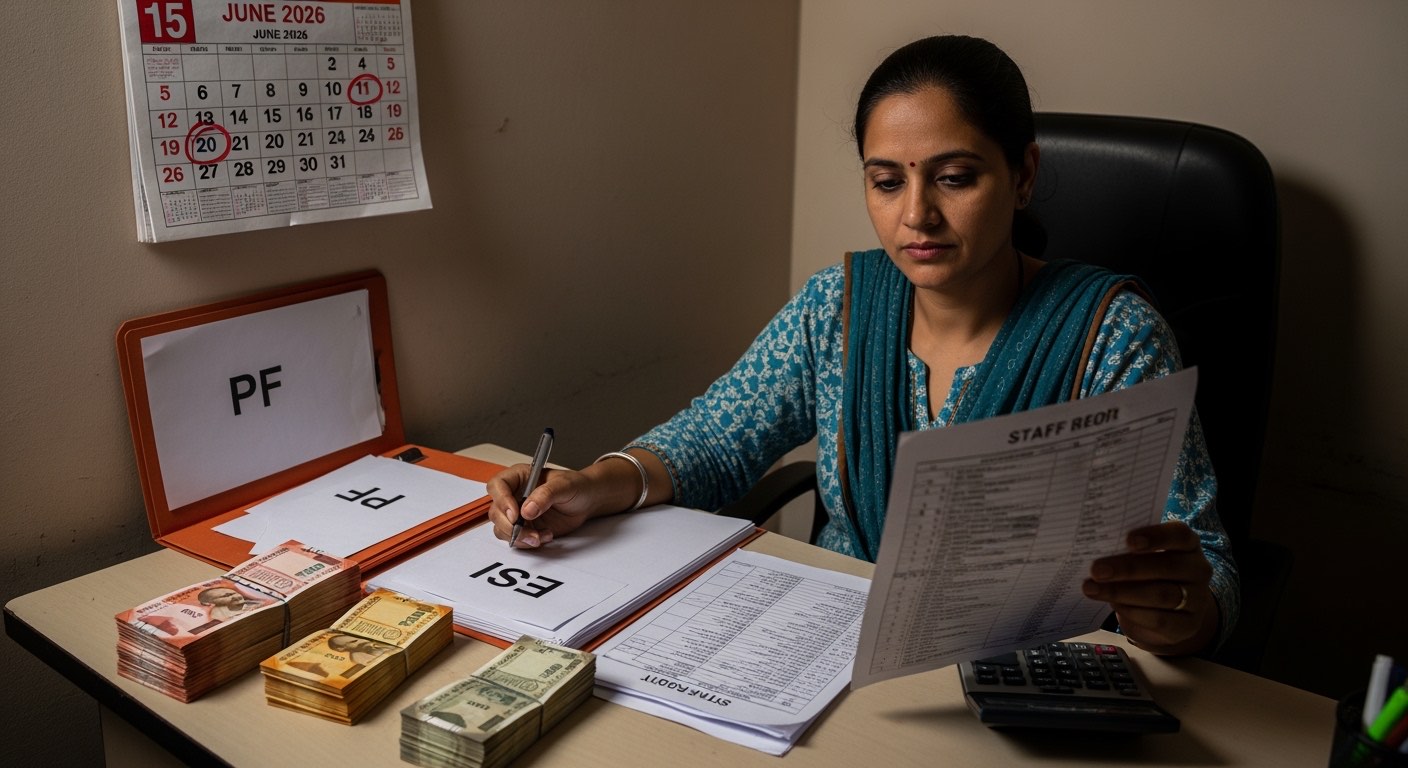
About this piece. PF and ESI registration is the single biggest payroll decision an Indian restaurant owner makes. Time it too early and you're carrying ~17.85% employer-side cost on every wage rupee from day one. Time it too late and you face inspection, arrears, interest, penalty. This piece walks through the headcount thresholds, the wage ceilings, the voluntary path, and the right time to flip from "not yet" to "yes, registered".
The two schemes in one paragraph each
Employees' Provident Fund (EPF / PF) is a mandatory savings scheme administered by the Employees' Provident Fund Organisation (EPFO). Both employee and employer contribute 12% of (Basic + DA) each month. The corpus is paid out at retirement, resignation (with conditions), or partial withdrawal for medical/housing/marriage. The Act is the Employees' Provident Funds and Miscellaneous Provisions Act, 1952.
Employees' State Insurance (ESI) is a contributory health and social security scheme run by the Employees' State Insurance Corporation (ESIC). Employee contributes 0.75%, employer contributes 3.25% of gross wages. Benefits include free medical care for employee + family, sickness benefit, maternity benefit, disability benefit. The Act is the Employees' State Insurance Act, 1948.
The thresholds that trigger registration
| Scheme | Headcount trigger | Wage ceiling for individual eligibility |
|---|---|---|
| PF | 20 or more employees | Mandatory if Basic + DA ≤ ₹15,000/month; voluntary above |
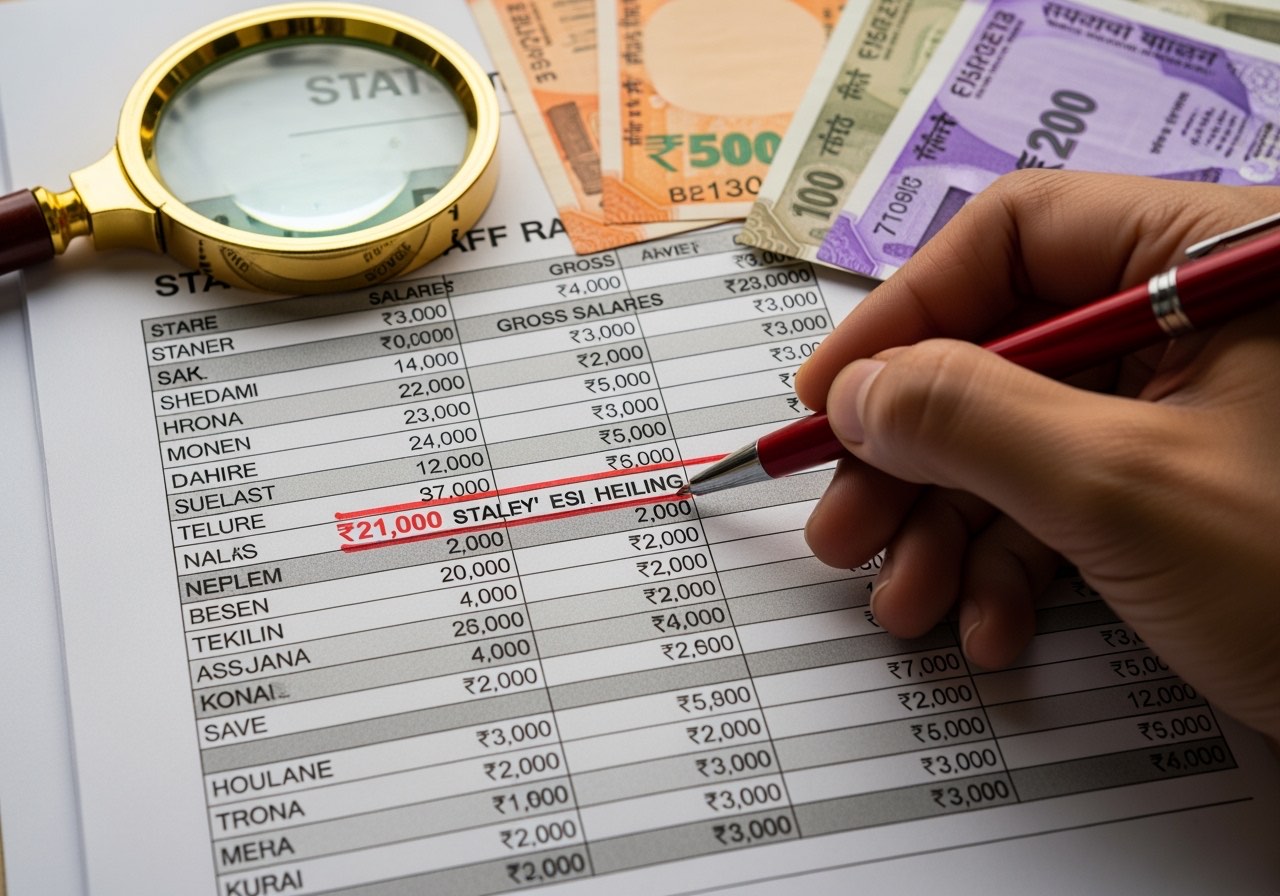
| ESI | 10 or more employees (some states), 20 in others | Mandatory if Gross ≤ ₹21,000/month; ₹25,000 for persons with disability |
Two layers operate together:
- The headcount layer triggers establishment registration. Cross 20 staff → register for PF. Cross 10 staff → check your state and register for ESI if applicable.
- The wage-ceiling layer decides which individual employees within a registered establishment are covered.
A 25-staff restaurant where every staff member earns > ₹21,000 gross is registered for ESI but covers nobody. Registration is establishment-level; coverage is wage-level.
The most common timing error: an outlet hires its 21st employee in July, registers PF in August, but the EPFO holds the registration date as the day headcount crossed 20. Arrears + interest + damages run from that date forward.
Headcount — what counts and what doesn't
EPFO and ESIC count differently. The defensible reading for restaurants:
| Person | Counts toward PF threshold? | Counts toward ESI threshold? |
|---|---|---|
| Permanent salaried staff | Yes | Yes |
| Probationer | Yes | Yes |
| Contract worker (paid by your outlet directly) | Yes | Yes |
| Apprentice under Apprentices Act | No | No |
| Trainee under formal training scheme | Sometimes — case-specific | Yes |
| Casual / daily wage labour > 3 days/month | Yes | Yes |
| Family member working without wages | No | No |
| Outsourced manpower (paid by agency, agency is employer) | No | No (agency must register) |
The trap: outsourced manpower agencies sometimes ask the restaurant to do their PF/ESI compliance. Refuse. The agency is the employer of record; their registration covers the workers. If you do their PF compliance, you've effectively assumed employer liability.
The contributions in detail
PF — both sides 12% of (Basic + DA), capped at ₹15,000 wage ceiling
Employee contribution = 12% × min(Basic + DA, 15,000)

Employer contribution = 12% × min(Basic + DA, 15,000)
                     where the 12% splits as:
                       8.33% → Employees' Pension Scheme (EPS), capped at 1,250/month
                       3.67% → EPF
                     plus additional charges:
                       0.50% → EDLI (Employee Deposit Linked Insurance)
                       ~0.50% → Admin charges (revised periodically)
ESI — 0.75% employee, 3.25% employer, on gross
Employee contribution = 0.75% × Gross  (only if Gross ≤ 21,000)
Employer contribution = 3.25% × Gross  (only if Gross ≤ 21,000)
Effective employer-side cost addition: ~17–18% on covered wages (PF + ESI + EDLI + admin).
The wage ceiling — what to do when staff cross it
When a staff member's gross crosses ₹21,000 mid-year, ESI deduction stops from the next contribution period. Two periods/year — Apr–Sep, Oct–Mar. The shift happens at period boundary.
When a staff member's Basic + DA crosses ₹15,000, PF can either:
- Continue at ₹15,000 cap (most employers' choice — keeps employer cost predictable)
- Continue at actual Basic + DA (some employers do this as benefit; both contributions scale with wage)
Pick a policy and apply uniformly to all staff. Mixing — capping for some and not others — invites EPFO scrutiny.
The cost of registering — and the cost of not
A worked example for a 25-staff outlet, average gross ₹17,000, average Basic ₹8,500:
| Line | Per month |
|---|---|
| Employer PF (12% × 8,500 × 25) | 25,500 |
| Employer ESI (3.25% × 17,000 × 25) | 13,813 |
| EDLI + admin (~0.5% + 0.5% × 8,500 × 25) | 2,125 |
| Total employer-side cost / month | 41,438 |
| × 12 | 4,97,256/year |
That's ₹5L/year of employer-side cost. Real. Not negotiable once registered.
The cost of NOT registering when you should have:
- Arrears of contributions from the trigger date — both employee and employer side, both schemes. The employee side cannot be recovered from staff retroactively; the outlet pays it.
- Interest at 12%/year on arrears.
- Damages: 25–100% of arrears (EPFO discretionary; usually 50%).
- Prosecution of the principal employer for wilful default.
For the same 25-staff outlet, 12 months of unregistered operation = ₹5L arrears + ₹60K interest + ₹2.5L damages = ~₹8L hit, all at once. Plus the inspector visit.
Voluntary registration — when it makes sense
Below the headcount threshold, registration is voluntary. The case for registering early:
- You're growing fast. If you'll cross 20 staff within 6–12 months, register now to avoid the ambiguous handover.
- You want to attract better staff. "We have PF" is a recruitment differentiator for kitchen staff coming from larger chains.
- You're raising debt or seeking institutional investors. They ask for compliant payroll. PF/ESI registration signals it.
The case against registering early:
- 17–18% employer load is real money. A 12-staff dhaba on ₹14,000 average gross adds ₹3L/year of employer cost. That's a meaningful margin hit.
- Voluntary registration is irreversible. Once registered, you cannot deregister just because headcount dropped. The compliance burden persists.
Rule of thumb: delay voluntary registration until you're 16–17 staff and growing. Below that, the cost is high and the benefit is low. Above that, the inspection risk overtakes the cost rationale.

The registration process — 4 steps
- PF — apply on the EPFO Unified Portal. Need PAN, GST, address proof, Form 5A (employer details), DSC. Approval is usually 7–15 working days.
- ESI — apply on the ESIC portal. Need similar documents plus a list of employees with wage details. Approval 5–10 working days.
- Generate UAN for each employee. PF requires Universal Account Number; ESIC issues an IP number.
- First contribution due: PF — 15th of the month following wage month. ESI — 15th of the month following contribution month.
Late deposit attracts interest + damages. Mark the 15th in the calendar in red.
The six monthly returns (don't skip)
| Return | Frequency | What it captures |
|---|---|---|
| ECR (Electronic Challan-cum-Return) | Monthly | PF contributions per UAN |
| Form 5 (PF) | Monthly | New joinees |
| Form 10 (PF) | Monthly | Exits |
| Form 12A (PF) | Monthly | Consolidated statement |
| ESI Monthly Contribution | Monthly | ESI contributions per IP |
| ESI Half-yearly Return | Apr–Sep, Oct–Mar | Reconciliation + employee details |
Most CA / payroll software handles these automatically. The owner just needs to ensure the underlying data — joinees, exits, wages — is accurate.
The 3-question decision framework
If you're trying to decide whether to register voluntarily right now:
- What's your 12-month headcount projection? If it crosses 20, register now.
- Can you absorb a 17–18% wage cost increase without raising menu prices? If yes, register opportunistically. If no, defer to threshold.
- Is there a recent inspection trigger? (Staff complaint, neighbouring outlet inspected, labour-department drive.) If yes, register defensively before the visit.
Related on Restaurant Daily
One operator playbook a week, in your inbox.
Cash close, petty cash, payroll, compliance, unit economics — sent every Monday morning. No spam, no upsell drip. Unsubscribe in one click.
Sent from noreply@restaurantdaily.ai. We never share your address.
Related reading
How to calculate restaurant staff salary in India — gross to net guide
How to calculate restaurant staff salary in India — gross to net, PF, ESI, advances, deductions, with a worked example for a 12-person outlet.
Tip pool distribution in Indian restaurants — fair models + CCPA rules
How Indian restaurants should distribute tips and service charge in 2026: 4 pool models compared, CCPA 2022 service-charge rules, and a defensible per-staff formula.
Salary advance format India — letter + ledger template (restaurant)
Free salary advance format for Indian restaurant staff. Request letter, owner ledger, recovery schedule, and the labour-law cap that stops the cycle going wrong.
Muster roll format for restaurants in India — free Excel + PDF (Form 25)
Free muster roll format for Indian restaurants — Form 25 Excel + printable PDF templates. Daily attendance, OT hours, statutory layout that passes labour audit.
Restaurant payroll software India — 7 tools compared (2026)
Restaurant payroll software India compared: KekaHR, GreytHR, RazorpayX Payroll, Zoho People, Petpooja Payroll, Restaurant Daily, manual. Pricing, fit, gaps.