Cafe daily ops checklist (India) — opening, mid-day, closing rituals for a 30-seater
A cafe daily ops checklist for a 30-seater Indian cafe — espresso prep, milk pars, opening/mid-day/closing rituals, and the four leakage points specific to cafes.
Last updated 9 Aug 2026
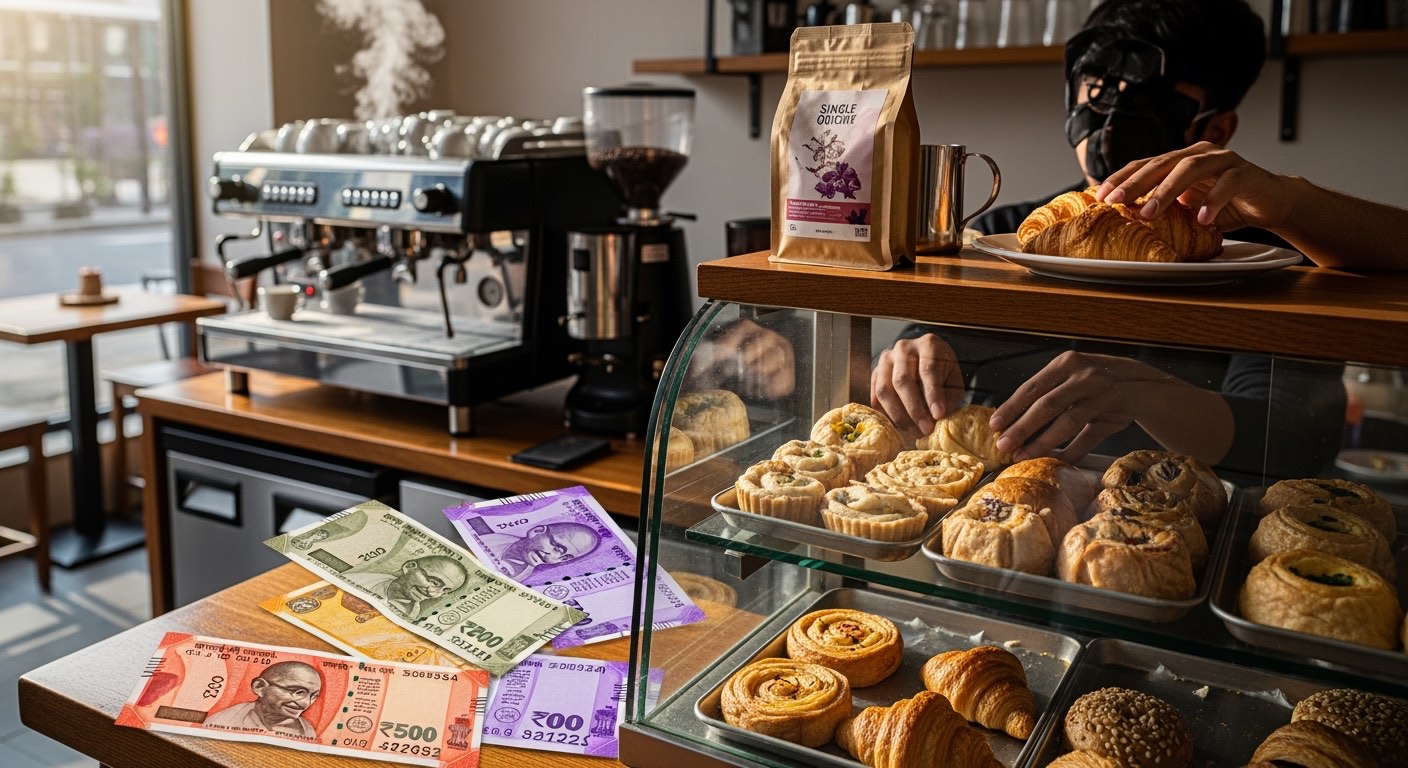
About this piece. A 30-seater Indian cafe is a different operating animal from a QSR or a dine-in restaurant — espresso machine warm-up windows, milk pars that sour by 4pm, single-origin beans that go stale in 14 days, and a customer who comes in for "one Americano and 2 hours of WiFi". This piece is a checklist tuned to that animal. Three rituals: opening, mid-day, closing. Plus the four leakage points cafes-specifically run into.
Why a cafe checklist isn't a generic restaurant checklist
A QSR optimises for throughput. A fine-dine optimises for table experience. A cafe optimises for two things at once: beverage consistency (the same flat white at 8am and 7pm) and ambient retention (people stay 90 minutes per cover, not 30). The checklist has to protect both.
Three operational facts drive everything below:
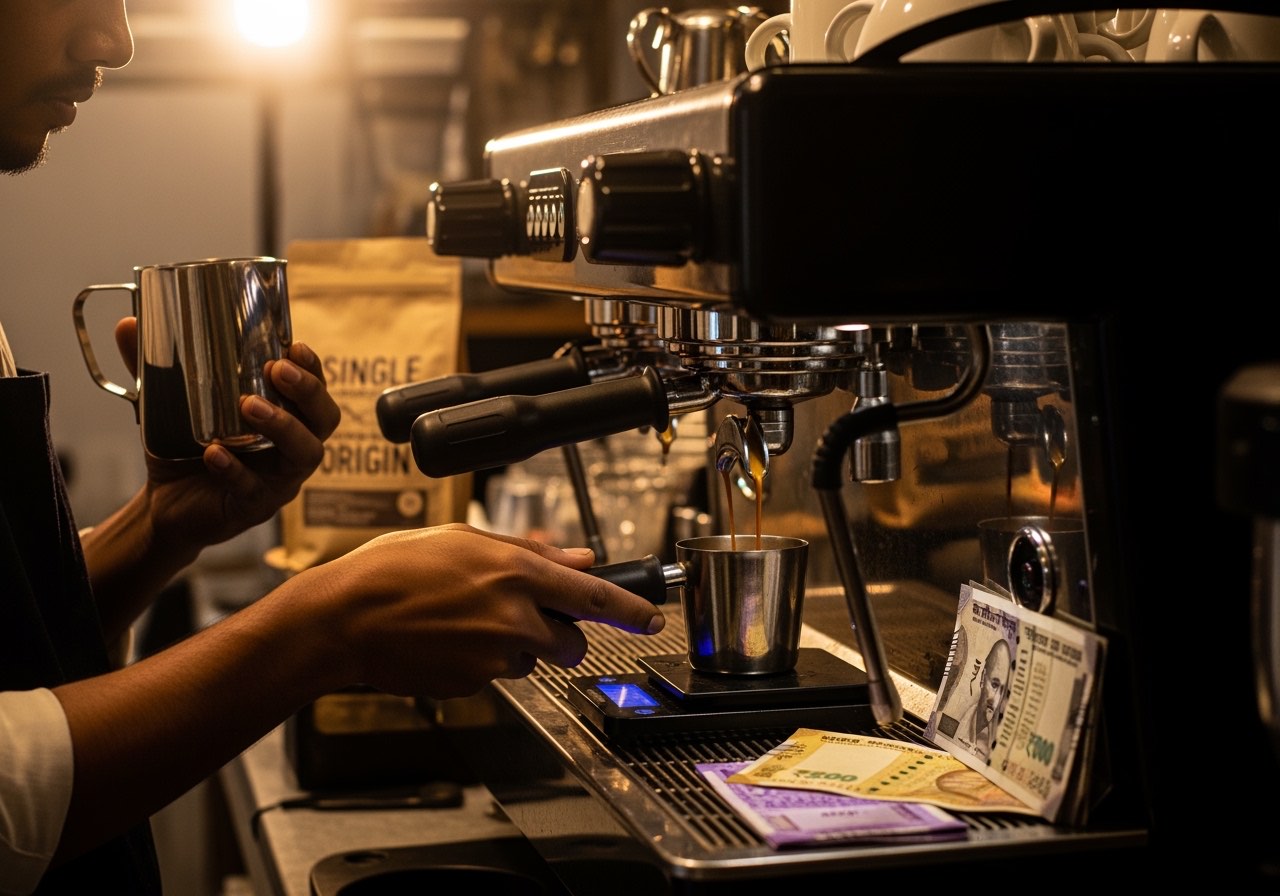
- Espresso machine warm-up is 25–30 minutes. From cold to pull-ready, with backflush and temperature stabilisation. If you open at 8am, machine on at 7:25am.
- Milk pars sour fast. Open packets in summer NCR have a real shelf-life of 6–8 hours, not the printed 24. Plan pars by half-day, not full-day.
- Bean staleness is a beverage-quality issue, not a waste issue. Opened bag of single-origin → 14-day window. After that, taste degrades before customers complain — they just stop coming back.
Opening ritual — 7:25am to 8:00am (35 minutes)
| Time | Task | Owner |
|---|---|---|
| 7:25 | Espresso machine on; group heads + steam wand backflush | Barista 1 |
| 7:30 | Grinder on, calibrate dose (18g → ~36g shot, 25–28s) | Barista 1 |
| 7:30 | Open till; verify imprest float = fixed amount | Cashier |
| 7:35 | Milk pars out of fridge into ice well — 4L full-fat, 2L toned, 1L oat | Barista 2 |
| 7:40 | Pastry display refilled from cold storage | Barista 2 |
| 7:45 | Test shot pulled, tasted, dialled in | Barista 1 |
| 7:50 | Music + WiFi check; tables wiped; menu boards correct | All |
| 7:55 | First customer-ready latte test pour (staff drink) | Barista 1 |
| 8:00 | Open | All |
Skip the test shot, and the first paying customer of the day is your QC sample. Don't do this. The 30 seconds of a discarded test shot saves the relationship with the customer who pays ₹250 for a flat white and gets sour grounds.
Mid-day ritual — 1:00pm to 1:30pm (the reset)
The 1pm reset is what separates a cafe that holds up at 6pm from one that doesn't. At 1pm:
- Backflush group heads — even on a busy day. 3 minutes total. Skipping this means by 5pm the espresso tastes burnt.
- Grinder dose re-check — humidity changes through the day; the 18g dose at 8am may pull 16.5g at 1pm. Re-zero, re-dose.
- Milk pars top-up — half the morning par is gone. Fresh 4L full-fat into the well; the half-empty packets refrigerated, not re-warmed.
- Pastry rotation — what's left from morning gets top-shelf placement (sells faster); fresh batch goes mid-shelf.
- WiFi router quick reboot — yes, every day. NCR cafes routinely lose half their afternoon traffic to slow WiFi between 2pm and 4pm because the router has been up 18 hours.
- Mid-day cash sweep — cashier counts till against opening float + morning POS sales. ±₹100 acceptable; investigate if outside.
Mid-day reconciliation:
  Expected = Opening float + Morning cash sales − Morning petty spend
  Counted vs Expected → variance ≤ ±₹100 = green
Closing ritual — 9:30pm to 10:00pm (30 minutes)
Closing is half operational, half handoff to tomorrow.
- Last order called at 9:30 — communicated to seated customers politely. No new orders after 9:35.
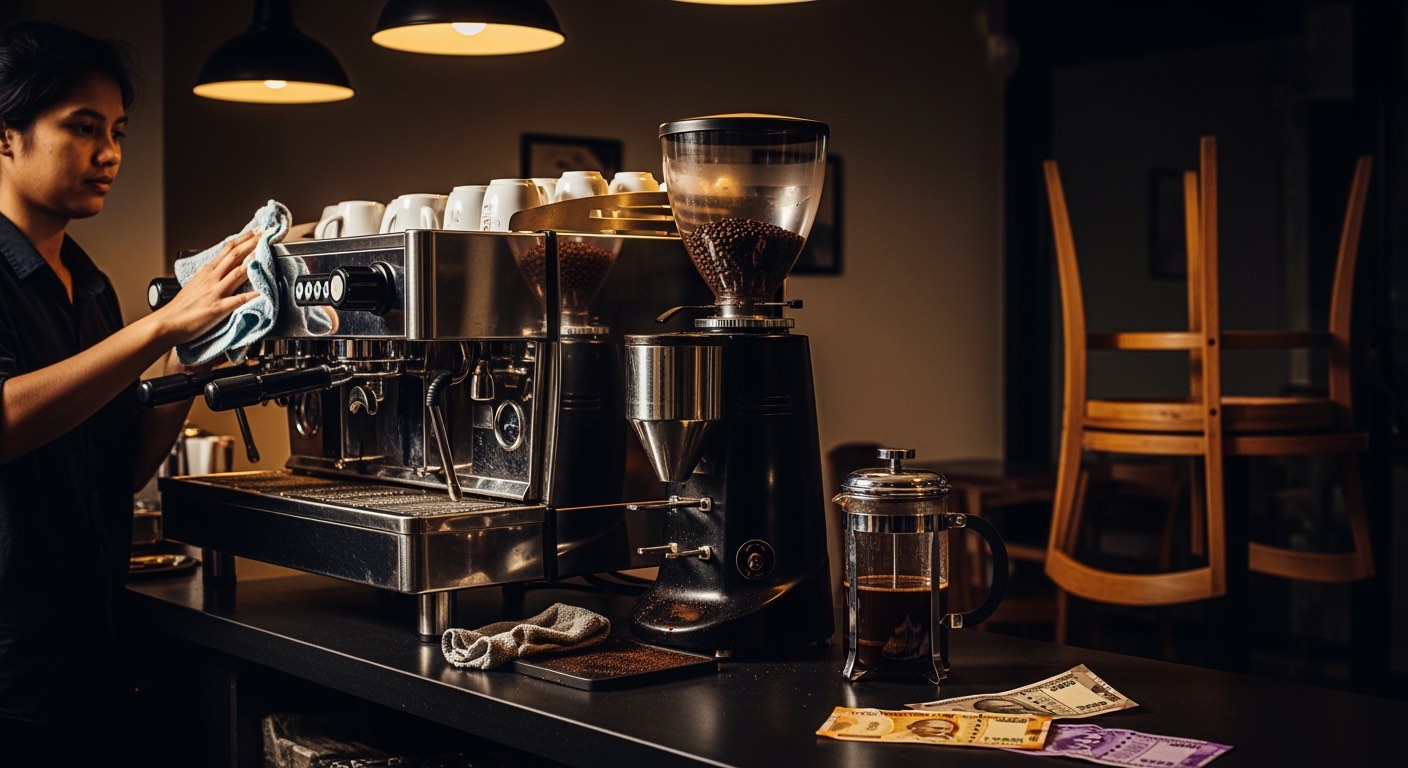
- Espresso machine cleanup — backflush with cleaning tablet, descale check, group head gaskets inspected.
- Grinder cleanup — run the brush; once a week deep-clean with grinder cleaner (Cafiza or similar).
- Milk fridge audit — open packets that are >12 hours stay refrigerated only if planned for tomorrow's cooking (paneer dishes, sauces) — not tomorrow's coffee. Tomorrow's first pours need fresh milk.
- Bean hopper empty — leftover beans back to airtight container; hopper has to be empty overnight.
- DSR + PCV close — 5-minute end-of-day reconciliation (DSR template).
- Pastry waste log — what got binned, what got staff-meal'd. Without this log, you can't tune tomorrow's pastry order.
- Tomorrow's prep list — single-origin beans for tomorrow taken out of cold (24-hour rest before grinding), milk order placed for delivery 6am.
The discipline that holds a cafe is the closing list, not the opening list. Skip the closing list and the opening list takes 50 minutes instead of 35 — every day, forever.
Four leakage points specific to cafes
These don't show up in QSR or dine-in checklists. They are cafe-specific.
1. Single-origin bean wastage from over-ordering
A 1kg bag of single-origin opened on Monday and finished by following Wednesday is fine. Same bag opened Monday and still 30% full the next Monday — those last 300g are stale. You'll either bin it (waste) or serve it (worse — customer churn). Rule: order to a 10-day window, not a 30-day discount.
2. Milk-cost creep through "the latte upgrade"
A standard latte at ₹220 uses 180ml whole milk → ~₹15 milk cost. Same drink with oat milk at "+₹40" — but oat milk costs ₹140/litre vs whole milk ₹62/litre. Your COGS on the upgrade is ₹14, not ₹40. The upgrade still makes sense, but if 30% of orders are oat upgrades and you priced the original drink assuming 8% upgrades, your margin model is off.
3. The 90-minute single-Americano table
Cafes don't have to push tables — but they have to know their economics. A ₹180 Americano at 90 minutes = ₹2/minute. A ₹450 brunch + ₹220 coffee at 60 minutes = ₹11/minute. If your cafe is 70% laptop-on-Americano, you have a slow-revenue mix. Not a problem if rent and footfall support it; a problem if they don't. Track it once a quarter; don't moralise about it.
4. The "barista special" off-menu cost
Baristas love to make off-menu drinks for regulars. This is great for retention. It's a leakage if those drinks aren't in the POS. Either price them and put them in the POS as "barista picks" with a fixed ₹X price, or accept the comp as marketing — but log it.
The 5-minute owner pulse (daily)
Owners don't need to walk the cafe; they need 5 minutes of daily data. The pulse:
| Metric | Source | Threshold |
|---|---|---|
| Total covers | POS | vs 7-day avg ±15% |
| Beverage : food ratio | POS | 60:40 typical for Indian cafe |
| Avg ticket | POS | vs 30-day avg ±10% |
| Cash variance (DSR) | DSR sheet | within ±₹100 |
| Wastage log entries | Closing checklist | non-zero on perishables |
If all five are green, no action. If any one is amber, a single WhatsApp to the cafe manager. The pulse takes 2 minutes to read; the discipline of looking at it daily is what keeps a 30-seater profitable.

What to do this week
Print the three checklists (opening, mid-day, closing) on a single A4 sheet, laminate it, stick it inside the back-counter cupboard. For the next 14 days, the closing barista signs the closing list before leaving. After 14 days the checklist is muscle memory — you can stop the signing — but the laminated sheet stays.
Related on Restaurant Daily
One operator playbook a week, in your inbox.
Cash close, petty cash, payroll, compliance, unit economics — sent every Monday morning. No spam, no upsell drip. Unsubscribe in one click.
Sent from noreply@restaurantdaily.ai. We never share your address.
Related reading
Tier-2 Indian city restaurant daily ops — what changes vs metro (staffing, supply, margins)
Tier-2 Indian city restaurant daily ops vs metro — what changes in staffing, supply chain reliability, ticket size, and margins. Operator-grade comparison and adjustments.
Fine-dine vs QSR operations in India — staffing, inventory cycles, margin maths
Fine-dine vs QSR operations in India compared — staffing ratios, inventory cycle, prep time, margin maths, and why running one like the other quietly destroys margin.
Restaurant pre-opening checklist (India) — 84 items, 90 days
Restaurant pre-opening checklist for India — 84-item checklist across licences, fit-out, hiring, supply, soft launch. Day-by-day, 90-day operator playbook.
Soft launch vs grand opening for restaurants in India — sequencing
Soft launch vs grand opening for restaurants in India — sequencing, media plan, when to switch. Operator-grade playbook covering the 21 days from quiet open to full visibility.
Food trial run before restaurant launch — friends & family protocol
Food trial run before restaurant launch in India — friends-and-family menu testing protocol, scoresheets, and what to actually fix between session 1 and opening night.