Petty cash voucher format India — free Excel + Google Sheets template
Petty cash voucher format for Indian restaurants — 9 fields covering Income Tax Rule 6DD + GST input credit. Free Excel, Google Sheets, and printable PDF templates.
Reviewed by Gaurav Rao (founder review pending pre-publish).
Last updated 9 Aug 2026
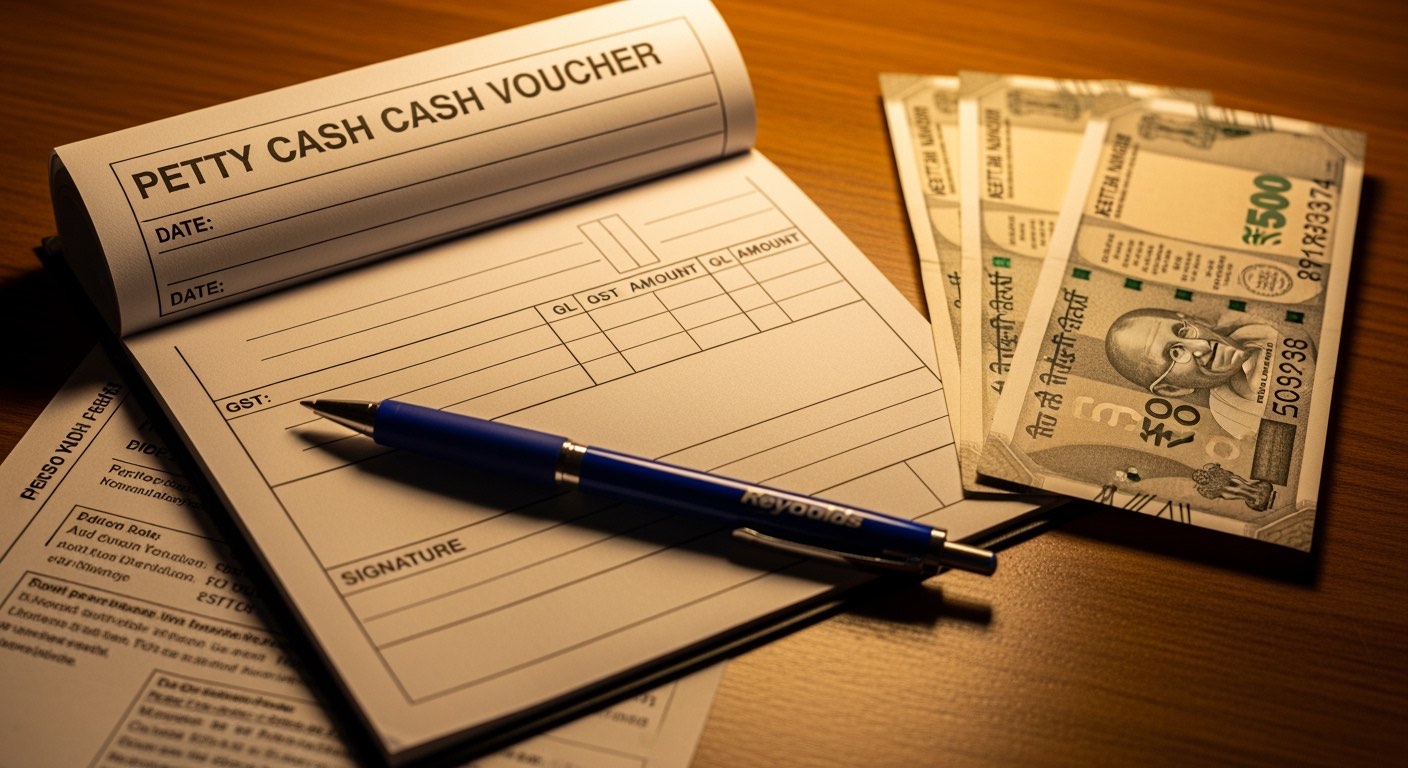
About this piece. Most Indian restaurant petty-cash vouchers I've seen across NCR operator networks are written on whatever paper was nearest to the till. The amount is there, sometimes the date, rarely the GL category, almost never a signature. This piece gives you a format that meets Income Tax + GST record-keeping needs, fits on one half-sheet, and is fast enough that a tired cashier at 11pm will actually fill it. Download links at the bottom — free, no email gate for the template itself.
Why the petty cash voucher exists (in 60 seconds)
A petty cash voucher (PCV) is the audit trail for every small cash payment made from the till — the dhaniya from the vegetable vendor, the auto fare to fetch a missing ingredient, the bottle of soap for the wash area. Three rules govern it:
- Income Tax Rule 6DD. Cash payments above ₹10,000 to a single party in a single day are disallowed as business expenses. PCVs document the per-payment amount and the recipient, which is what you'll need if the assessing officer asks.
- GST input credit. If your vendor is GST-registered and you want to claim input credit on the purchase, the PCV needs the vendor's GSTIN, the invoice/bill reference, and the GST amount split. Without it, the input credit is uncollectible.
- Owner P&L hygiene. Without a GL category on the voucher, every PCV becomes "miscellaneous" — and a P&L where 8% of expenses is "miscellaneous" can't be read.
So the voucher has to serve three masters at once: the assessing officer, GSTR-3B, and your own P&L. The format below does that on one half-sheet.
The 9 fields that matter
A petty cash voucher in India should capture:
| # | Field | Why |
|---|---|---|
| 1 | Voucher number (sequential) | Audit trail; matches DSR end-of-day |
| 2 | Date | Mandatory; expense claim period |
| 3 | Paid to (name + address) | Income Tax Rule 6DD |
| 4 | Vendor GSTIN (if registered) | GST input credit |
| 5 | Amount in ₹ (figures + words) | Anti-tampering; standard practice |
| 6 | GST split (if applicable) | GSTR-3B input |
| 7 | GL category | P&L readability |
| 8 | Bill / invoice reference (Y/N + ref no.) | Audit + GST claim |
| 9 | Cashier + recipient signatures | Anti-disputes |
A 10th optional field — purpose / 1-line description — is useful for the owner's Sunday review; not strictly required for compliance.
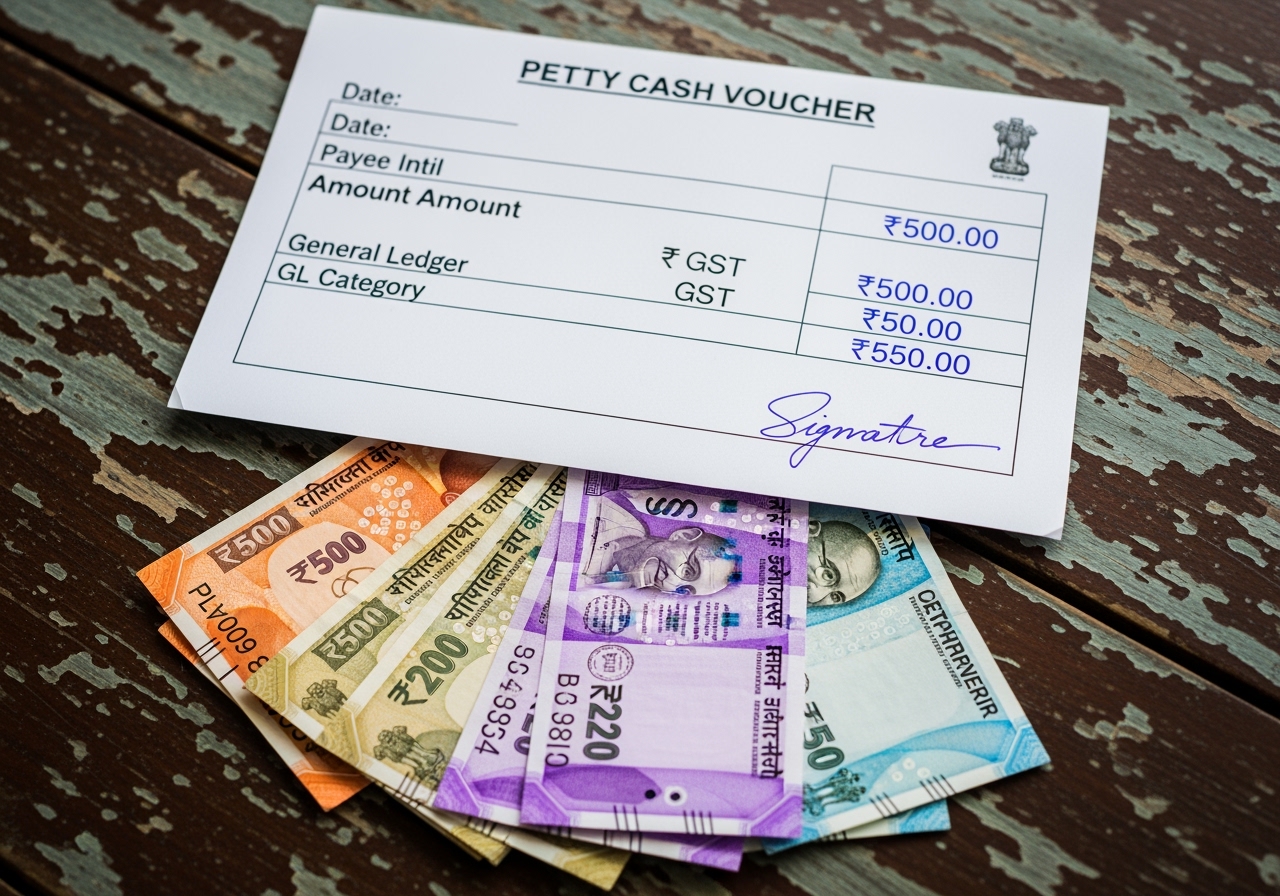
The format (one half-sheet, printed in pads of 50)
┌────────────────────────────────────────────────────────────┐
│  PETTY CASH VOUCHER                                         │
│  [Outlet name + address]                                    │
│                                                             │
│  Voucher No: ___________      Date: ____ / ____ / ______    │
│                                                             │
│  Paid to: ________________________________________________  │
│  Address: _______________________________________________   │
│  GSTIN (if registered): ______________________________      │
│                                                             │
│  GL Category:  □ Food / Ingredients   □ Cleaning            │
│                □ Repairs              □ Utilities           │
│                □ Staff welfare        □ Petrol / Transport  │
│                □ Other (specify): ____________________      │
│                                                             │
│  Amount in figures: ₹ ___________                           │
│  Amount in words:  Rupees __________________________ only   │
│                                                             │
│  GST split (if claimable):                                  │
│    Base ₹ ______   CGST ₹ ______   SGST ₹ ______            │
│                                                             │
│  Bill / invoice ref attached? □ Yes  Ref no: ___________    │
│                                □ No  (reason: __________)   │
│                                                             │
│  Purpose: _______________________________________________   │
│                                                             │
│  Cashier signature: _____________   Recipient signature:    │
│                                     ________________        │
└────────────────────────────────────────────────────────────┘
That's the printable format. The downloadable templates implement the same fields in:
- Excel (.xlsx) — one row per voucher; auto-sum + auto-category-totals at the bottom; conditional formatting flags amounts > ₹10,000 as "Rule 6DD watch"
- Google Sheets — same as Excel; shareable link works for multi-cashier outlets
- PDF pad — print 50 per outlet, A6 size, two-up on A4
Download links are at the bottom of this piece.
Three mistakes that make the voucher useless
I've reviewed a couple of hundred PCV stacks across operator networks. The same three mistakes turn up repeatedly:
- Voucher number not sequential. If your voucher numbers reset every shift, or skip, you can't reconcile to the DSR. Sequential across the month — that's the rule. Roll over the pad at end-of-month.
- GL category left blank. If 30% of vouchers don't have a category, your P&L "miscellaneous" line is doing too much work. The cashier ticks one box at the time of filling. If "Other" is being ticked more than 10% of the time, your category list needs a new option.
- Recipient signature missing. This is the one that actually breaks during an audit. A voucher without a recipient signature is a piece of paper from one person to themselves — it's not evidence of payment. Two-signature rule: cashier + recipient. Always.
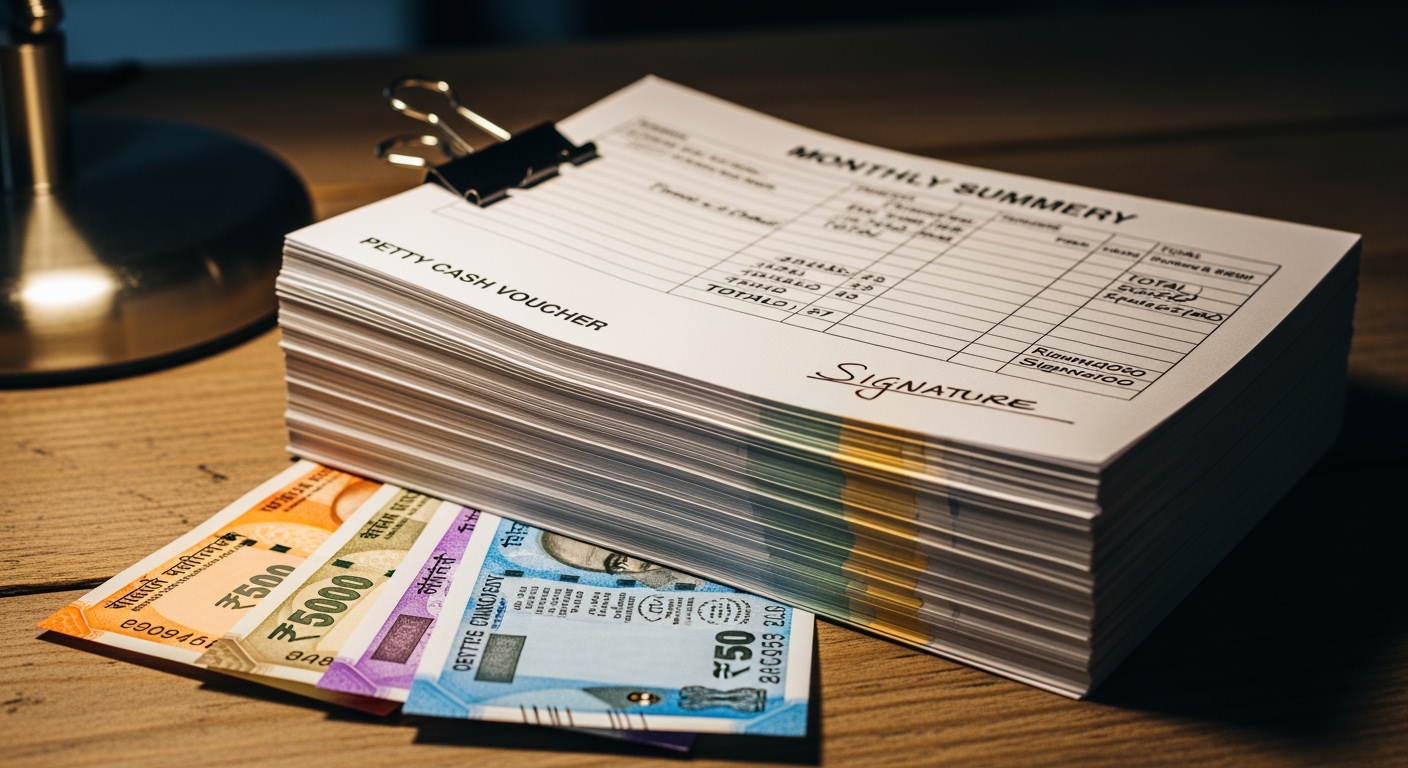
How the voucher fits the daily-ops loop
End of shift:
- Cashier counts cash + sums vouchers in the drawer. Total should equal the imprest float (more on imprest here).
- Voucher stack is rubber-banded with a cover sheet showing date + total ₹ + total count.
- Next morning, manager / owner counts the stack, replaces with float top-up cash.
- Vouchers go into the month's PCV bundle, filed by date. End of month, bundle goes to the accountant for GST + Income Tax filings.
The whole loop takes about 60 seconds at end of shift and 5 minutes at top-up. The discipline lives in the format. If the format is right, the loop runs itself.
Where this fits with the rest of cash management
The PCV is one of three documents that close the daily-cash loop:
- Imprest cash float — the fixed working float against which vouchers are counted (read the spoke)
- Petty cash voucher — the audit trail for each cash spend (this piece)
- Daily cash register / DSR — the day's consolidated cash ledger (upcoming P1 hub)
Get all three running and your cash-handling discipline is in the 90th percentile of Indian SMB restaurants — without any software. That's the foundation Restaurant Daily builds on; if you choose not to use software, the discipline still holds.
Download
- Excel template — coming with publish
- Google Sheets template — coming with publish
- PDF pad (print + photocopy) — coming with publish
- Hindi labels overlay — coming, after Hindi editor onboard
No email required to download. If you want the rest of the cluster — DSR template, salary advance ledger, weekly margin sheet — drop us a line and we'll send each one as it ships.
One operator playbook a week, in your inbox.
Cash close, petty cash, payroll, compliance, unit economics — sent every Monday morning. No spam, no upsell drip. Unsubscribe in one click.
Sent from noreply@restaurantdaily.ai. We never share your address.
Related reading
Rule 6DD restaurant — when ₹10,000 cash limit applies (and doesn't)
Rule 6DD restaurant guide — when the ₹10,000 single-day cash limit applies under §40A(3), exceptions, daily-ops impact, and the workflow that keeps you safe.
Cashier accountability form — free template for Indian restaurants
Cashier accountability form for Indian restaurants — free declaration template + how to deploy it without alienating staff. Operator-grade controls.
GST petty cash expense for restaurants — input credit, RCM, Rule 6DD
GST on petty cash expense for Indian restaurants — what you can claim as input credit, when reverse charge kicks in, and how Rule 6DD interacts with cash spends.
पेटी कैश वाउचर फॉर्मेट — Hindi में free Excel + printable PDF
भारतीय रेस्टोरेंट के लिए पेटी कैश वाउचर फॉर्मेट हिंदी में — 9 ज़रूरी फ़ील्ड्स, Income Tax Rule 6DD + GST input credit, free Excel/Sheets/PDF template.
Petty cash limit company policy — single-page template for restaurants
Petty cash limit company policy template for Indian restaurants — what limits to set per voucher, per category, per month. Single-page, free, ready to deploy.