Cashier accountability form — free template for Indian restaurants
Cashier accountability form for Indian restaurants — free declaration template + how to deploy it without alienating staff. Operator-grade controls.
Last updated 9 Aug 2026

About this piece. A cashier accountability form is a one-page declaration the cashier signs before taking custody of the float. It's not a punishment document and it's not a substitute for trust — it's a clarity document that says exactly what the cashier is responsible for, what the variance threshold is, and what happens if the threshold is breached. Done well, it reduces friction with staff because it removes ambiguity. Done badly, it creates an adversarial environment that costs you good cashiers. This piece gives you the format and the deployment script.
Why most operators don't have one (and why that's expensive)
In our conversations with single- and multi-outlet operators, the most common pattern is no formal cashier accountability document at all. The cashier takes the till, runs the shift, hands back what's there, and any variance is handled informally — sometimes a stern conversation, sometimes ignored, sometimes deducted from salary without explanation.
Three problems with the informal pattern:
- No predictable consequence for variance. A ₹100 short on Monday might be ignored; a ₹100 short on Friday might trigger a salary deduction. The cashier can't tell which is coming.
- No protection for the cashier. If the float was ₹3,000 at handover but the cashier remembers it being ₹2,800, there's no signed evidence either way.
- Disputes escalate. Without a written agreement, a ₹500 variance becomes a he-said-she-said that ends in a resignation. Replacing a trained cashier costs 2–4 weeks of training time and a learning curve.
The accountability form solves all three by being explicit, signed at start of custody, and referenced consistently for variance handling.
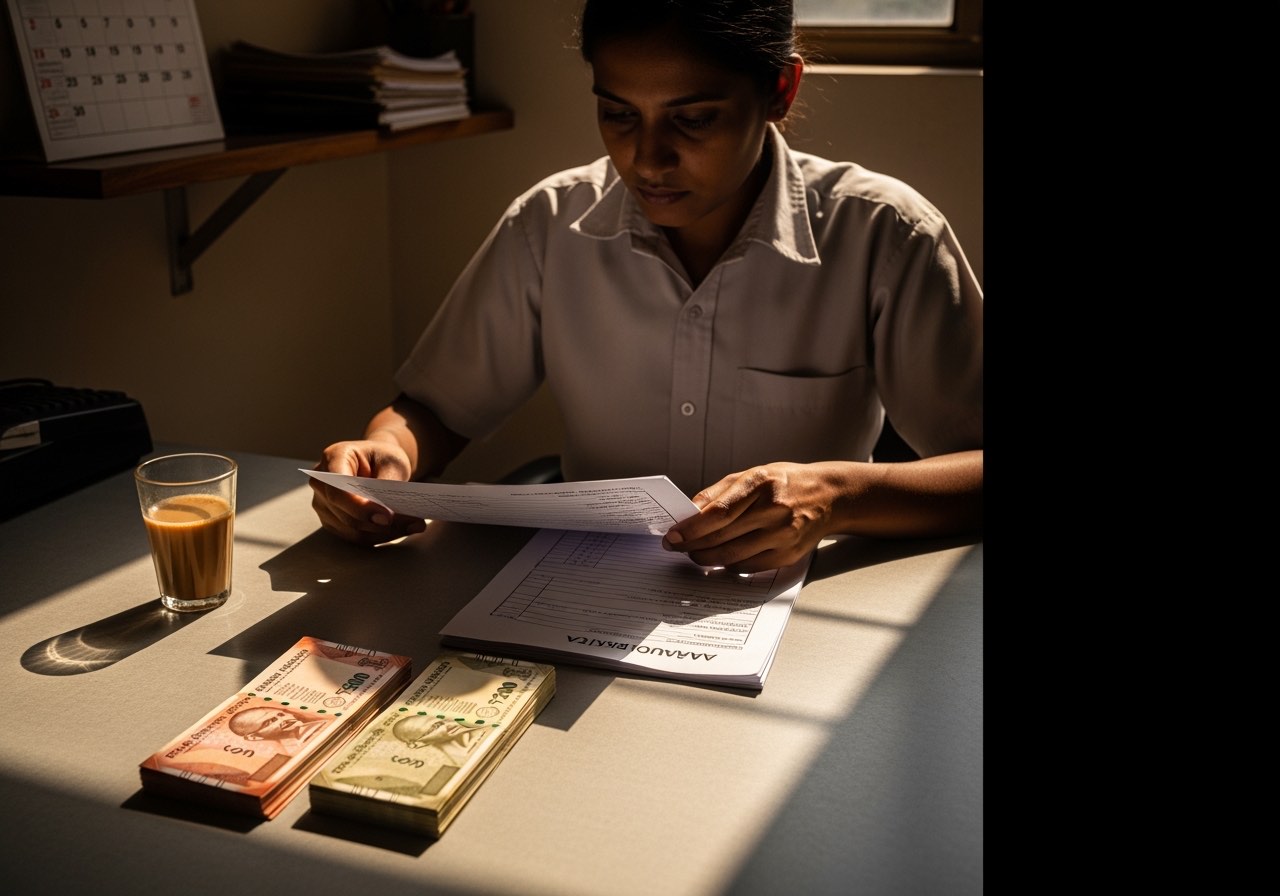
What the form does and what it doesn't
What it does. Names the cashier, the outlet, the float amount, the start date. Lists the specific responsibilities (count at start, reconcile at end, voucher discipline, handover protocol). States the variance tolerance band and the escalation pattern. Captures cashier and manager signatures.
What it doesn't do. It is not a salary deduction authorisation. It is not a contract change. It is not a confession-of-guilt template for future variances. Operators who try to make it any of those things end up in disputes — sometimes Industrial Disputes Act disputes — they didn't expect.
The form is a clarity instrument, not a punishment instrument.
The 7 sections of the form
| # | Section | What it captures | Why it's there |
|---|---|---|---|
| 1 | Identification | Cashier name, employee ID, outlet, date | Audit trail |
| 2 | Float assignment | PCH amount, denomination breakdown at handover | Both-side reference number |
| 3 | Responsibilities | Open-count, end-count, reconciliation, voucher rules | Clarity on the job |
| 4 | Variance tolerance | Band within which no action; band beyond which review | Predictability |
| 5 | Reporting protocol | Who to inform, how, by when, for what | Removes guesswork |
| 6 | Custody handover | What happens at shift change, leave, resignation | Clean transitions |
| 7 | Signatures + acknowledgement | Cashier + manager + date | Evidence |
The form is one A4 page, plain language (Hindi/English depending on outlet), and signed in duplicate — one copy in the cashier's file, one copy posted in the back office.
The format
┌──────────────────────────────────────────────────────────────────┐
│  CASHIER ACCOUNTABILITY DECLARATION                               │
│  [Outlet name + address]                                          │
│                                                                   │
│  Cashier name: ________________________  Employee ID: __________  │
│  Effective from date: ____ / ____ / ______                        │
│                                                                   │
│  1. FLOAT ASSIGNED                                                │
│  PCH amount: ₹ _________ (Rupees ___________________ only)        │
│  Denomination breakdown at handover:                              │
│   ₹500 × ___   ₹200 × ___   ₹100 × ___   ₹50 × ___   ₹20 × ___    │
│   ₹10 × ___   ₹5 × ___   Coins: ₹ ____                            │
│                                                                   │
│  2. RESPONSIBILITIES                                              │
│  I confirm I have read and understood the following:              │
│   □ Open-count: I count the float at start of my shift            │
│   □ End-count: I count cash + sum vouchers at end of my shift     │
│   □ Reconciliation: (cash + vouchers) must equal PCH at end       │
│   □ Voucher discipline: every cash spend = a signed PCV           │
│   □ Top-up: only against voucher value, not by request            │
│                                                                   │
│  3. VARIANCE TOLERANCE                                            │
│  Tolerance band:  ±₹50  No action; documented in shift log        │
│  Review band:     ±₹51 to ±₹500  Manager review next day          │
│  Escalation:      Above ±₹500  Owner review + written explanation │
│  Repeat shorts:   3 in 30 days within review band → owner review  │
│                                                                   │
│  4. REPORTING PROTOCOL                                            │
│  Variance > ±₹50: report to manager same shift, in writing,       │
│  on the back of the day's PCV bundle.                             │
│                                                                   │
│  5. CUSTODY HANDOVER                                              │
│  At shift change / leave / resignation, float is counted in the   │
│  presence of the manager and the incoming cashier (if any).       │
│  Both sign the handover sheet. PCH must equal labelled value.     │
│                                                                   │
│  6. ACKNOWLEDGEMENT                                               │
│  I understand this declaration is for clarity of responsibility   │
│  and is not a salary deduction authorisation. Any deduction       │
│  follows the procedure under [outlet's HR policy / employment     │
│  letter]. I retain the right to dispute any variance attributed   │
│  to me, and to provide explanation in writing.                    │
│                                                                   │
│  Cashier signature: _________________      Date: ____ / ____      │
│  Manager signature: _________________      Date: ____ / ____      │
└──────────────────────────────────────────────────────────────────┘
This is a one-page form. Print on the outlet letterhead. Two copies, both signed. One in the cashier's file, one posted on the back-office board (with the float amount visible — that's part of the discipline).
The deployment script — how to introduce this without alienating
The form fails when it's introduced badly. The most common bad pattern is sliding it in front of a long-tenured cashier with no context — "sign this." Predictable result: insulted cashier, suspicion about why now, possible resignation.
The script that works:
- Introduce it as a clarity tool, not a control tool. "Hum sab cashiers ke saath ek standard process le rahe hain — sabke liye clear ho ki responsibility kya hai aur variance ke time kya hota hai. Tumhe sign karna hai aur ek copy tumhare paas rahegi."
- Frame the variance band as protective. Most cashiers are more afraid of being unfairly accused than of being held accountable. The ±₹50 no-action band is a protection: a small variance won't trigger anything. Make this point explicitly.
- Sign it together. Manager signs first. Cashier signs second. Both copies stay together until both sign.
- Post it in the back office. Visible, not hidden. Makes the process feel transparent, not punitive.
- Reference it consistently. When a variance happens, walk to the form. "Form mein likha hai — ₹50 tak no action, ₹500 tak manager review." The form does the talking.
The single biggest test: if the cashier could see this form before joining and would still take the job, the form is right. If they'd hesitate, the variance bands are too tight or the language is too punitive. Adjust.

What variance band to set
The ±₹50 no-action band in the template is a starting point for typical SMB restaurants in India. Adjust based on:
- Volume. A 100-cover dinner outlet handling ₹40,000+ in cash a shift can reasonably accept ±₹100. A 20-cover cafe handling ₹3,000 should be ±₹30.
- Cash-mix. Outlets with high UPI share have lower cash variance risk; the band can be tighter on absolute ₹.
- Cashier tenure. A new cashier in their first 30 days deserves a slightly wider band; tighten after the probation period.
The review and escalation bands in the form scale roughly 10× and 50× the no-action band. Don't set them as percentages of revenue — variance is about cash handling discipline, not revenue size.
Variance handling — the other side of the form
The form names the bands. The handling at the bands is where most operators slip. Three rules:
- No-action band. Document on the shift log. Don't deduct. Don't lecture. The discipline is in the documentation, not the consequence.
- Review band. Manager and cashier sit down within 24 hours. Review the day's vouchers. Most ₹100–₹300 shorts trace to a missing voucher, a mis-counted denomination at handover, or a customer change error. Find the cause. Document. Move on.
- Escalation band. Owner involvement. Written explanation from the cashier. If a pattern emerges (3rd time in 30 days), the conversation moves from "this happened" to "what's the systemic fix" — sometimes that's tighter handover, sometimes a different shift assignment, sometimes a cashier change.
Salary deduction for cash variance is a hard topic in India — the Payment of Wages Act, 1936 places restrictions on what employers can deduct. Don't try to authorise deductions through this form. If a deduction is genuinely warranted, run it through your HR consultant or CA per your employment terms, not via a one-page declaration.
The legal posture — what this form is and isn't
The accountability form is not:
- A contract or contract amendment
- A salary deduction authorisation under the Payment of Wages Act, 1936
- A confession of liability
- A waiver of any statutory right
It is:
- A signed acknowledgement of role and procedure
- Evidence of float amount at handover
- A reference document for variance handling protocol
If you want any of the things in the "is not" list, those need to be in the employment letter or a separate document, drafted with HR/legal input. Don't overload the accountability form.
Multi-cashier outlets — the handover sheet
Outlets with shift changes (lunch shift cashier different from dinner shift cashier) need a companion document — the handover sheet. One line per handover, both signed:
| Date | Time | Outgoing cashier | Incoming cashier | Float ₹ | Variance | Both sign |
|---|---|---|---|---|---|---|
| ____ | ____ | __________ | __________ | ______ | ______ | __ / __ |
This sits in the back office on a clipboard. Every handover, both cashiers count, both sign. The accountability form references this sheet — see Section 5.

Where this fits with the rest of petty cash discipline
The accountability form is the staff-facing artefact for the cash discipline you're already running:
- Float you've sized — see how much petty cash to hold
- Voucher format — see petty cash voucher format India
- Audit cadence — see petty cash audit checklist (12-point quarterly)
Without the form, the discipline lives in the manager's head and breaks when the manager isn't present. With the form, the discipline is documented, visible, and signed — by both sides.
What to do this week
Print the form on outlet letterhead. Sit with each existing cashier this week, in 15-minute slots. Walk through the form using the deployment script. Sign in duplicate. Post the manager copy on the back office board. From there, every variance conversation has a reference document.
Related on Restaurant Daily
- Petty cash voucher format India — free template — the voucher the form references
- Petty cash audit checklist — 12-point quarterly — the audit that uses the form's bands
- Imprest vs floating petty cash systems — the system the form supports
One operator playbook a week, in your inbox.
Cash close, petty cash, payroll, compliance, unit economics — sent every Monday morning. No spam, no upsell drip. Unsubscribe in one click.
Sent from noreply@restaurantdaily.ai. We never share your address.
Related reading
Petty cash voucher format India — free Excel + Google Sheets template
Petty cash voucher format for Indian restaurants — 9 fields covering Income Tax Rule 6DD + GST input credit. Free Excel, Google Sheets, and printable PDF templates.
Petty cash limit company policy — single-page template for restaurants
Petty cash limit company policy template for Indian restaurants — what limits to set per voucher, per category, per month. Single-page, free, ready to deploy.
Imprest vs floating petty cash — which fits a single-outlet restaurant
Imprest vs floating petty cash systems compared for Indian restaurants. Reconcilability, control overhead, fit by outlet size — with the rule for which to choose.
Petty cash leakage prevention — 8 patterns Indian restaurants miss
Petty cash leakage prevention for Indian restaurants — 8 leakage patterns we see again and again, with the specific control fix for each. Operator-grade.
Rule 6DD restaurant — when ₹10,000 cash limit applies (and doesn't)
Rule 6DD restaurant guide — when the ₹10,000 single-day cash limit applies under §40A(3), exceptions, daily-ops impact, and the workflow that keeps you safe.