Imprest vs floating petty cash — which fits a single-outlet restaurant
Imprest vs floating petty cash systems compared for Indian restaurants. Reconcilability, control overhead, fit by outlet size — with the rule for which to choose.
Last updated 9 Aug 2026
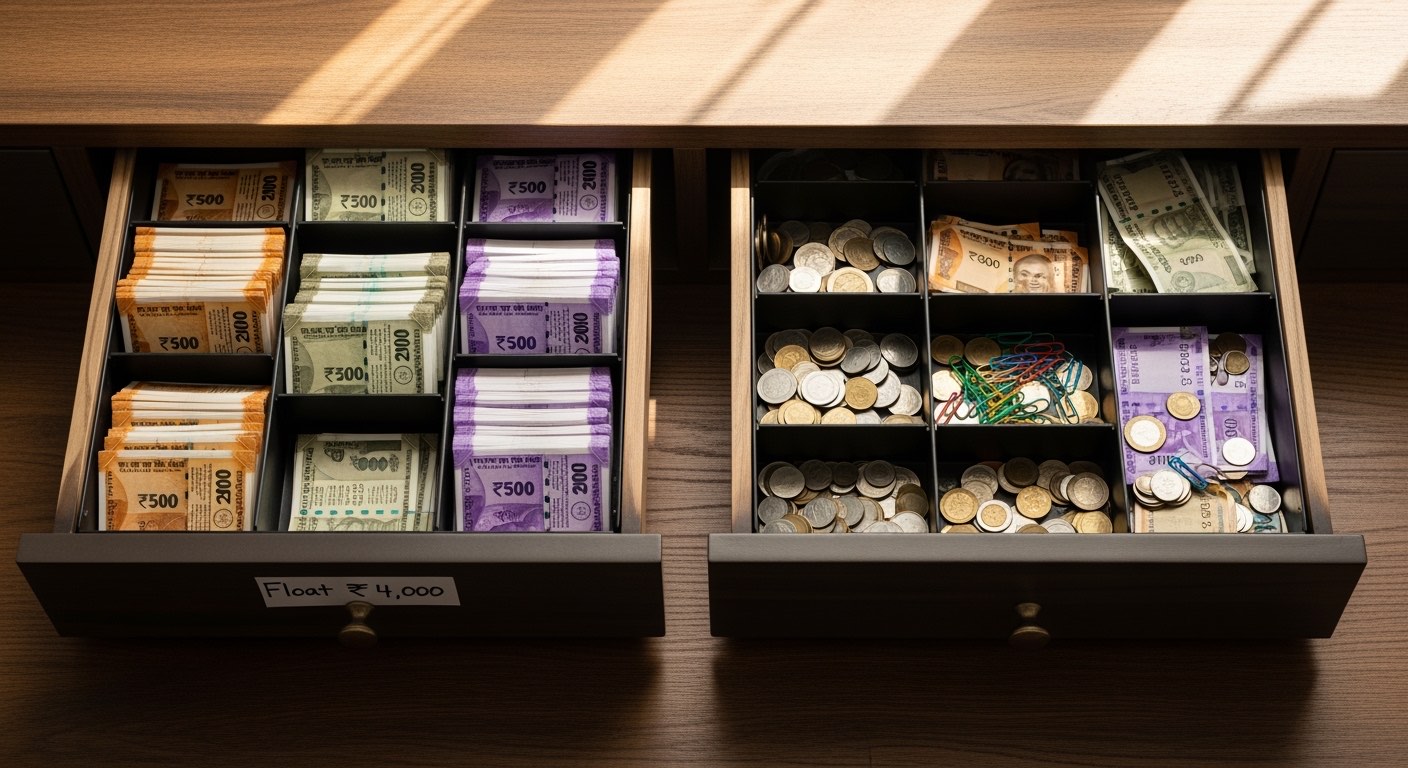
About this piece. Most operator articles online conflate the two systems or treat "floating" as if it's a respectable alternative. It isn't, in most restaurant contexts — but the floating system is what the majority of single-outlet Indian restaurants are actually running, by accident. This piece names the two systems clearly, compares them on the dimensions an operator cares about, and gives you the rule for which one fits your stage.
The two systems in plain terms
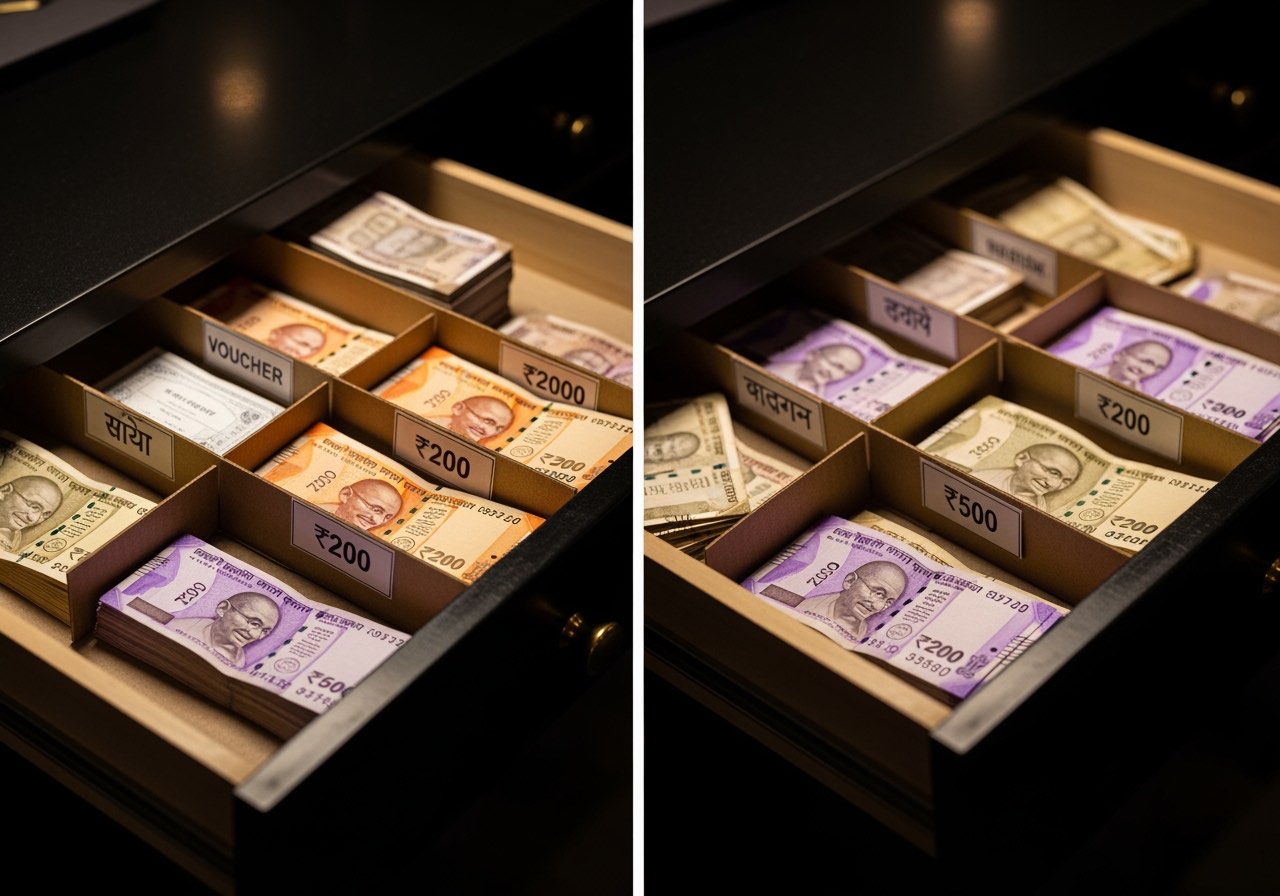
Imprest system. The petty cash drawer holds a fixed working amount — say ₹4,000 — that never changes. Spend reduces the cash, paper vouchers replace the cash. At top-up time, the manager replaces the vouchers with cash equal to their total, restoring the float to exactly ₹4,000. The drawer always equals (cash + vouchers = ₹4,000).
Floating system. The petty cash drawer holds whatever amount happens to be there. It might be ₹3,200 today, ₹2,800 tomorrow, ₹4,500 the day after. Top-ups happen "when low" rather than against vouchers. The drawer's balance is a moving target.
The third pattern that exists — let's call it the vague drawer — is no system at all. Cash gets added, cash gets removed, vouchers may or may not exist. About 30% of single-outlet operators we've spoken to are running this without realising it.
The comparison that matters
| Dimension | Imprest | Floating |
|---|---|---|
| Reconciliation time per shift | 60 seconds | 5–15 minutes |
| Variance visibility | Same-day | Month-end at best |
| Top-up cadence | Predictable, voucher-driven | Reactive ("looks low") |
| Audit trail | Tight — voucher stack always reconciles to fixed number | Loose — no fixed reference |
| Owner travel risk | Low — discipline is in the system | High — discipline lives in owner's head |
| Setup overhead | One-time sizing exercise (1 week) | None |
| Cashier training | One conversation + label | None — informal |
| Compatibility with monthly P&L | Strong | Weak — month-end totals drift |
| Compatibility with GST/Rule 6DD audit | Strong | Weak |
There is no dimension on which floating beats imprest except setup overhead — and the setup is one week of one person's attention. For any restaurant doing more than ~₹3L/month in revenue, the trade is overwhelmingly in favour of imprest.
Why floating feels fine until it isn't
Floating works in three contexts:
- The single owner-operator who is also the cashier, never travels, and personally signs every spend. Discipline is in the operator's head; no system needed. This is the dhaba pattern.
- The first 30 days of a new outlet before patterns settle and the operator hasn't sized the float yet.
- An outlet so small that monthly petty spend is below ~₹15,000, making the drag from informality tiny in absolute terms.
In every other context — multi-staff, owner-operator with two-jobs, multi-outlet, cashier ≠ owner — floating accumulates an invisible drag. The Crisil F&B SME margin study (2023) puts unrecovered cash leakage at SMB Indian restaurants at 3–8% of revenue; the floating system is a contributor to that band, not a neutral baseline.
The three failure modes of floating, with examples
Failure 1 — The variance is invisible
Day 1: cashier counts ₹2,800 in the drawer. Day 2: ₹2,750. Day 3: ₹2,900. Is there a ₹50 short? Nobody knows — there's no reference number to compare against. Variance noise floor is ~₹100 because the expected number is itself fuzzy. Real shorts get absorbed into the fuzz.
Imprest equivalent: drawer is supposed to be (cash + vouchers = ₹3,000). End of shift count: ₹1,400 cash + ₹1,560 in vouchers = ₹2,960. Short ₹40. Visible same day.
Failure 2 — The top-up becomes discretionary
Floating: "drawer looks low, here's ₹500." No paper trail of why. The float silently grows over months — what was meant to be ₹3,000 is now structurally ₹4,500.
Imprest: top-up is exactly the value of vouchers exchanged. Float doesn't grow without a deliberate, documented decision to grow it.
Failure 3 — Reconciliation requires a forensic exercise
Floating drawer at month-end: cash on hand minus opening balance plus top-ups should equal total vouchers. In practice the opening balance was estimated, top-ups weren't all logged, vouchers are partly missing — every month-end is detective work.
Imprest drawer at month-end: voucher stack total = top-ups during the month. One subtraction, done.
The 4-week migration from floating to imprest
If you're running floating today and want to move, this is the cleanest sequence:
- Week 1 — measure. Run the existing floating system but log every top-up and every voucher carefully. Sum month's petty spend; pick largest single PCV.
- Week 2 — size. Compute PCH using the formula in how much petty cash to hold:
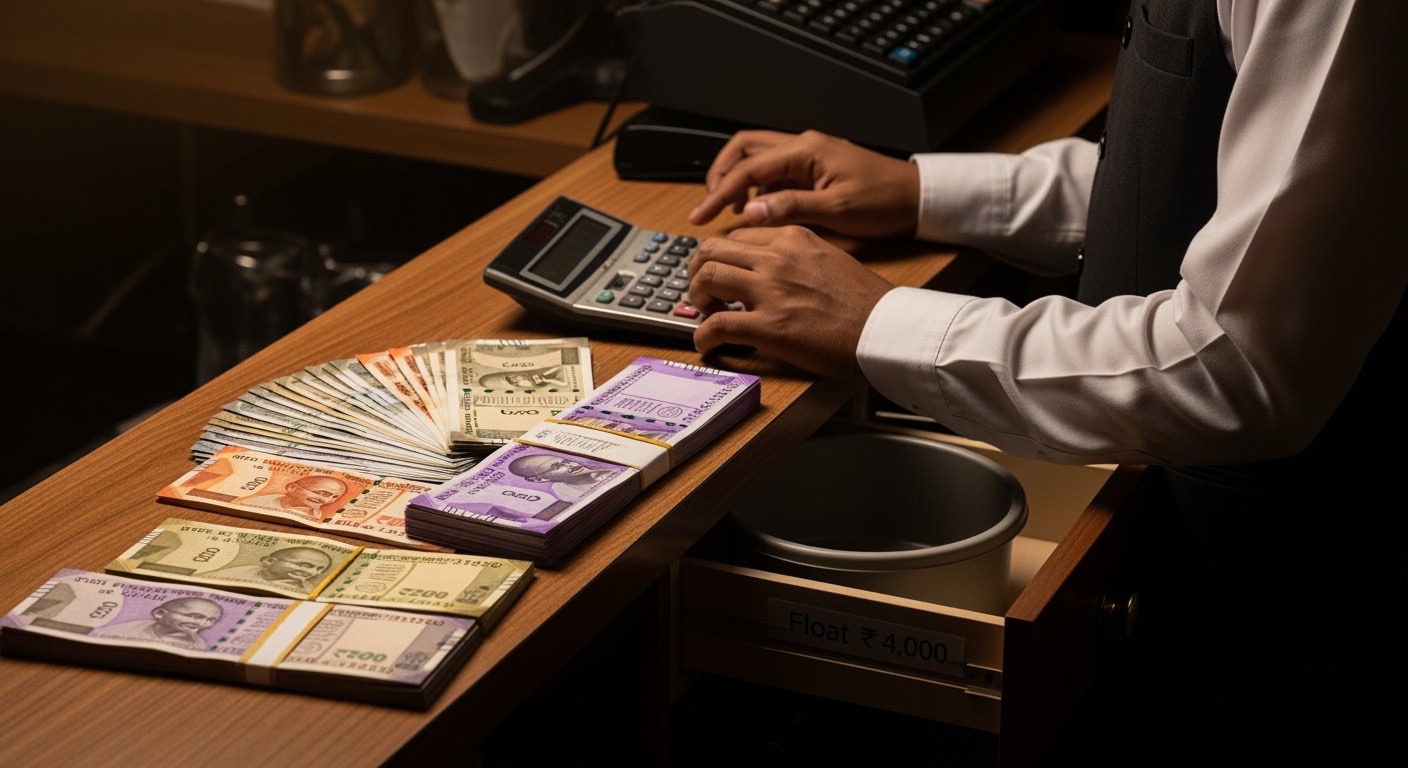
PCH = (D × C) + (1.5 × largest PCV). Round to nearest ₹500. - Week 3 — reset. On Monday morning, count out the new PCH in mixed denominations. Anything over goes to deposit; anything under, top up from operating. Stick a label inside the drawer: "Float = ₹X. Always."
- Week 4 — enforce. Two-signature rule on every voucher; top-up only against voucher value; end-of-shift reconciliation = (cash + vouchers must equal PCH).
Three weeks in, the cashier's muscle memory adjusts. Reconciliation drops from 10 minutes to 60 seconds. Variance becomes visible the day it happens.
When imprest doesn't fit (yes, those cases exist)
Three legitimate exceptions:
- The single owner-operator dhaba — see dhaba cash management for single owners. Imprest is overkill when one person runs the till start to finish.
- The food truck with no back-office — different patterns apply, see food truck daily cash close.
- The very-low-volume outlet (<₹3L/month revenue) — the sizing exercise costs more than the leakage you'd recover. Run a vague drawer until volume justifies tightening.
For everything else — and that's the vast majority of Indian restaurants — imprest is the right answer.
The owner question to answer first
Before committing to a system, the owner needs to answer: "Who reconciles the drawer at end of every shift?"
- If it's the owner personally, every shift, on premises — floating may survive (though imprest is still cleaner).
- If it's a cashier or shift manager — imprest is the only system that gives the owner a way to verify without being there.
The choice is really a choice between owner-dependent control and system-dependent control. Owner-dependent control breaks the moment the owner has a fever, a wedding, a second outlet, or simply needs a Sunday off.
What about hybrid systems?
Some operators ask about a "monthly imprest" — a fixed monthly drawer top-up of ₹X, rather than per-voucher. That's not imprest. It's a budget-and-spend pattern with the same reconciliation problems as floating. The defining feature of imprest is per-voucher top-up to a fixed working level, not periodic top-ups regardless of spend.
The only respectable hybrid is alternate-day imprest — top-up cycle of 2 days instead of 1 (the C = 2 case in the PCH formula). Same imprest discipline, less manager time. Works fine if drawer is right-sized for two days of normal spend plus a buffer.
If your accountant calls something "imprest" but the float drifts month to month, it isn't imprest — it's floating with a respectable name. The test is whether
cash + vouchers = PCHholds at every shift end. If yes, imprest. If no, floating.
A 30-second decision rule
For 95% of Indian restaurants:
- Single outlet, ≥ ₹3L/month revenue, owner not always on premises → imprest, full stop.
- Multi-outlet, any size → imprest at every outlet, with the area manager reconciling on visits.
- Single owner-operator dhaba, < ₹3L/month, on premises every shift → floating is acceptable but you'll regret it the first time you take a week off.
Where this fits with the rest of cash management
The system choice anchors three downstream disciplines:
- Sizing the float — how much petty cash to hold
- Voucher format that supports the system — petty cash voucher format India
- Audit cadence — petty cash audit checklist (12-point quarterly)
Choose imprest, size it right, run the voucher format, audit quarterly. Four habits, one closed loop.
What to do this week
If you're on floating today, log every voucher and every top-up for the next 7 days. That data feeds the PCH formula. By next Monday, you can reset to a fixed float and never look back.
Related on Restaurant Daily
- How much petty cash should a restaurant hold — formula — the sizing input
- Imprest cash float for Indian restaurants — the discipline deep-dive
- Petty cash leakage in restaurants — 8 patterns — what floating quietly costs you
One operator playbook a week, in your inbox.
Cash close, petty cash, payroll, compliance, unit economics — sent every Monday morning. No spam, no upsell drip. Unsubscribe in one click.
Sent from noreply@restaurantdaily.ai. We never share your address.
Related reading
Petty cash limit company policy — single-page template for restaurants
Petty cash limit company policy template for Indian restaurants — what limits to set per voucher, per category, per month. Single-page, free, ready to deploy.
Cashier accountability form — free template for Indian restaurants
Cashier accountability form for Indian restaurants — free declaration template + how to deploy it without alienating staff. Operator-grade controls.
Petty cash leakage prevention — 8 patterns Indian restaurants miss
Petty cash leakage prevention for Indian restaurants — 8 leakage patterns we see again and again, with the specific control fix for each. Operator-grade.
How much petty cash in restaurant — formula, ranges, common mistakes
How much petty cash should an Indian restaurant hold? The PCH formula, three sized examples, and the four mistakes that quietly inflate the working float.
Petty cash voucher format India — free Excel + Google Sheets template
Petty cash voucher format for Indian restaurants — 9 fields covering Income Tax Rule 6DD + GST input credit. Free Excel, Google Sheets, and printable PDF templates.