Food truck daily cash close — 9-step protocol when there's no back-office
Food truck daily cash close — a 9-step protocol that runs from the truck's side hatch when there's no back-office, no till, and the operator is also the cook.
Last updated 9 Aug 2026
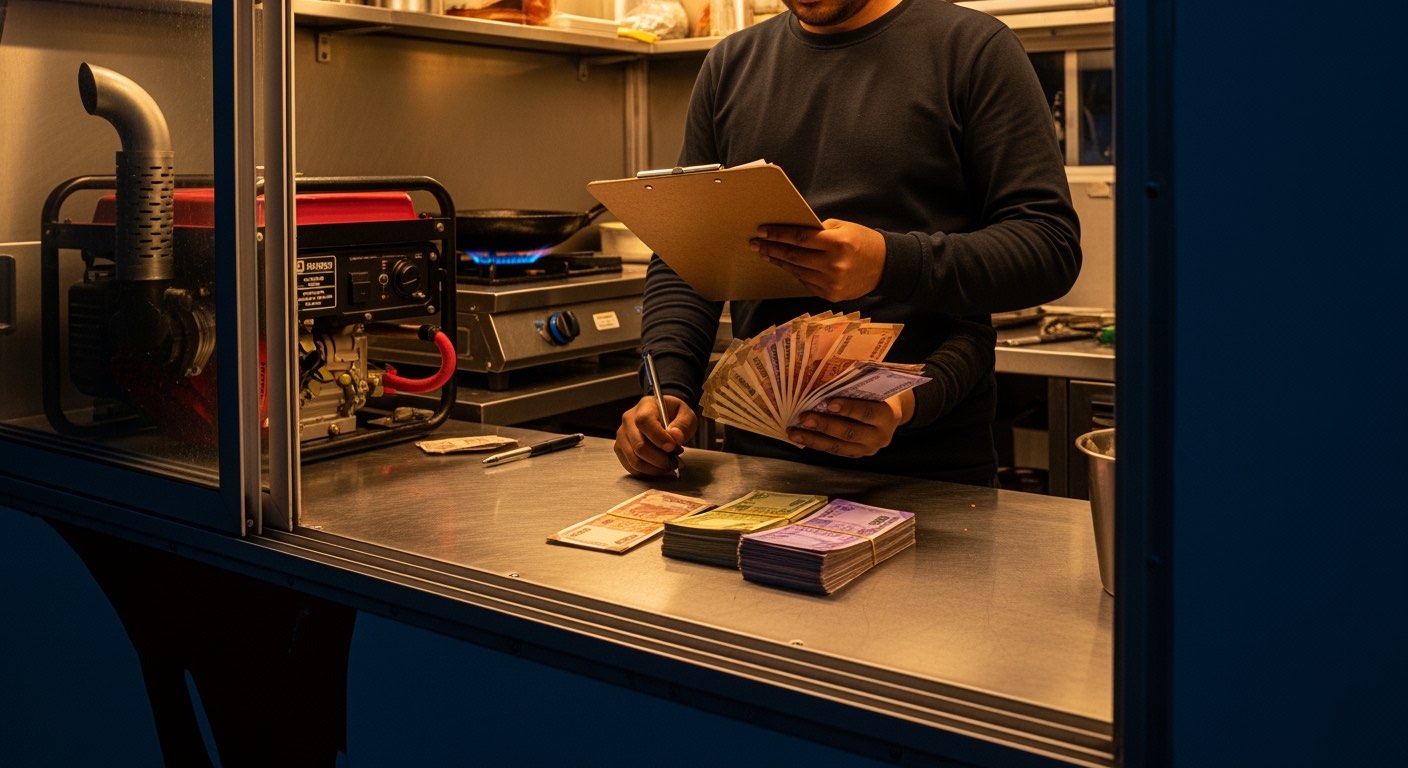
About this piece. A food truck is the most constrained restaurant format on cash discipline — one or two operators doing everything, no back-office, no till, no fixed counter, often parked at a curb where parking discipline matters more than financial discipline. And yet — food truck operators run real businesses with real GST and real Income Tax exposure. This piece gives you a 9-step daily cash close that fits in a clipboard and runs from the truck's side hatch in 12 minutes.
Why a food truck needs a daily cash close even more than a brick-and-mortar
Three reasons most food trucks under-build cash discipline:
- The operator is also the cook. Cognitive load is high during service; once service ends, the impulse is to drive home, not reconcile.
- Parking + permit volatility. A truck might park at three different spots in a week; the absence of a fixed counter blurs the day's structure.
- Cash + UPI-only payment mix. No card terminals. UPI screenshots/notifications stand in for receipts. Easy to lose track.
But the same three constraints make leakage worse, not better — there's no second pair of eyes, no POS audit trail, no till to physically separate the float from sales. Either you build the discipline into a clipboard routine, or you don't have it.
Public benchmark: NRAI 2024 segment data on food trucks (small sample) suggests cash leakage 5–11% of revenue — the high end of the SMB restaurant range. Operator interviews suggest the gap is mostly tracking, not theft — most food truck owners are sole operators or 2-person teams. Discipline is the lever, not surveillance.
The 9-step daily cash close (12 minutes, at end of service)
| # | Step | Time |
|---|---|---|
| 1 | Park truck somewhere safe (last service spot or home base) | 0:00 |
| 2 | Stop accepting orders; engine off; counter hatch closed | 0:00–0:01 |
| 3 | Cash drawer / cash bag emptied onto a tray | 0:01–0:02 |
| 4 | Cash counted denomination-wise; entered on day-sheet | 0:02–0:05 |
| 5 | UPI total: open PhonePe Business / Paytm / GPay; today's transactions sum | 0:05–0:07 |
| 6 | Order-count from bill book or notepad; cross-check vs cash + UPI | 0:07–0:09 |
| 7 | PCV stack totalled; entered on day-sheet | 0:09–0:10 |
| 8 | Variance calculation; flag if outside ±₹150 | 0:10–0:11 |
| 9 | Deposit envelope sealed; clipboard locked in truck | 0:11–0:12 |
That's the protocol. 12 minutes including the 1-minute safety park. The clipboard travels with the operator; the deposit envelope locks in the truck's lockbox or goes home with the operator.
What goes on the day-sheet
A food truck day-sheet is a one-page A5 form, simpler than a restaurant DSR:
┌────────────────────────────────────────────────────┐
│  FOOD TRUCK DAY-SHEET                              │
│  Date: ___ / ___ / ______                          │
│  Park location(s): __________________________      │
│  Hours of service: ___ am to ___ pm                │
│                                                    │
│  A. Opening float                ₹ ____________    │
│                                                    │
│  B. Cash counted                                   │
│     ₹500 × ___    ₹200 × ___                       │
│     ₹100 × ___    ₹50 × ___    ₹20 × ___           │
│     Total cash counted          ₹ ____________     │
│                                                    │
│  C. UPI received (today only)                      │
│     PhonePe Business            ₹ ____________     │
│     Paytm                       ₹ ____________     │
│     GPay                        ₹ ____________     │
│     Total UPI                   ₹ ____________     │
│                                                    │
│  D. Petty cash spend (PCV total)  ₹ ____________   │
│                                                    │
│  E. Order count (from bill book)  ___ orders       │
│                                                    │
│  F. Total revenue                                  │
│     = (B − A) + C + D            ₹ ____________    │
│                                                    │
│  G. Avg ticket = F / E           ₹ ____________    │
│                                                    │
│  H. Variance check                                 │
│     Sense check: F vs typical day                  │
│     Flag if outside ±15%                           │
│                                                    │
│  Operator sign: ____________                       │
└────────────────────────────────────────────────────┘
Note row F. For a food truck, you reconstruct revenue from cash + UPI + PCV (since petty spend came out of cash sales). It's not the same equation as a restaurant DSR (where opening float is fixed and cash sales come from POS) — for a truck without a POS, the bill book is the audit trail and revenue is reconstructed.
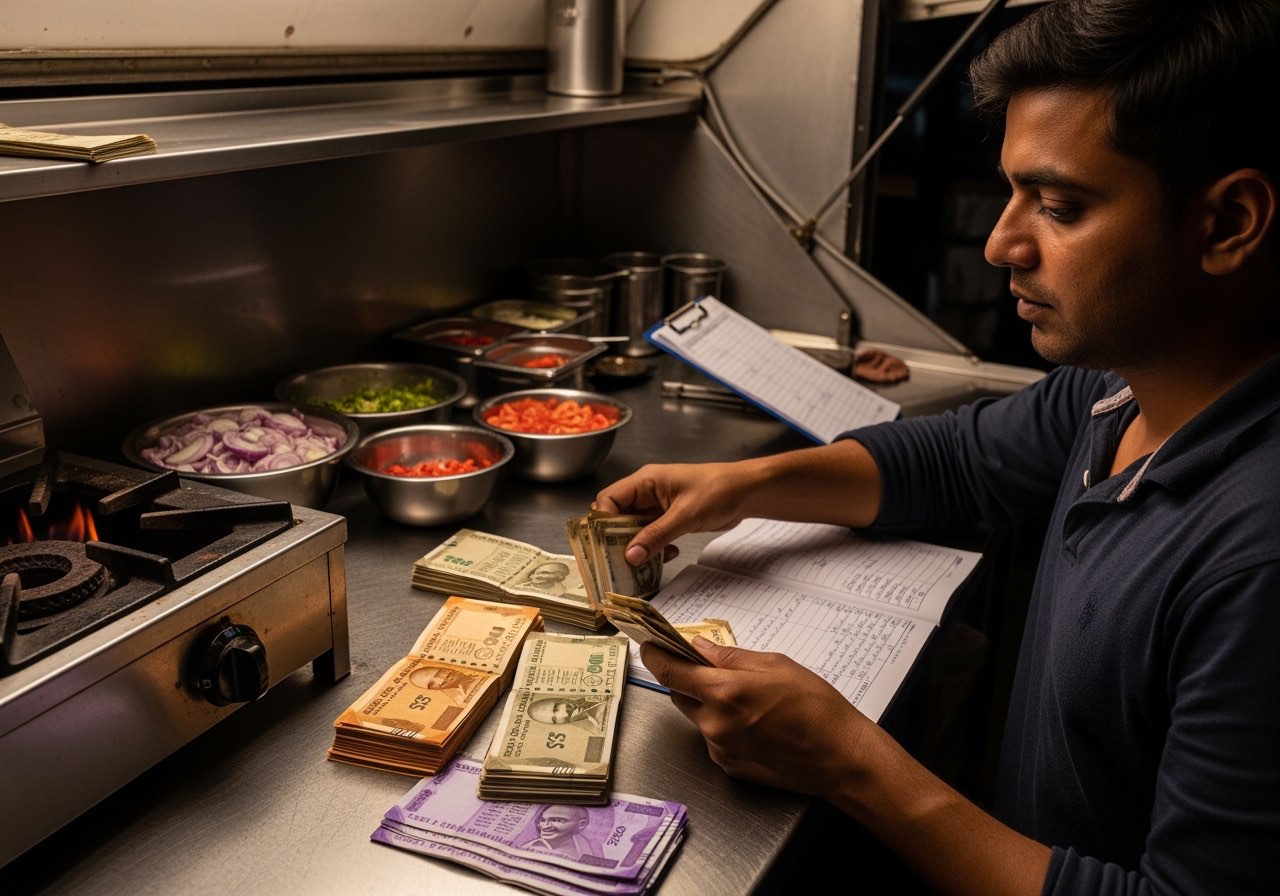
The imprest float for a food truck
A food truck's float should be small — ₹1,500 to ₹2,500 — for two reasons:
- Loss exposure. A bigger float is a bigger one-shot loss if the truck is broken into.
- Change requirements are predictable. A ₹220 ticket size and a small denomination spread of ₹500/₹200/₹100 means you don't need ₹4,000 of working float.
Apply the formula F = D × p × s:
| Truck type | D | p | s | Float |
|---|---|---|---|---|
| Single-spot lunch truck (office park) | ₹600 | 1.5 | 1.0 | ₹900 (round to ₹1,000) |
| Multi-spot lunch + dinner | ₹900 | 1.5 | 1.3 | ₹1,755 (round to ₹2,000) |
| Festival / event truck | ₹1,200 | 2.0 | 1.3 | ₹3,120 (round to ₹3,000) |
The label sticks inside the lockbox lid: "Float = ₹2,000 | Top-up against PCVs only".
The bill book — the food truck POS substitute
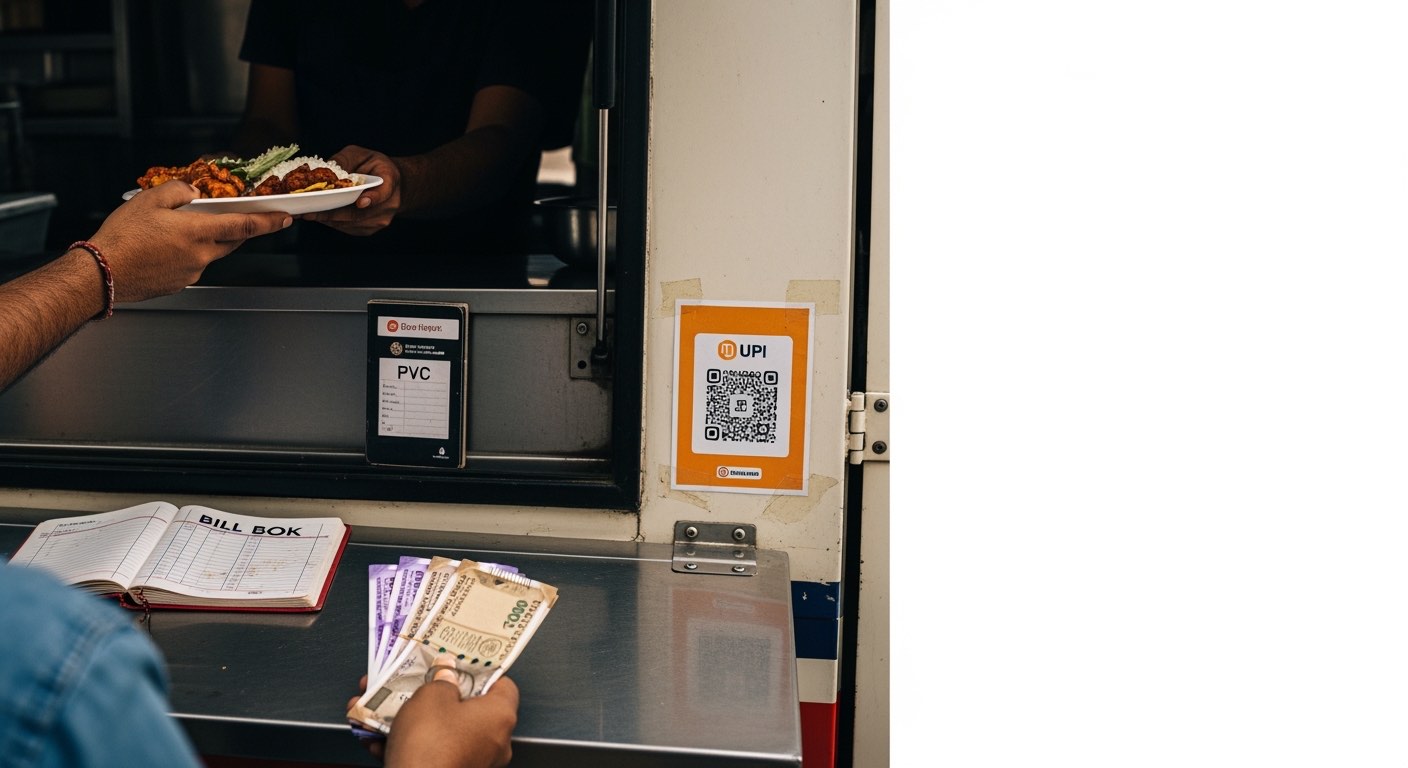
Most food trucks don't run a POS. The bill book — sequentially numbered, carbon-copy — is the audit trail. Three rules:
- Every order gets a bill. Even the ₹40 vada-pao. Customer doesn't have to take it; carbon stays.
- Bill numbers don't reset per day. They roll across the month (or until the book ends). End-of-month roll-over = new book.
- Total at bottom of every day's pages. Cash + UPI + (rare) card splits noted.
The bill book + the PCV stack + the day-sheet = the entire audit trail. Compliant for GST (under composition) and Income Tax.
Three leakage points specific to food trucks
1. UPI to personal account, not business
A common mistake — the operator's personal PhonePe is used for receiving customer payments because "the business UPI hasn't activated yet" or "this is faster". Net effect: personal bank account inflates with business income, business GST register is short, accountant has to reconcile bank-by-bank later. Fix on day 1: Open a business UPI / current-account-linked UPI. Print the QR code; tape it to the side hatch.
2. The "sample handout"
Friends, regulars, the parking guard — get free samples. ₹40 each, 6/day, 25 days a month = ₹6,000/month in untracked giveaways. Either log them as "promotional sample" PCVs (treat as marketing spend) or stop. Don't let them be invisible.
3. Diesel / generator fuel mixing with personal vehicle fuel
The truck's diesel tank and the operator's personal vehicle's tank both get filled at the same pump. Receipt mixed up. Truck's actual fuel cost becomes invisible. Fix: separate fuel-only PCV with kilometres logged (date + reading + amount). A petrol pump receipt stapled. Different colour pen or marker for personal-vehicle fuel — never mixed in PCV pad.
Composite Mumbai food truck operator started a 9-step close in March 2026. By April week 4 he'd discovered three leakage points: ₹3,200/month in untracked sample handouts, ₹1,800/month in personal-vs-truck fuel confusion, and a ₹600/week UPI gap traced to one regular customer paying his cousin's UPI by mistake (cousin not refunding, cousin "didn't know"). Recovered ₹38,000 across the next 90 days from these three.
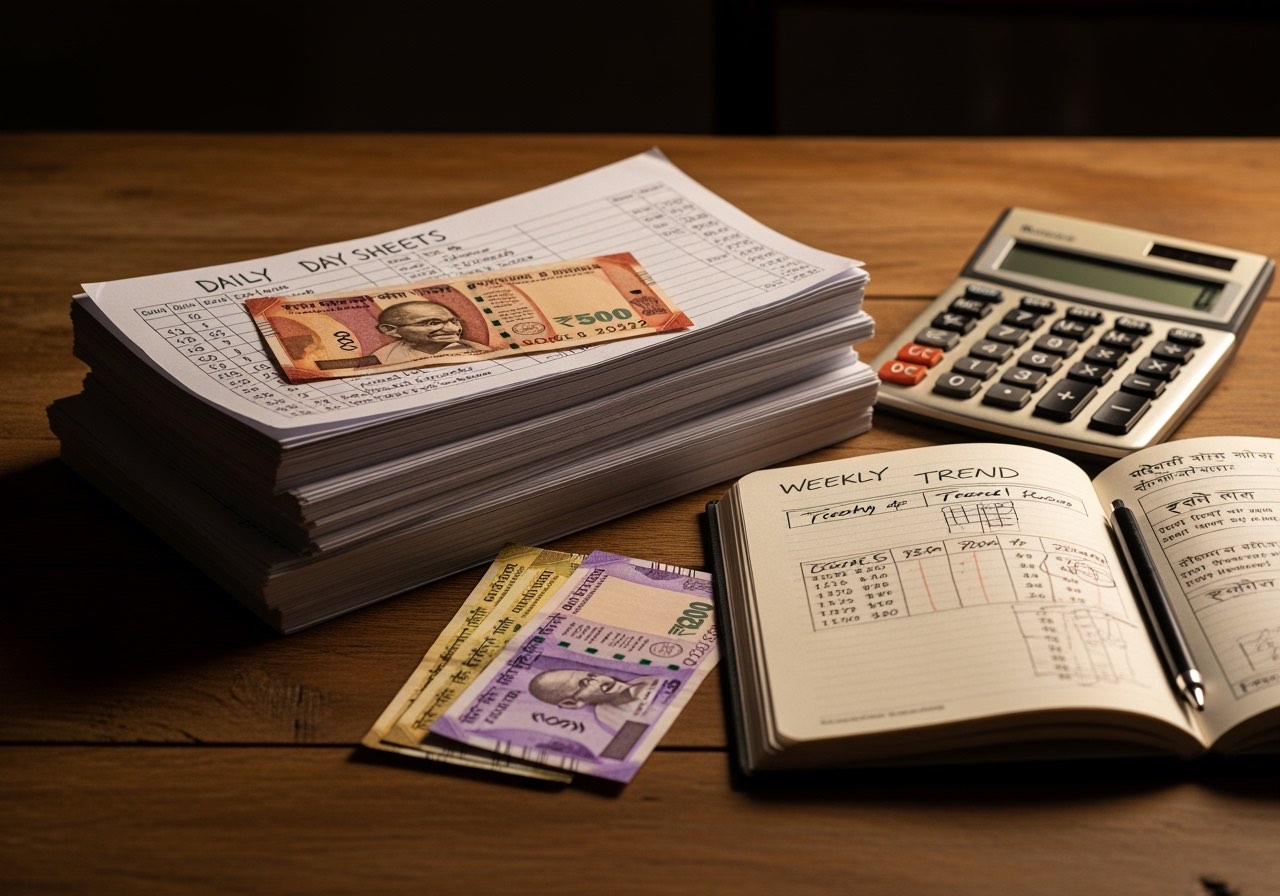
Weekly review — Sunday night, 20 minutes
Stack 7 day-sheets. Check four things:
- Average ticket trend — flat is fine; declining is a menu / pricing signal
- Order count trend by location — which parking spot brings what volume?
- PCV category mix — fuel, ingredients, supplies, repairs — any one ballooning?
- Variance flags — how many days flagged this week? More than 2 = investigate
The Sunday review converts the daily clipboard into a strategic view. Without it, you're just collecting paper.
Compliance — what an audit will ask for
If the GST officer or Income Tax assessing officer visits a food truck for verification, they will ask for:
- Bill books for the period (sequential, complete)
- PCV pads for the period
- Day-sheets for the period (or DSR equivalent)
- Bank statements for the linked current account
- UPI settlement statements for the linked merchant account
- GST registration certificate + last 3 returns
If you're running the 9-step close, you have everything except the GST returns themselves (which the accountant files). The audit is then a 30-minute conversation, not a 3-day forensic exercise.
What to do this week
Print a week's worth of day-sheets (7 copies). Tape the 9-step protocol to the inside of the cash lockbox. Run it for 7 nights. By next Sunday you'll know your average ticket, your typical day's revenue, your PCV mix — numbers most food truck operators in your city don't know about themselves.
Related on Restaurant Daily
One operator playbook a week, in your inbox.
Cash close, petty cash, payroll, compliance, unit economics — sent every Monday morning. No spam, no upsell drip. Unsubscribe in one click.
Sent from noreply@restaurantdaily.ai. We never share your address.
Related reading
रेस्टोरेंट का हिसाब कैसे करें — रोज़ाना cash, POS, deposit reconcile करने का guide
रोज़ाना रेस्टोरेंट का हिसाब कैसे करें — cash float, POS sales, Swiggy/Zomato payout, deposit slip और GST के लिए एक practical Hindi गाइड Indian operators के लिए।
दैनिक बिक्री रिपोर्ट रेस्टोरेंट — Hindi Excel template + DSR भरने का तरीका
भारतीय रेस्टोरेंट के लिए दैनिक बिक्री रिपोर्ट (DSR) — हिंदी Excel template, भरने का step-by-step तरीका, और cash/UPI/card reconciliation का सही method।
Dhaba cash management when you're the single owner — paper-only system that passes audit
Dhaba cash management for the single owner-operator — a paper-only system that handles GST, Income Tax Rule 6DD, vendor udhaar, and still passes audit. No software.
Shift ke end mein cash kaise count karein — staff checklist (Hindi)
Shift ke end par cash count karne ka simple checklist — denomination, vouchers, POS Z-report, variance reason. Hindi-English mein, tired cashier ke liye.
Daily cash reconciliation restaurant — POS, drawer, deposit (India)
Daily cash reconciliation for Indian restaurants — three-way tie between POS Z-report, drawer count, and bank deposit, with thresholds and a printable form.