Daily cash reconciliation restaurant — POS, drawer, deposit (India)
Daily cash reconciliation for Indian restaurants — three-way tie between POS Z-report, drawer count, and bank deposit, with thresholds and a printable form.
Last updated 9 Aug 2026
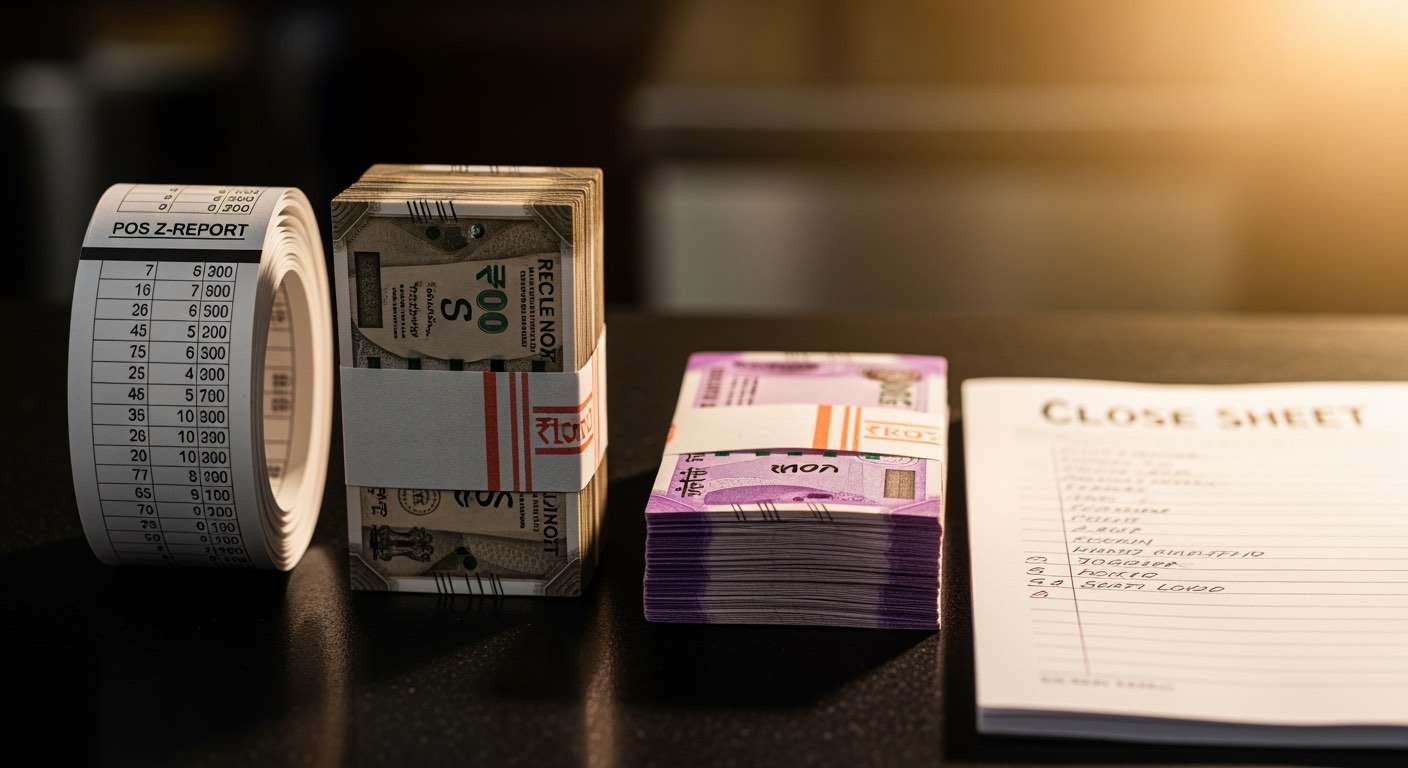
About this piece. "Reconciliation" is a word accountants use. Operators use it without realising — every time you check the drawer against the till. This piece is about doing that check on purpose, with a method, every single night, in under 10 minutes. Not for the accountant. For your own sanity, because un-reconciled days are the ones that hide leakage.
What gets reconciled, against what
Daily cash reconciliation in an Indian restaurant is a three-way tie:
- POS Z-report cash sales — what the till believes happened
- Drawer count (cash + vouchers, minus float) — what physically exists
- Bank deposit slip — what leaves the building tomorrow morning
A clean day means all three numbers agree, within a tolerance you've defined ahead of time. A dirty day means at least two disagree, and the difference has been written down with a reason before anyone leaves.
That's it. That's the whole game. The complexity comes from the dozen ways UPI, refunds, discounts, advances, and Swiggy/Zomato cash-on-delivery muddy the waters.
The reconciliation identity
The arithmetic that ties the three numbers:
Drawer cash counted
+ Petty cash vouchers in drawer
− Opening float
= Net cash from operations
And this should equal:
POS Z-report cash sales
− POS Z-report cash refunds
And both of those should equal:
Bank deposit slip amount
+ Float retained for next shift
− Opening float
If you're doing this on a notebook, write all three lines on the close sheet and circle any one that doesn't tie. A typical NCR QSR runs ₹0–₹40 of variance on 80% of nights, ₹40–₹200 on 15%, and ₹200+ on 5%. The last bucket is where the leakage lives.
The reconciliation table — what to fill, what to compare
| Line | Source | Example (₹) |
|---|---|---|
| Opening float | Cash drawer label | 3,000 |
| Cash sales | POS Z-report | 18,400 |
| Cash refunds | POS Z-report | 200 |
| PCV outflows | Voucher stack count | 850 |
| Expected drawer cash | Float + sales − refunds − PCV | 20,350 |
| Actual drawer cash counted | Denomination sheet | 20,310 |
| Variance | Actual − expected | −40 |
| Voucher chits in drawer | Voucher count | 850 |
| Closing float | Cash drawer label | 3,000 |
| Deposit envelope | Actual − float | 17,310 |
The variance row is the only row that matters. If it's outside the threshold (±₹100 for sub-₹40k/day outlets, ±0.25% of cash sales for larger), the close is incomplete until a one-line reason is on the sheet.
Operators in NCR who track this nightly tell us the same thing: the pattern of variance is more useful than any single night. Three Mondays in a row where variance is exactly −₹50 is not coincidence. That's a UPI mismatch, a forgotten staff meal, or a small skim. Without a tracked nightly number, the pattern is invisible.
The four payment modes that break reconciliation most often
Indian restaurants in 2026 take five tender types: cash, UPI, card, Swiggy/Zomato pre-paid, Swiggy/Zomato cash-on-delivery. Reconciliation breaks at the boundaries.
- UPI failures recorded as success. Customer pays ₹420 by UPI, transaction is "pending", customer leaves. Cashier doesn't notice. The Z-report shows ₹420 of UPI sales that never settle. Cross-check the daily UPI dashboard (PhonePe, Google Pay, Razorpay) against the POS UPI total before signing the close.
- Cash-on-delivery (COD) from aggregators. Swiggy/Zomato delivery executive pays the cashier cash for a COD order. The Z-report logs it as Swiggy revenue, not cash. Drawer is "over" by the COD amount. Always log COD into a separate line on the close sheet.
- Card tip vs card sale. Customer adds a ₹100 tip on the card slip. POS records ₹X sale, ₹100 tip. Settlement comes as ₹X+100. Easy to mis-read as a phantom variance. Track tips separately.
- Discount applied after cash collected. Customer pays full ₹500. Cashier later applies a 10% discount in the POS. Now the Z-report says ₹450, drawer has ₹500. A ₹50 "over". The fix: apply discounts before payment, not after.
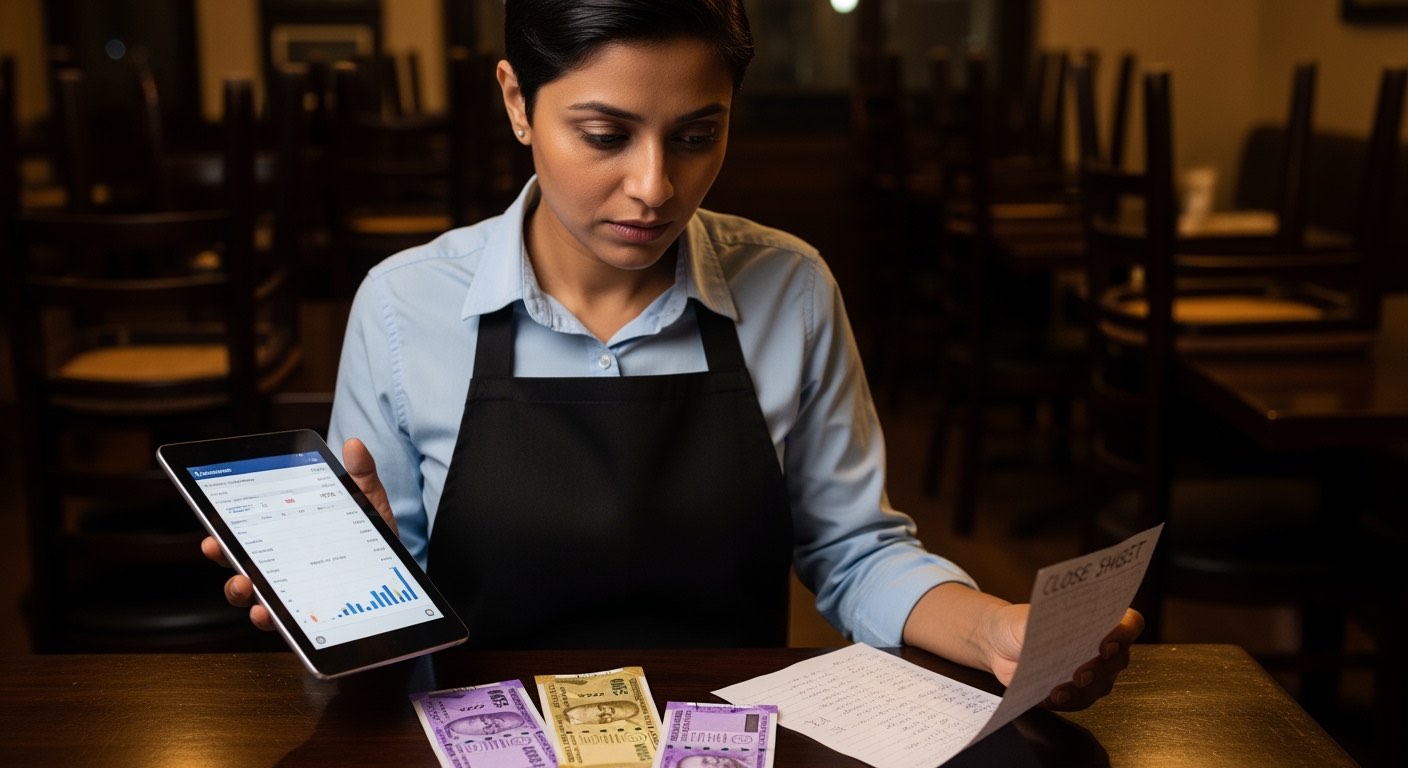
The 60-second nightly routine (once you're trained)
After two weeks of doing the full method, an experienced cashier compresses the close into a routine:
- Print Z-report. (10 seconds)
- Count drawer using the denomination sheet. (90 seconds)
- Sum vouchers, write count. (30 seconds)
- Compute expected drawer cash on the close sheet. (15 seconds)
- Compute variance. If inside threshold, sign and close. If outside, hold and write reason. (15 seconds)
Total: about 3 minutes for the routine when nothing is off, 8–10 minutes on a variance night when you're investigating.
This is the loop that takes the cash drawer from "we'll figure it out at month-end" to "we know where every rupee went tonight." That difference compounds — both in money saved and in time the owner doesn't spend on Saturday morning.
Three thresholds worth setting in writing
Pick these once, write them on the back of the close sheet, never debate them again.
| Threshold | Action | Suggested |
|---|---|---|
| Variance to log only | Sign and continue | ±₹40 |
| Variance to investigate same night | Hold close, write reason, owner notified next day | ₹40–₹200 |
| Variance to escalate | Owner reviews drawer footage / cashier interview | ₹200+ |
For a tier-2 city dhaba doing ₹15,000/day, those numbers might compress to ±₹20, ₹20–₹100, ₹100+. For a 100-cover casual-dine doing ₹1.2L/day, they might widen. The principle is the same: fixed thresholds make variance objective. Without them, every variance becomes a negotiation.
What ties this to the rest of cash management
Daily reconciliation is one node in a 4-node loop:
- Imprest cash float — the fixed reference (read)
- Petty cash voucher format — the outflow audit trail (read)
- Cash close process — the nightly ritual that ties it all (read)
- Daily reconciliation — the three-way tie (this piece)
Each is independently useful. Stack all four and your cash discipline is in the top decile of Indian SMB restaurants — without any software. That's what Restaurant Daily automates; the discipline still holds without it.
What to do this week
Tonight, before you close, write down the three numbers (POS cash sales, drawer count, expected cash). Compare. The first night will feel awkward; by night four it's reflex. By night ten you'll have noticed something — a UPI gap, a recurring ₹40 short, a phantom Swiggy COD — that you didn't know existed.
That's the whole point of the practice. Make leakage visible. The fix follows from the visibility, not the other way around.
Related on Restaurant Daily
One operator playbook a week, in your inbox.
Cash close, petty cash, payroll, compliance, unit economics — sent every Monday morning. No spam, no upsell drip. Unsubscribe in one click.
Sent from noreply@restaurantdaily.ai. We never share your address.
Related reading
Restaurant cash close process — end-of-day reconciliation playbook (India)
The restaurant cash close process used by disciplined Indian outlets — 7 steps from drawer count to bank deposit, variance thresholds, and the 60-second nightly check.
Shift ke end mein cash kaise count karein — staff checklist (Hindi)
Shift ke end par cash count karne ka simple checklist — denomination, vouchers, POS Z-report, variance reason. Hindi-English mein, tired cashier ke liye.
Cash variance in restaurant — 11 root causes and the fix for each
Cash variance in restaurants explained — 11 root causes from UPI failures to skim, with the diagnostic question and concrete fix for each. India operator-grade.
Imprest cash float for Indian restaurants — the formula and the mistake that costs ₹2,000/month
How to size your restaurant's imprest cash float using the F = D × p × s formula, three worked examples, and the floating-float mistake that quietly drains margin.
Restaurant cash management software India — 6 options compared (2026)
Restaurant cash management software in India compared — Petpooja, Posist, Khatabook, Vyapar, Restaurant Daily, manual Excel — pricing, features, support, fit.