Denomination sheet restaurant cash count — Excel template + how to use it
Free denomination sheet for Indian restaurant cash counts — Excel + printable PDF, with auto-totals, variance row, and the right way to count a drawer in 2 minutes.
Last updated 9 Aug 2026
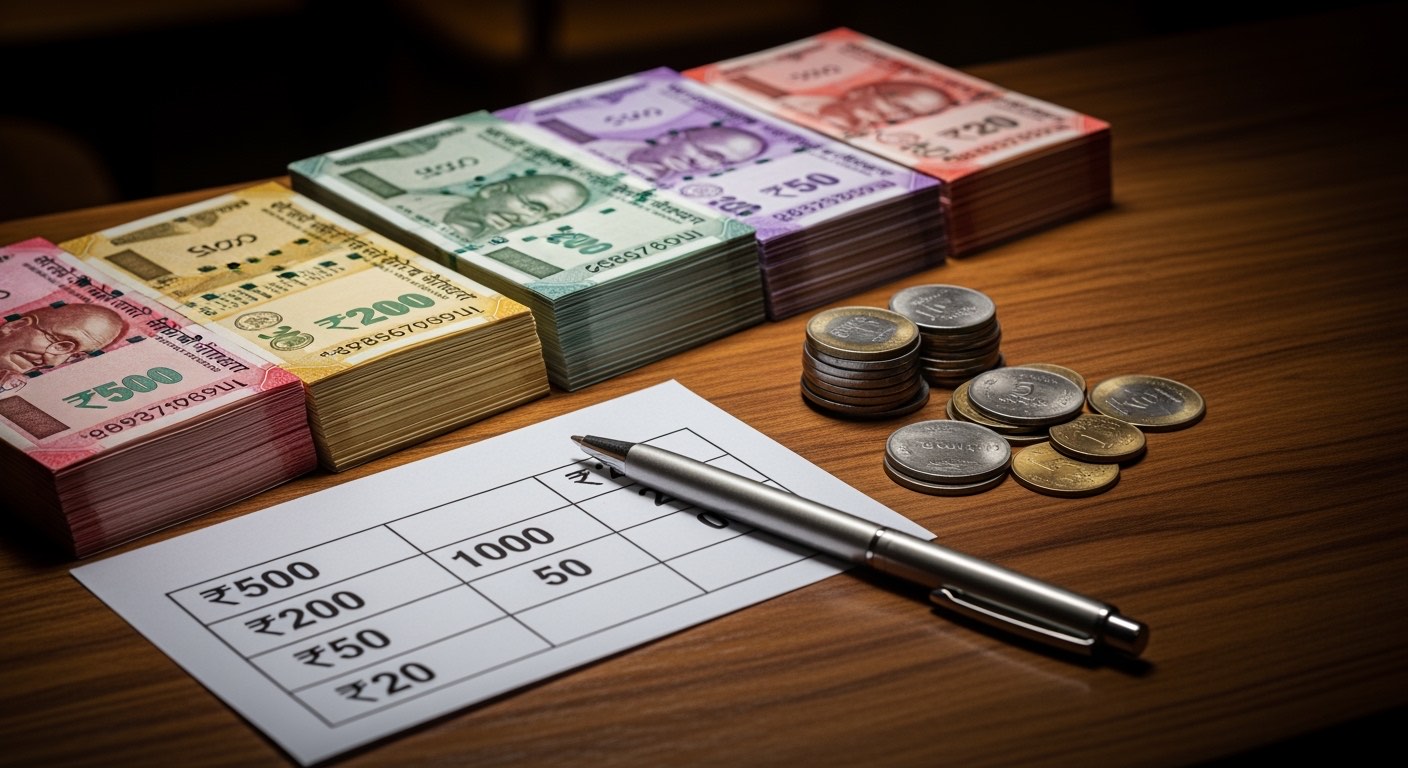
About this piece. A denomination sheet is the cheapest cash-counting tool in the world — a piece of paper with a row per note value. Disciplined Indian restaurants use one for every shift open and every shift close. Most don't. The ones who don't run 2× the variance of the ones who do, for no other reason than counting accuracy. This piece gives you the format, the workflow, and the 90-second drawer count.
Why the eyeball count fails
The mental "₹500 ka pile, ₹100 ka pile, eyeball" works for ₹500. It fails consistently in two situations:
- Notes are mixed. A pile that looks like ₹500s often has 2–3 ₹200s slipped in. The eyeball undercounts by ₹600–₹900 per drawer.
- The cashier is tired. At 11pm after a 12-hour shift, recounting twice is the only way to be sure. The denomination sheet makes the recount easy because each row is independent.
A composite operator we work with switched from eyeball to denomination sheet across 3 outlets. Variance dropped from an average ₹95/night to ₹38/night within 3 weeks. Same staff, same process — only the counting tool changed.
What's in the sheet
Indian currency in 2026 has 7 active denominations (notes) plus coins:
| Denom | Colour cue | Notes |
|---|---|---|
| ₹500 | saffron | most common high-value |
| ₹200 | yellow | often misidentified as ₹500 |
| ₹100 | violet | mid-range workhorse |
| ₹50 | violet (paler) | becoming rarer |
| ₹20 | greenish-yellow | minor |
| ₹10 | brown / orange | minor |
| Coins (₹1, ₹2, ₹5, ₹10) | metallic | often ignored — don't |
The sheet has one row per denomination, a count column, an amount column, and a total row.
The half-sheet format
┌──────────────────────────────────────────────────┐
│ DENOMINATION SHEET — [Outlet]                    │
│ Date: __/__/____  Shift: ____  Cashier: _______  │
│ Count type: □ Open  □ Close  □ Audit             │
│                                                  │
│ Denom   │ Count │ Amount         │              │
│ ──────  │ ────  │ ─────────      │              │
│ ₹500    │  ___  │ ₹ ________     │              │
│ ₹200    │  ___  │ ₹ ________     │              │
│ ₹100    │  ___  │ ₹ ________     │              │
│ ₹50     │  ___  │ ₹ ________     │              │
│ ₹20     │  ___  │ ₹ ________     │              │
│ ₹10     │  ___  │ ₹ ________     │              │
│ ₹5 coin │  ___  │ ₹ ________     │              │
│ ₹2 coin │  ___  │ ₹ ________     │              │
│ ₹1 coin │  ___  │ ₹ ________     │              │
│ ₹10 coin│  ___  │ ₹ ________     │              │
│                                                  │
│ TOTAL DRAWER CASH:        ₹ ________             │
│                                                  │
│ Expected (from close sheet): ₹ ________          │
│ Variance (actual − expected):₹ ________          │
│                                                  │
│ Cashier sign: ______  Manager sign: ______       │
└──────────────────────────────────────────────────┘
Print 100 per outlet, A6 size, two-up on A4. Stack on top of the cash drawer.
The Excel version — auto-totals + flagging
Same fields, plus formulas:
| Cell | Formula |
|---|---|
| C4 (₹500 amount) | =B4*500 |
| C5 (₹200 amount) | =B5*200 |
| ... | ... |
| C14 (total) | =SUM(C4:C13) |
| C16 (variance) | =C14-C15 |
| Conditional format C16 | red if ABS(C16)>100 |
Add a second sheet that pulls in the date + variance from each daily sheet to plot the 30-day variance trend. Two minutes of formula setup; weeks of pattern visibility.
The 90-second drawer count
Order matters. Counting in this sequence is what gets the count to 90 seconds reliably.
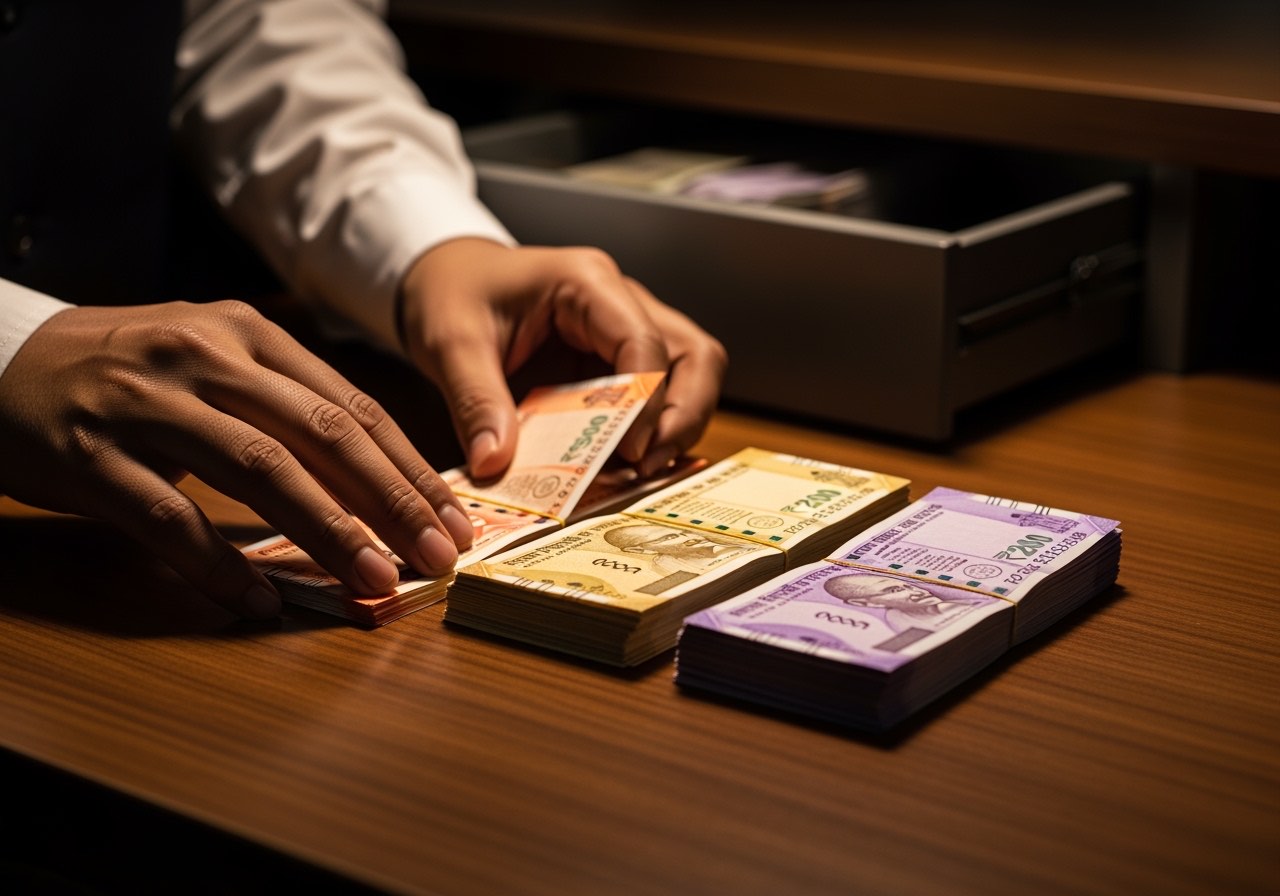
- Pull the drawer fully open. Empty it onto the counter. Don't count from inside the drawer — easy to miss notes wedged in the back.
- Sort by denomination first, then count. Make a pile per note value. The sort takes 20 seconds; the counts are then independent.
- Count highest to lowest. ₹500 first (fewest notes, biggest contribution). ₹200 next. Down to coins. The mental math gets easier as the values shrink.
- Write the count immediately after each pile. Don't count three piles and then write — the count escapes.
- Read the row totals back. "₹500 × 14 = ₹7,000" out loud. Catches arithmetic errors.
- Sum the column. Use a calculator, not your head.
90 seconds for an experienced cashier. 2 minutes when learning. The slowness of being deliberate beats the speed of recounting because of an error.
When to use the sheet
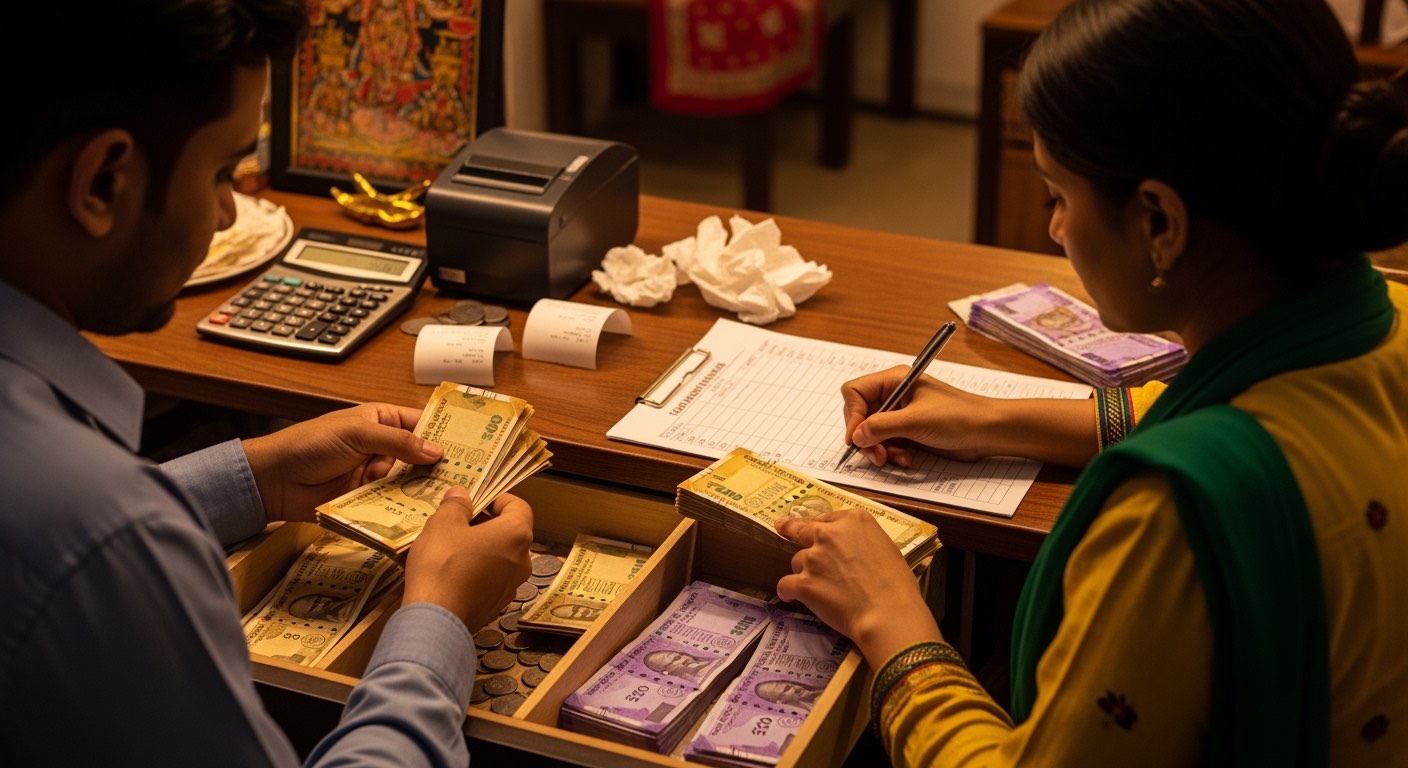
Three windows. Don't skip any of them.
- Shift open. Confirms the drawer actually has the float amount. Catches yesterday's float reset failure within 30 seconds of the new shift starting.
- Shift close. Inputs into the close sheet. Variance computed from this number.
- Surprise audit. Owner / area manager runs the count themselves; cashier observes. (Audit checklist.)
A fourth optional window — mid-shift spot-check by the manager — is useful in outlets with newer cashiers or recent variance issues. Compute expected cash from the X-report; compare with sheet count. 5 minutes; high deterrent value.
Three counting mistakes that cost money
- Counting by stacks of 10 without breaking. "Yeh 10 ki gaddi hai" — sometimes it's 9 or 11. Always physically count into piles of 10, then count the piles.
- Coins in a separate jar that gets ignored. Coins are real money. ₹50–₹150 in coins per drawer is normal. Over a year that's ₹18,000–₹54,000 of float capital sitting unaccounted. Count them weekly even if you don't deposit them weekly.
- One person counts and signs. Two-eyes rule: one counts, the other watches and signs. The watching is what catches the error.
A composite cashier we observed once at a 50-cover NCR casual-dine had been recording "₹0 in coins" for 11 weeks. The coin jar had ₹2,400. The denomination sheet would have caught it on day one — the row would have been blank, which is itself a flag.
How the sheet ties to other artefacts
The denomination sheet is one input. It's used by:
- Close sheet — the drawer cash total feeds the variance calculation (till close)
- Internal deposit slip — the denomination split is reused on the bank deposit (format)
- Surprise audit — auditor runs the same sheet, signed by both (audit checklist)
Done well, you fill the same denomination split once in the morning (open), once at night (close), and once at deposit (bank challan). The sheet is the source; everything else copies from it.
When the bank wants a specific denomination split on the challan
Many bank branches require denomination split on the cash deposit challan. Some give you a stamped slip to fill it on. Either way — you've already filled it on the close-time denomination sheet. Copy the relevant rows; you're done in 30 seconds. Without the sheet, you're recounting at the bank counter, holding up the queue.
What the 30-day variance pattern looks like
After 30 days of disciplined denomination sheets + close sheets:
- 5–8 days: variance = 0 (clean)
- 14–18 days: variance within ±₹40 (sub-threshold)
- 4–8 days: variance ₹40–₹150 (logged, investigated)
- 0–2 days: variance > ₹150 (escalated)
If your distribution looks much different — say, 18 days of variance > ₹100 in a month — the issue isn't counting accuracy alone. Run the 11-cause variance diagnostic.

Where this fits in the daily-ops loop
The denomination sheet is a small, load-bearing piece of paper. It enables:
- Accurate counting (cashier discipline)
- Witnessable counts (two-signature trust)
- Audit-grade record (auditor uses the same sheet)
- Bank deposit speed (denomination split pre-counted)
The whole loop is what Restaurant Daily automates with a simple per-denomination input on the close screen; without software, the half-sheet does the same job.
What to do this week
Print 50 sheets tonight. Tape one to the cashier's binder. Brief on Monday morning. Use it tomorrow open, tonight close, every shift after.
By night four it's reflex. By week two, the variance pattern is clearer. By week four, the outlet runs in the top decile of cash discipline for SMB Indian restaurants.
Related on Restaurant Daily
One operator playbook a week, in your inbox.
Cash close, petty cash, payroll, compliance, unit economics — sent every Monday morning. No spam, no upsell drip. Unsubscribe in one click.
Sent from noreply@restaurantdaily.ai. We never share your address.
Related reading
Cash deposit slip format restaurant — free fillable bank deposit template
Bank cash deposit slip format for Indian restaurants — fillable template covering denomination split, outlet code, cashier sign, and reconciliation back to DSR.
Shift handover format restaurant — single-page form for cash, stock, complaints
A single-page shift handover format for Indian restaurants — covering cash, stock alerts, open complaints, comps, and pending tasks. Free printable template.
Daily sales report restaurant Excel — free DSR template (India)
Free daily sales report Excel + Google Sheets template for Indian restaurants — 18 fields covering tender modes, GST splits, refunds, advances, and weekly rollup.
Restaurant till close checklist — printable 14-step end-of-day form
A 14-step restaurant till close checklist used by disciplined Indian outlets — printable A5 form covering cash, vouchers, POS, UPI, COD, and deposit envelope.
Restaurant cash management software India — 6 options compared (2026)
Restaurant cash management software in India compared — Petpooja, Posist, Khatabook, Vyapar, Restaurant Daily, manual Excel — pricing, features, support, fit.