Cash drawer audit checklist — owner's 9-step surprise audit (India)
Owner's surprise cash drawer audit checklist for Indian restaurants — 9 steps to run unannounced in 12 minutes, with thresholds and dispute-proof artefacts.
Last updated 9 Aug 2026
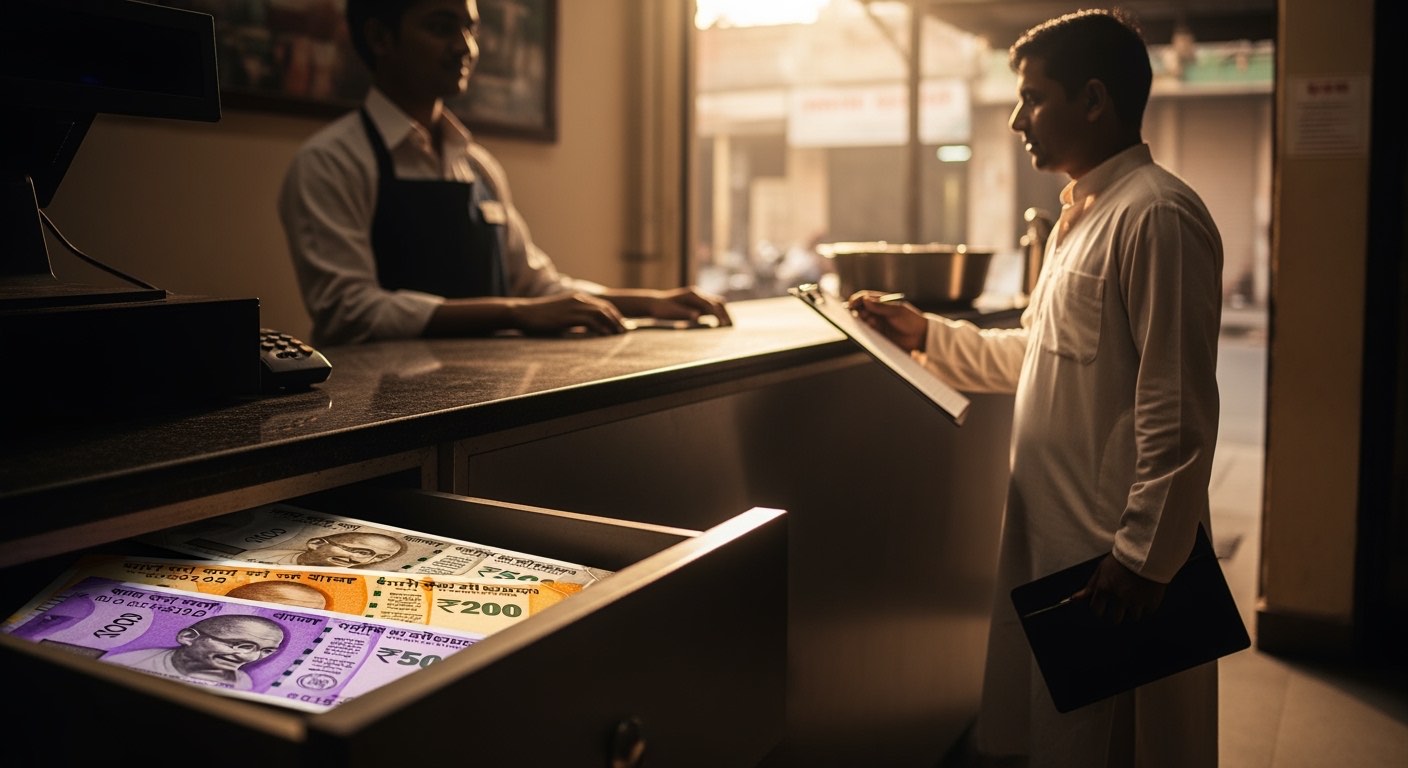
About this piece. A surprise cash drawer audit is one of the cheapest and most effective owner-control tools in an Indian restaurant. It takes 12 minutes, requires no special equipment, and a single audit per outlet per month is enough to keep cash discipline honest. This piece is the 9-step protocol, the form, and the rules of conduct that keep it from feeling like an accusation.
Why surprise, and why an owner
Two design choices are doing the work.
Surprise because a scheduled audit is theatre. The cashier knows it's coming, prepares, and the drawer is clean for that one day. Discipline doesn't transfer to other days. A surprise audit measures the normal state, which is what you actually need to know.
Owner (not manager) because the manager and cashier work in the same loop daily. Their incentives are aligned with making the close look clean, even when it isn't. Owner is the only role with both authority and outsider-perspective. (Larger groups can use an area manager from a different cluster — same principle.)
A composite single-outlet operator we work with in NCR runs one surprise audit per month and has not had a major variance event in 14 months. The audit is the deterrent; the pattern review is the diagnostic.
When and how to time the audit
The best window is mid-shift, not at close. Why: at close, the drawer is being counted anyway. Mid-shift is when the drawer is in its working state — vouchers in, change made, partial sales recorded. That's the state most relevant to discipline.
| Window | Why |
|---|---|
| Mid-lunch (1:30–2:30pm) | Drawer is at peak working state |
| Mid-dinner (8:30–9:30pm) | Same, plus higher cash mix |
| Avoid first 30 min of shift | Float just opened, no work to audit |
| Avoid last 30 min of shift | Cashier is preparing for close |
Frequency: monthly per outlet is the floor. Twice a month if there's been a recent variance pattern. Don't go above twice — it stops being surprise and starts being supervision.

The 9-step audit protocol
Run these in order. Time the whole thing — discipline of timing is part of the discipline of the audit.
| # | Step | Time |
|---|---|---|
| 1 | Walk in unannounced; greet cashier and manager calmly | 30 sec |
| 2 | Ask cashier to lock the till (no new orders for 12 minutes) | 30 sec |
| 3 | Print POS X-report (mid-shift snapshot, not Z) | 1 min |
| 4 | Pull the drawer; count cash by denomination | 3 min |
| 5 | Sum vouchers in drawer; check date + signature on each | 3 min |
| 6 | Compute expected cash = Float + sales-so-far − refunds-so-far − vouchers + COD | 1 min |
| 7 | Variance = Actual − Expected; record on audit sheet | 30 sec |
| 8 | Spot-check: pull 3 random vouchers, verify GL category + recipient signature | 2 min |
| 9 | Sign the audit sheet with both cashier and manager; restore drawer; thank team | 1 min |
Total: 12 minutes. Anything longer and it stops being a surprise audit and starts being an investigation.
The audit sheet
Print 24 of these (two per month for a year). One per audit.
┌────────────────────────────────────────────────────────┐
│ SURPRISE CASH DRAWER AUDIT — [Outlet]                  │
│ Date: __/__/____  Time: __:__   Auditor: ___________   │
│ Cashier on duty: ___________  Manager: ___________     │
│                                                        │
│ A. Float on drawer:                ₹ ________          │
│ B. Cash sales so far (X-report):   ₹ ________          │
│ C. Cash refunds so far:            ₹ ________          │
│ D. Aggregator COD received:        ₹ ________          │
│ E. Voucher total in drawer:        ₹ ________  (count: __) │
│                                                        │
│ Expected drawer cash = A + B − C − E + D    ₹ ________ │
│ Actual drawer cash counted                  ₹ ________ │
│ Variance (actual − expected)                ₹ ________ │
│                                                        │
│ Voucher spot-check (3 random):                         │
│   1. Voucher #__  GL: _______  Sig: Y/N  Bill: Y/N     │
│   2. Voucher #__  GL: _______  Sig: Y/N  Bill: Y/N     │
│   3. Voucher #__  GL: _______  Sig: Y/N  Bill: Y/N     │
│                                                        │
│ Findings / actions:                                    │
│ _________________________________________________      │
│                                                        │
│ Auditor sign: __________  Cashier sign: __________     │
│ Manager sign: __________                               │
└────────────────────────────────────────────────────────┘
Keep the audit sheets in a separate "Owner Audits" binder, not the daily close binder. They're a different evidence stream.
Thresholds — what counts as a finding
| Variance | Classification | Action |
|---|---|---|
| ±₹40 | Clean | Sign and continue |
| ₹40–₹150 | Note | Discuss at next manager meeting |
| ₹150–₹500 | Concern | Investigate same week — pull last 14 days variance log |
| ₹500+ | Escalation | Owner reviews CCTV, voucher pad, full process |
Voucher spot-check findings are independent of variance:
- Missing recipient signature → process failure; brief cashier same day
- Missing GL category → process failure; brief cashier same day
- Missing bill ref where vendor is GST-registered → input credit lost; brief and re-train
- Voucher dated 2+ days old → possible backfilling; serious, requires explanation

Rules of conduct — keeping it from feeling like accusation
The audit is a control, not an interrogation. The cashier did not invite it; treat the moment with care.
- Walk in calmly, greet first. No "I'm here to audit." A simple "ek check karna hai, 10 minute" sets the tone.
- Run the form, not your suspicion. Even if you think you know what's wrong, follow the steps in order. The form is the boundary.
- Don't accuse on a single audit. Variance on one day is data, not proof. Pattern across audits + close sheets is evidence. Speak to pattern, not single events.
- Always sign in front of the cashier. Don't write findings later, behind their back. The form is signed in the moment, with both seeing what's written.
- Thank the team at the end. Audit is part of the job. Closing it gracefully matters more than people credit.
A composite owner-operator we work with frames the audit explicitly with their staff: "main saare outlets mein ek-ek mahine yeh karta hoon. Nothing personal — yeh process hai." The framing matters.
Three patterns the audit reveals over 6 months
Run the audit monthly for 6 months and you'll see one of three patterns:
- Consistently clean. Variance stays inside ±₹40, vouchers tidy, signatures present. The audit is doing prevention work; the discipline holds without intervention.
- Slow drift. Variance widens month over month — ₹30 → ₹60 → ₹120. Process slipping. Re-brief, re-set float, audit twice the next month.
- Spike. One audit shows ₹400+ variance and missing voucher signatures. Investigate immediately — pull CCTV, review last 30 days of close sheets, decide on action.
The audit doesn't fix the problem. It surfaces it early. The fix lives in the regular close process, the voucher format, and management response.
What to audit at multi-outlet
For 3+ outlets, the audit becomes a rotation. Each outlet gets one surprise audit per month, but on a rolling, unpredictable schedule. The owner / area manager keeps a private calendar; outlets don't know when their month is.
| Outlet | Month rotation |
|---|---|
| Outlet A | Wk 1 mid-lunch / Wk 3 mid-dinner alternating months |
| Outlet B | Wk 2 mid-lunch / Wk 4 mid-dinner alternating months |
| ... | ... |
The principle: same outlet, different shifts each month, always mid-shift.

Where this fits in the daily-ops loop
The surprise audit is the owner's diagonal cross-check on the regular nightly process. It interlocks with:
- Till close — the regular reconciliation; audit checks whether close discipline holds in the wild (read)
- Petty cash voucher — voucher discipline is half of what the audit measures (format)
- Variance log — audit findings feed the same pattern review
- Cash variance diagnostic — when audit reveals variance, the 11-cause diagnostic tells you where to look next
The whole loop is what Restaurant Daily digitises; the audit itself is irreducibly human and stays so.
What to do this month
Pick one outlet, one mid-shift window in the next 14 days. Run the 9-step audit cold — no warning. Bring the form, follow it, sign it, thank the team.
The first audit will feel awkward. The second is routine. By the third month, the audit is part of the operating rhythm and the cash discipline is in the top decile of Indian SMB restaurants.
Related on Restaurant Daily
One operator playbook a week, in your inbox.
Cash close, petty cash, payroll, compliance, unit economics — sent every Monday morning. No spam, no upsell drip. Unsubscribe in one click.
Sent from noreply@restaurantdaily.ai. We never share your address.
Related reading
Restaurant till close checklist — printable 14-step end-of-day form
A 14-step restaurant till close checklist used by disciplined Indian outlets — printable A5 form covering cash, vouchers, POS, UPI, COD, and deposit envelope.
Shift ke end mein cash kaise count karein — staff checklist (Hindi)
Shift ke end par cash count karne ka simple checklist — denomination, vouchers, POS Z-report, variance reason. Hindi-English mein, tired cashier ke liye.
Restaurant cash management software India — 6 options compared (2026)
Restaurant cash management software in India compared — Petpooja, Posist, Khatabook, Vyapar, Restaurant Daily, manual Excel — pricing, features, support, fit.
Denomination sheet restaurant cash count — Excel template + how to use it
Free denomination sheet for Indian restaurant cash counts — Excel + printable PDF, with auto-totals, variance row, and the right way to count a drawer in 2 minutes.
Cash deposit slip format restaurant — free fillable bank deposit template
Bank cash deposit slip format for Indian restaurants — fillable template covering denomination split, outlet code, cashier sign, and reconciliation back to DSR.