Cash deposit slip format restaurant — free fillable bank deposit template
Bank cash deposit slip format for Indian restaurants — fillable template covering denomination split, outlet code, cashier sign, and reconciliation back to DSR.
Last updated 9 Aug 2026

About this piece. The bank cash deposit slip is the last paper in the daily cash chain — the artefact that proves yesterday's drawer cash actually reached the bank. Most Indian restaurants use the bank's printed challan and stop there. That's enough for the bank, but not enough for the restaurant. This piece gives you the internal deposit slip — the one that bridges the close sheet, the deposit envelope, and the bank challan — plus how to file the trio for audit-grade record keeping.
Two slips, not one
A clean cash deposit chain has two slips, not one:
- Bank challan — the bank's pre-printed pay-in slip. This goes to the bank with the cash. Bank stamps it; the customer copy comes back.
- Internal deposit slip — the restaurant's own slip that captures denomination split, internal voucher number, cashier sign, manager counter-sign, and ties to the close sheet.
The bank challan tells you "₹17,310 was deposited on 16-May." The internal slip tells you which day's revenue, which cashier, which envelope, which close sheet. Without the internal slip, you can never match a bank entry to an operating day except by approximate amount — which is fine until two consecutive days have similar deposits and the chain breaks.
What the internal deposit slip captures
| Field | Why |
|---|---|
| Internal deposit number | Sequential per outlet per month; ties to close sheet |
| Outlet name + code | Multi-outlet roll-up |
| Date of deposit | Today |
| Date of revenue | Yesterday's close (one row in DSR) |
| Cashier (revenue night) | Who closed |
| Manager (revenue night) | Who countersigned the close |
| Person depositing today | Who is going to the bank (often a different person) |
| Amount in figures | Net deposit |
| Amount in words | Anti-tampering |
| Denomination split | ₹500/₹200/₹100/₹50/₹20/₹10/coins |
| Bank name + branch | Where it's going |
| Bank account number | Last 4 digits is fine on the internal copy |
| Bank challan number (filled after deposit) | Tie back to bank record |
| Counter-sign by depositor on return | Closes the loop |
That's the full set. Sounds like a lot; fits on a half-sheet.
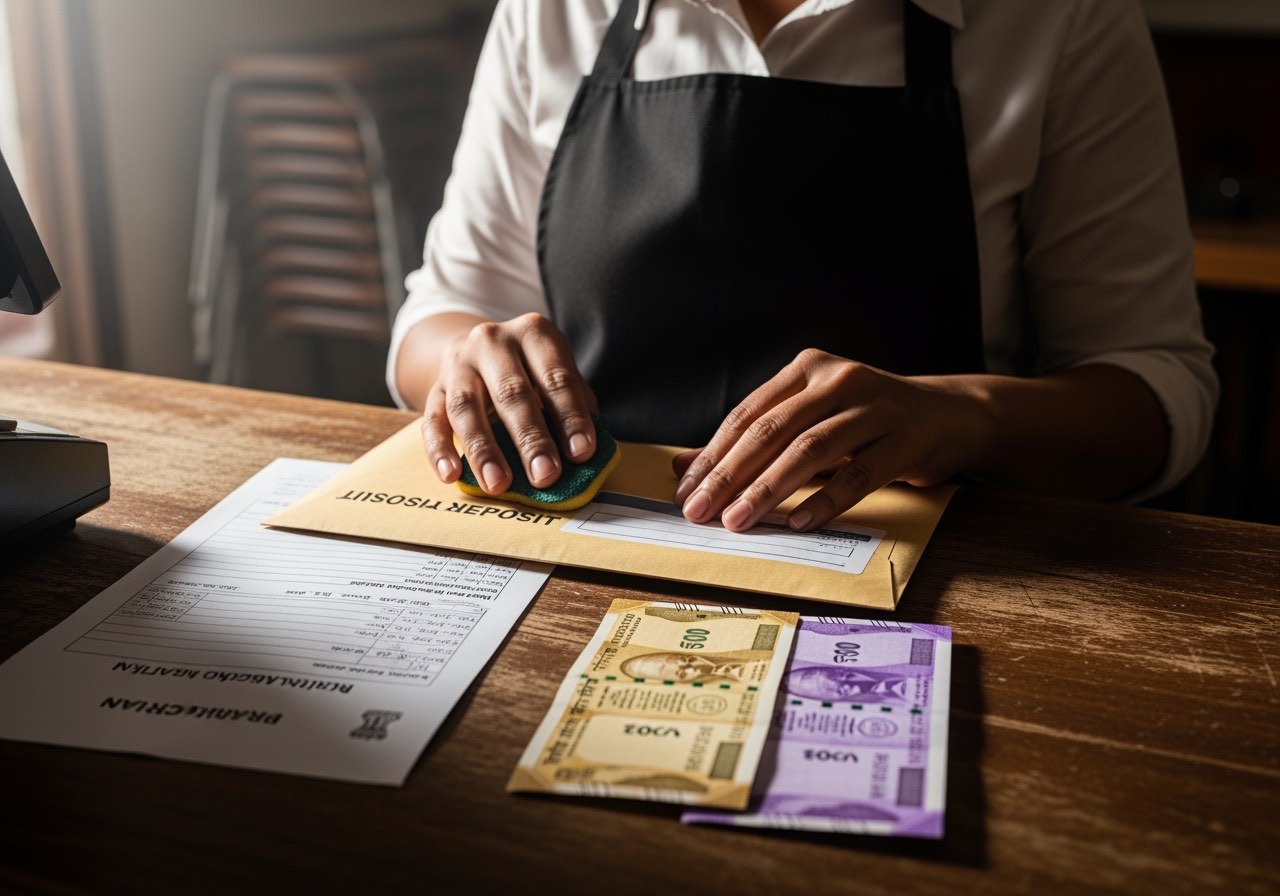
The half-sheet format
┌────────────────────────────────────────────────────────┐
│ INTERNAL CASH DEPOSIT SLIP — [Outlet]                  │
│                                                        │
│ Deposit no: ____________      Date: __/__/____         │
│ Outlet code: ______           For revenue date: __/__/__│
│                                                        │
│ Cashier (revenue night): ___________                   │
│ Manager (revenue night): ___________                   │
│ Person depositing today:   ___________                 │
│                                                        │
│ Amount in figures: ₹ ____________                      │
│ Amount in words:   Rupees __________________ only      │
│                                                        │
│ Denomination split:                                    │
│   ₹500  ×  ___  =  ₹ _______                           │
│   ₹200  ×  ___  =  ₹ _______                           │
│   ₹100  ×  ___  =  ₹ _______                           │
│   ₹50   ×  ___  =  ₹ _______                           │
│   ₹20   ×  ___  =  ₹ _______                           │
│   ₹10   ×  ___  =  ₹ _______                           │
│   Coins                ₹ _______                       │
│   TOTAL                ₹ _______                       │
│                                                        │
│ Bank: _____________  Branch: _____________             │
│ A/c last 4: ____                                       │
│                                                        │
│ Bank challan no (filled on return): __________         │
│ Bank stamp date: __/__/____                            │
│                                                        │
│ Cashier sign: ______   Manager sign: ______            │
│ Depositor sign on return: ______                       │
└────────────────────────────────────────────────────────┘
Print 100 per outlet. They live in the same binder as the close sheets, filed by date.
The cash deposit chain — three artefacts, one truth
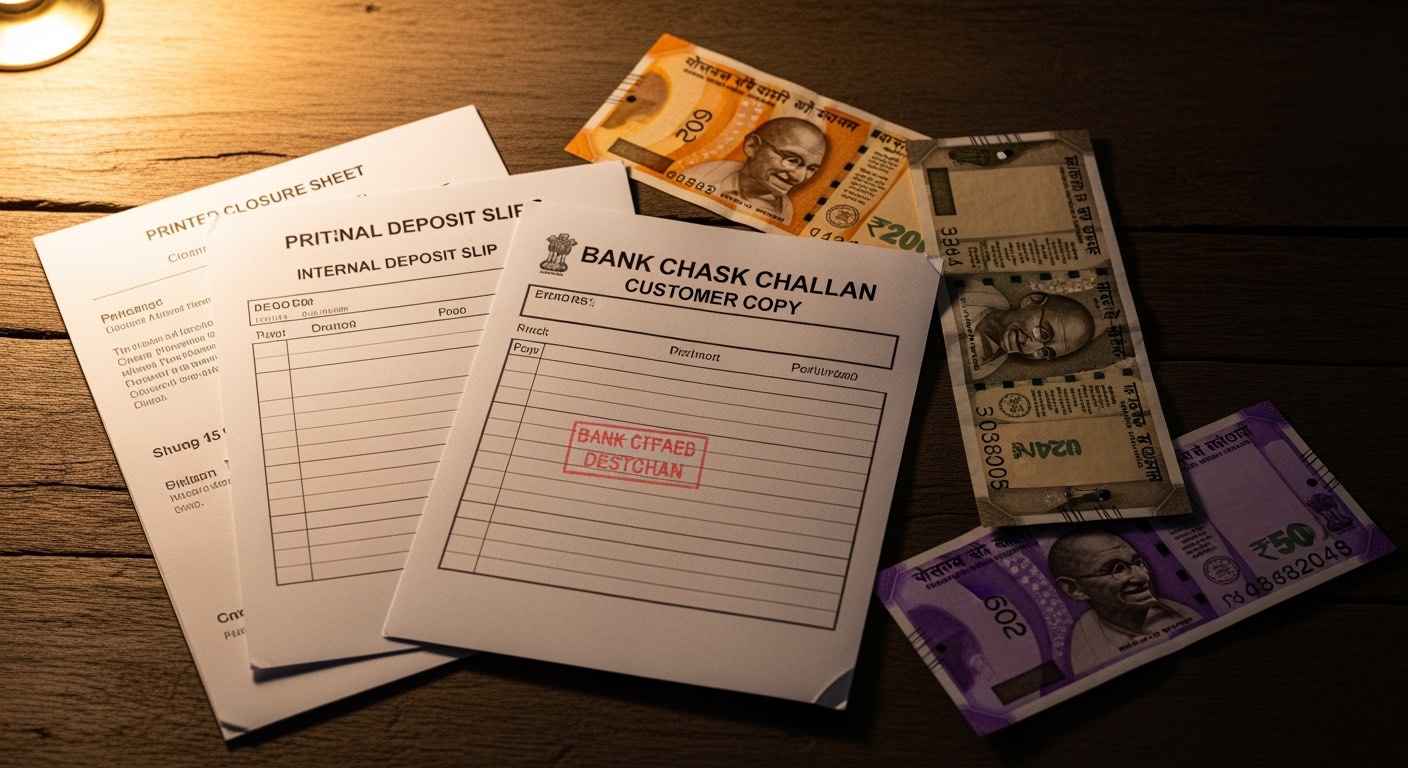
A clean day's deposit produces three pieces of paper that all agree on one number:
- Close sheet — yesterday's "Deposit envelope" line (till close)
- Internal deposit slip — the half-sheet above
- Bank challan (customer copy) — the bank's stamped slip
The amount on all three should be identical. If they don't agree, the close sheet is the source of truth — that's the moment the cash existed in the drawer and was witnessed by two people. The other two slips are downstream.
Most reconciliation pain at month-end stems from the chain being broken: a deposit slip with no challan attached (lost on the way), a challan with no internal slip (envelope went unrecorded), or two days' deposits combined into one bank entry. Filing the trio together prevents 90% of the pain.
How the deposit happens — order of operations
The morning after the revenue night, before the bank opens:
- Pull the close sheet from the previous night's binder
- Open the deposit envelope — count cash by denomination, fill the internal slip
- Cross-check — internal slip total should equal close sheet's "deposit envelope" number to the rupee
- Fill the bank challan — same denomination split, same total
- Take the cash, both slips, and the envelope to the bank
- Bank stamps the challan; keep customer copy
- Return to outlet — fill bank challan number on internal slip, sign as depositor
- Staple the trio — close sheet, internal slip, bank challan customer copy
- File in the month's deposit binder
That stapled trio is the audit-grade record. If anyone ever asks "what happened to the cash from 15-May", you pull one stapled set and it tells the whole story.
Six common deposit mistakes
- Combining two days' cash in one deposit. Tempting (saves a bank trip) but breaks the chain. Each revenue day = one deposit slip = one challan. Even if you go to the bank only on alternate days, prepare two slips.
- Bank challan amount differs from internal slip. Usually arithmetic. Recount before going to the bank, not after.
- Bank challan number not back-filled. The internal slip has a blank field for the challan number — it must be filled when the depositor returns. If it's not, the chain is loose.
- No depositor signature on return. The depositor confirms they handed over the right amount and the right challan. Without their signature, the chain has a gap.
- Coin deposits ignored. Coins accumulate. Many bank branches accept coin deposits only on specific days. Have a separate coin deposit slip; deposit weekly even if cash deposits are daily.
- Single denomination on slip when actual was mixed. Lazy filling — writing ₹15,000 as 30 × ₹500 when it was actually mixed. The bank teller may catch it; the audit trail is broken regardless. Fill the actual split.
Multi-outlet deposit handling
For 3+ outlets, deposits may consolidate at a central cashier or area manager, or each outlet may bank independently. Both work; the chain rules don't change.
| Model | Pros | Cons |
|---|---|---|
| Per-outlet bank deposit | Simpler chain, faster reconciliation | More bank trips, more accounts |
| Central cashier consolidates | One bank trip, one account | Adds a hand-off node — more places to lose the chain |
If you consolidate, add one more slip — the inter-outlet cash transfer slip — which records the hand-off from outlet to central cashier. Treat it like an inter-store transfer of stock: numbered, dated, signed by both ends.
A composite multi-outlet operator running 4 NCR outlets through a central cashier had a ₹4,200 mismatch take 11 days to resolve once. Root cause: outlet C's hand-off slip had been signed by the central cashier but not the outlet manager. The 11 days were spent trying to figure out which outlet was short. A signed-both-ends transfer slip would have caught it in 24 hours.
What the bank statement reconciliation looks like
End of month, the deposit binder gets reconciled against the bank statement. One row per deposit. The key columns:
| Date | Internal slip # | Outlet | Amount | Bank challan # | On bank statement? | Diff |
|---|---|---|---|---|---|---|
| 16-May | 042 | Lajpat | 17,310 | LJP/26/0512 | Yes, 17-May | 0 |
| 17-May | 043 | Lajpat | 19,840 | LJP/26/0517 | Yes, 17-May | 0 |
| 18-May | 044 | Lajpat | 21,200 | — | No | -21,200 |
That row 44 — no challan, no bank entry — is what you want to catch within the same month, not three months later.

Where this fits in the daily-ops loop
The deposit slip is the last node of the cash chain. It interlocks with:
- Till close — produces the deposit envelope amount (read)
- DSR — the day's "Bank deposit" calculated field ties to this slip (read)
- Bank statement reconciliation — monthly review pulls this binder
The whole loop is what Restaurant Daily digitises end-to-end; the deposit slip is the manual node where most outlets lose the trail today.
What to do this week
Print 50 internal deposit slips. Start using them tomorrow morning. Staple the trio (close sheet, internal slip, bank challan) for the next 30 days. End of month, reconcile against the bank statement.
You'll find at least one anomaly. That anomaly, found within the month, is what justifies the form's existence.
Related on Restaurant Daily
One operator playbook a week, in your inbox.
Cash close, petty cash, payroll, compliance, unit economics — sent every Monday morning. No spam, no upsell drip. Unsubscribe in one click.
Sent from noreply@restaurantdaily.ai. We never share your address.
Related reading
Denomination sheet restaurant cash count — Excel template + how to use it
Free denomination sheet for Indian restaurant cash counts — Excel + printable PDF, with auto-totals, variance row, and the right way to count a drawer in 2 minutes.
Shift handover format restaurant — single-page form for cash, stock, complaints
A single-page shift handover format for Indian restaurants — covering cash, stock alerts, open complaints, comps, and pending tasks. Free printable template.
Daily sales report restaurant Excel — free DSR template (India)
Free daily sales report Excel + Google Sheets template for Indian restaurants — 18 fields covering tender modes, GST splits, refunds, advances, and weekly rollup.
Restaurant till close checklist — printable 14-step end-of-day form
A 14-step restaurant till close checklist used by disciplined Indian outlets — printable A5 form covering cash, vouchers, POS, UPI, COD, and deposit envelope.
Restaurant cash management software India — 6 options compared (2026)
Restaurant cash management software in India compared — Petpooja, Posist, Khatabook, Vyapar, Restaurant Daily, manual Excel — pricing, features, support, fit.