Dhaba cash management when you're the single owner — paper-only system that passes audit
Dhaba cash management for the single owner-operator — a paper-only system that handles GST, Income Tax Rule 6DD, vendor udhaar, and still passes audit. No software.
Last updated 9 Aug 2026
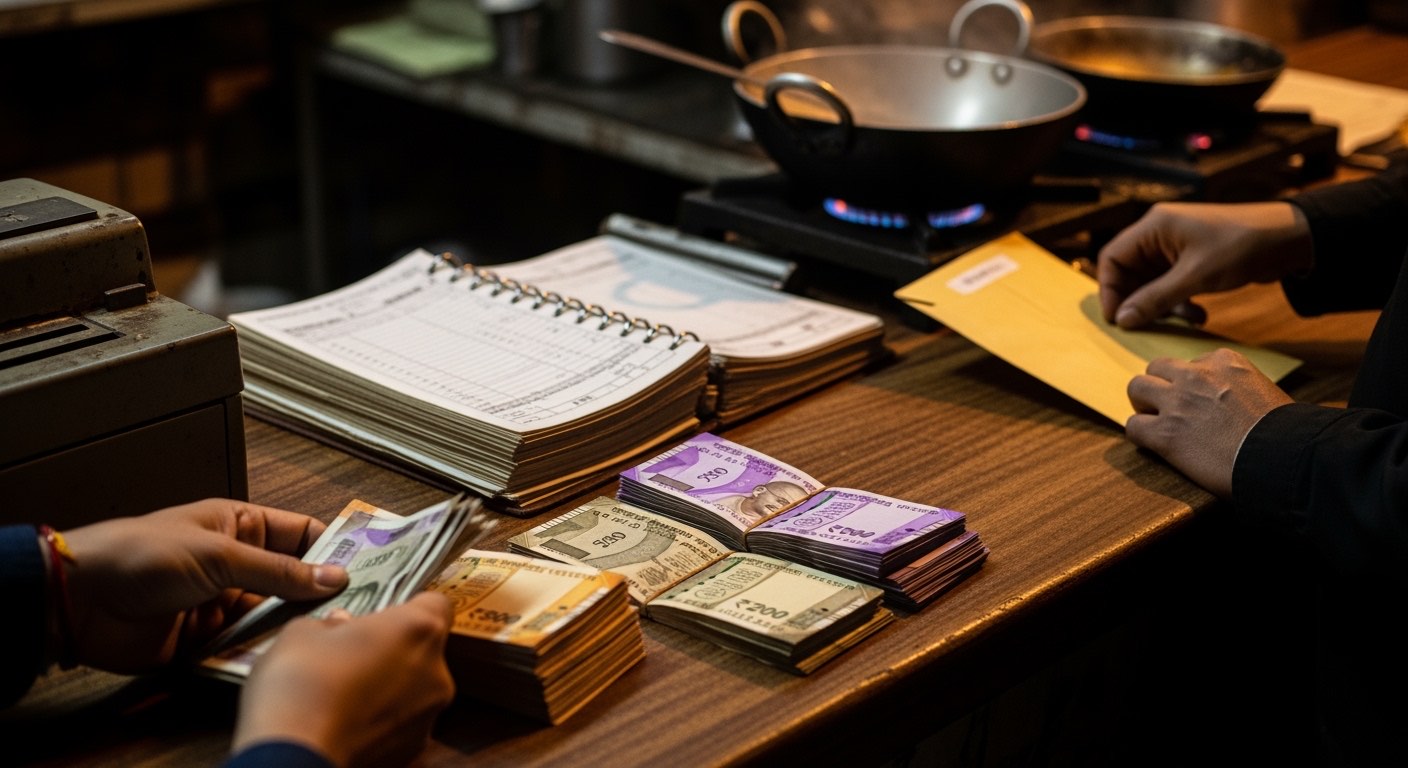
About this piece. A dhaba is a different cash-handling problem from a metro restaurant. The owner is at the counter most of the day. The cashier and the owner are often the same person. The accountant is a part-time visitor. Software is overhead the owner doesn't want, and frankly doesn't need. This piece gives you a paper-only cash management system that handles GST, Income Tax compliance, vendor udhaar, and still passes audit — designed specifically for the dhaba single owner-operator.
Why a dhaba can run paper-only and still be compliant
GST and Income Tax law require records, not digital records. Indian SMB dhabas under ₹2 Cr turnover (Composition Scheme threshold) can run a fully paper-based system and meet both. The catch is that the paper has to be:
- Sequentially numbered — every voucher, every bill, every register entry
- Cross-referenced — daily register entries reference voucher numbers
- Date-ordered + monthly bundled — every month's papers in one bundle, banded and labelled
- Two-signature on cash transactions ≥ ₹500 — owner + recipient
If the paper meets those four rules, the dhaba is compliant. The system below is built around those rules.
The four registers a dhaba needs
Just four. No more.
| Register | What it tracks | Format |
|---|---|---|
| Sales register (बिक्री बही) | Every day's gross sales — cash + UPI separately | A4 register, one page per day |
| Petty cash voucher pad (PCV) | Every cash spend ≥ ₹50 | Half-sheet PCV pad (format) |
| Vendor udhaar bahi | Every vendor — supply received, payment made, balance | A4 register, one page per vendor |
| Daily summary register (DSR) | End-of-day reconciliation | A4 register, one page per day |
The four registers + a deposit envelope per day = the entire system. No software.
Daily flow — open to close
A dhaba day looks like this:
6:30am — Open. Cashier (often owner) counts till = imprest float (₹3,000 typical).
         Sales register page started for today.

7:00am — First customer. Order taken. Bill book entry made (sequential).
         Cash/UPI mode noted.

Through day — Every cash spend → PCV written (carbon copy stays in pad).
              Every UPI received → marked in sales register.
              Every vendor delivery → vendor udhaar bahi entry.

10:30pm — Last customer.

10:45pm — Cash count. PCV total. Sales register totalled (cash + UPI + card).

10:50pm — DSR entry: opening float + cash sales − petty spend = expected cash.
         Compare to actual. Variance noted.

11:00pm — Deposit envelope: actual cash − tomorrow's float.
         Envelope sealed, dated, signed.
         All four registers locked.
That's the whole loop. 15 minutes at close.
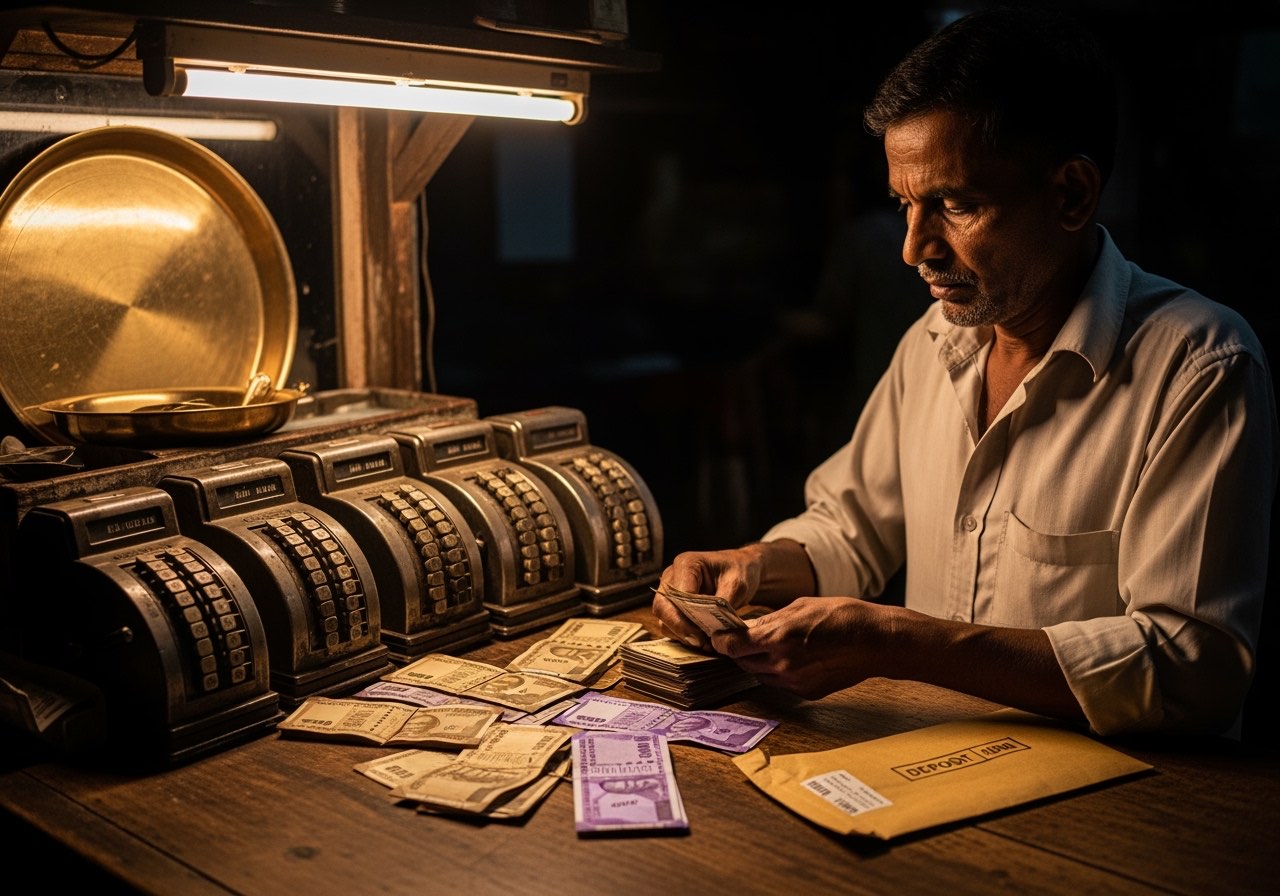
The imprest float for a dhaba
Same formula as for any restaurant — F = D × p × s:
D= average daily petty spend (₹/day)p= peak factor (1.5 typical, 2.0 if NH-side dhaba with truck festivals)s= shift coverage (1.0 for single-owner; 1.3 if helper covers afternoon)
For a typical NH-side single-owner dhaba doing ₹12,000–₹18,000/day in sales:
| Type | D | p | s | Float |
|---|---|---|---|---|
| Roadside dhaba, single shift | ₹1,200 | 1.5 | 1.0 | ₹1,800 |
| Highway dhaba, day+night | ₹1,800 | 1.5 | 1.3 | ₹3,510 |
| Festival/transport-heavy | ₹2,000 | 2.0 | 1.3 | ₹5,200 |
Round to nearest ₹500. The number gets stuck on the inside of the cash drawer. Detail in the imprest float piece.
Vendor udhaar bahi — the udhaar discipline
Most dhabas in tier-2/3 India run on vendor udhaar — सब्ज़ी वाला, दूध वाला, गैस सिलेंडर, आटा। Settlement is weekly or monthly. A vendor udhaar bahi has one page per vendor:
Vendor: Ramesh Sabzi Mandi              Page 7
Phone: 98XXXXXXX

Date     | Supply (₹)  | Payment (₹) | Balance (₹) | Owner sign
---------|-------------|-------------|-------------|------------
01/Aug   | 1,240       | -           | 1,240       | [sign]
02/Aug   | 1,180       | -           | 2,420       | [sign]
03/Aug   | 1,090       | -           | 3,510       | [sign]
05/Aug   | -           | 3,500       | 10          | [sign]
05/Aug   | 1,150       | -           | 1,160       | [sign]
Two rules:
- Owner signs every entry — supply and payment both. Without owner sign, dispute resolution is impossible.
- Vendor signs payment entries — when you pay, vendor signs against the payment row. That's the receipt.
Monthly settlement: page totalled, vendor + owner both sign at month-end. Page rolled to next month's bahi with carry-forward balance.
Composite Karnal NH-44 dhaba owner had three vendors disputing balances at year-end 2025 — total contested = ₹47,000. None of his udhaar entries had vendor signatures. He paid ₹31,000 in disputed amounts that he knew he'd already settled, just to keep the relationships. Two-signature rule for ₹3,000 worth of registers would've saved that.
The PCV pad — same as any restaurant
Standard 9-field PCV format, half-sheet, A6 size, 50 to a pad. (Detailed format here.) Three dhaba-specific tweaks:
- Carbon copy version — original goes to vendor/recipient if asked; carbon stays in pad. Easier for audit.
- GL category list shorter — Food, Cleaning, Petrol, Gas, Repairs, Staff welfare, Other. Six categories, not ten.
- Hindi labels — most dhaba cashiers (often family) read Hindi faster. (Hindi PCV template.)
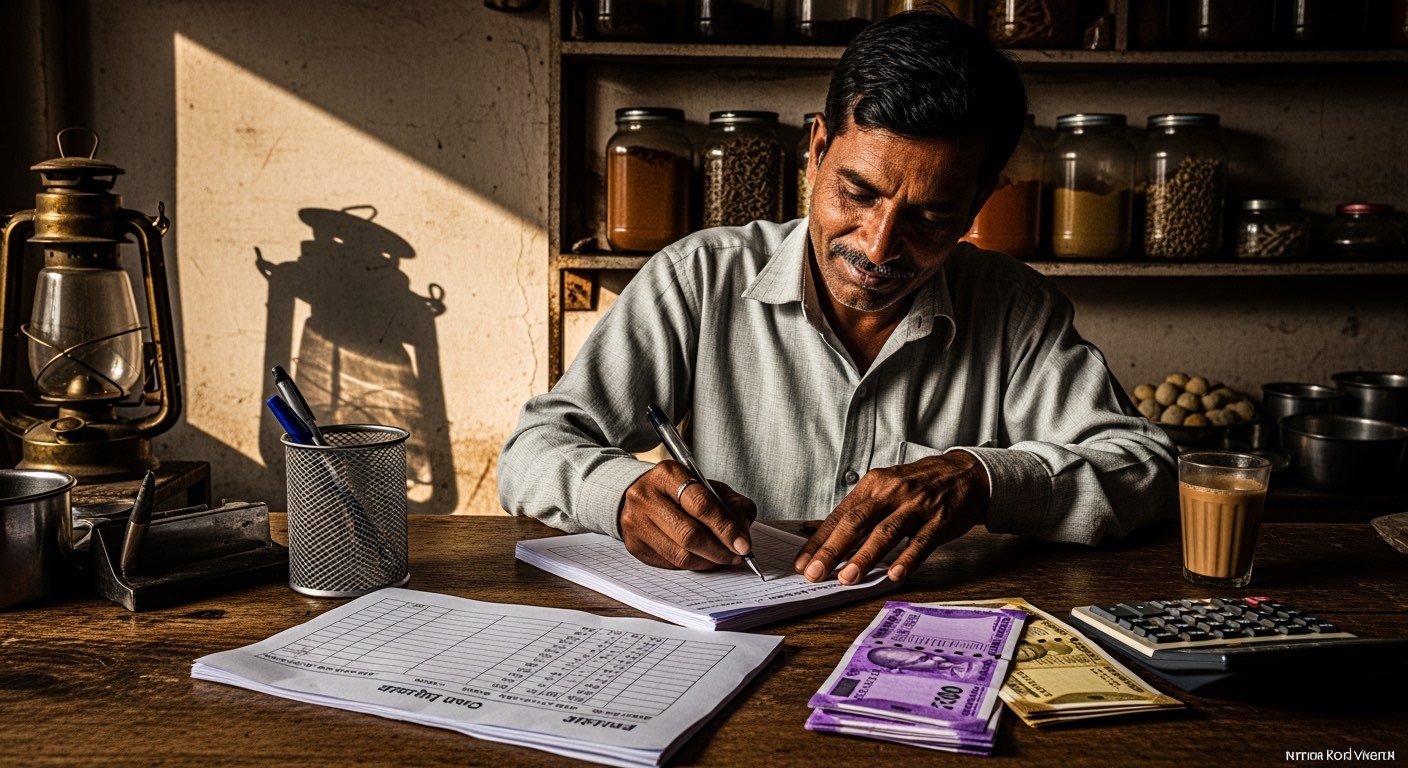
Sales register — the bill book + the page
The sales register is your daily ledger. Two parts:
- Bill book — sequentially numbered, carbon-copy. Every order gets a bill, even ₹40 chai. Customer's copy goes; carbon stays.
- Sales register page — at end of day, bill book is totalled. Page has columns for cash sales, UPI sales (taken from PhonePe/Paytm history), card sales (rare in dhabas), and aggregator (Swiggy/Zomato if applicable).
Day's total = sum of these four. This number flows into the DSR.
DSR — the daily reconciliation
12-field DSR format covered in detail in the Hindi DSR piece. The dhaba version uses the same format with one addition: vendor udhaar payments made today is a separate line item below petty spend, since vendor payments are usually larger than typical PCV amounts and you want them visible.
Variance ±₹100 acceptable for a dhaba doing ₹15,000/day in sales (~0.7%). >₹300 = investigate.
Monthly bundle for the accountant
Once a month — 5th of next month — bundle and hand over:
| Item | Form |
|---|---|
| Sales register pages × 30 | Bound monthly |
| PCV pad (used) | One pad per month |
| Vendor udhaar bahi | Photocopies of each vendor page |
| DSR pages × 30 | Bound monthly |
| Bank deposit slips × 30 | Stapled by date |
| GST input invoices | Folder, by date |
Accountant reconciles, files GST return, files Income Tax (annual). 30 minutes of accountant time per month with this bundle vs 4 hours without. The accountant's fee will reflect that.
Three mistakes dhaba single-owners make
1. Skipping bills for "small" sales
A ₹40 chai without a bill is ₹40 untracked. Across a day that's 60 chais = ₹2,400. Across a year, ₹8.7 lakh. The Income Tax assessing officer's reconstruction of unrecorded revenue uses electricity bills + LPG cylinder usage + vendor invoices — and they will reconstruct it. Bill every sale.
2. Mixing personal and business cash
Owner takes ₹2,000 from till for personal use → no entry → ₹2,000 variance at close → "ye to mein hi nikaala tha, normal hai". Three months of this and the cash discipline is gone. Rule: every personal withdrawal is a PCV with category "Owner drawing". Two-signature: owner + helper.
3. Vendor payment without recording
Paying ₹5,000 to गैस वाला without an entry in the udhaar bahi → next month dispute. Pay on the spot, write on the spot, sign on the spot. No exceptions.
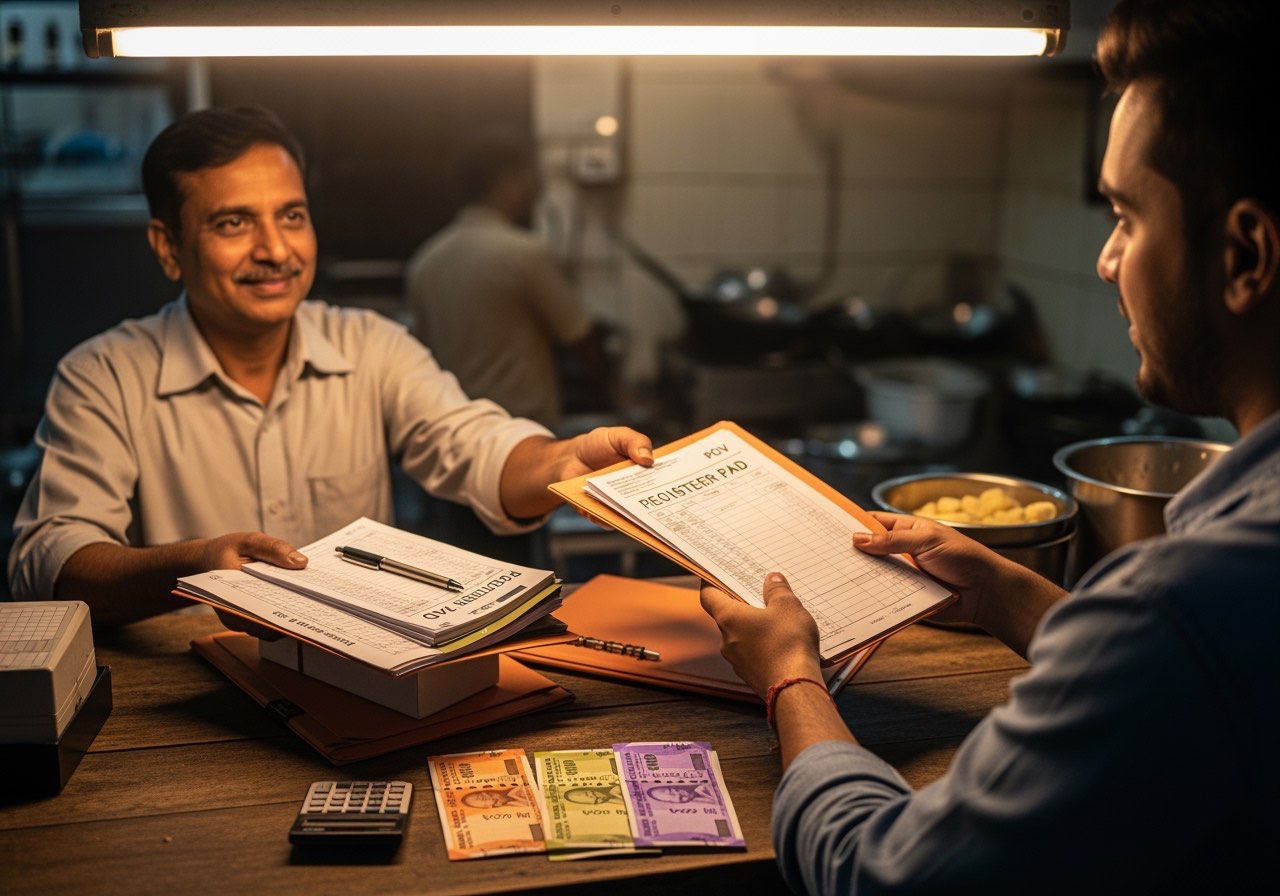
What to do this week
If you're not running this system: buy four registers and one PCV pad. Total cost ₹350. Start the system Monday morning. By Sunday you'll have one full week of paper records — more financial discipline than 70% of your peers, and your accountant will notice immediately.
Related on Restaurant Daily
One operator playbook a week, in your inbox.
Cash close, petty cash, payroll, compliance, unit economics — sent every Monday morning. No spam, no upsell drip. Unsubscribe in one click.
Sent from noreply@restaurantdaily.ai. We never share your address.
Related reading
रेस्टोरेंट का हिसाब कैसे करें — रोज़ाना cash, POS, deposit reconcile करने का guide
रोज़ाना रेस्टोरेंट का हिसाब कैसे करें — cash float, POS sales, Swiggy/Zomato payout, deposit slip और GST के लिए एक practical Hindi गाइड Indian operators के लिए।
Food truck daily cash close — 9-step protocol when there's no back-office
Food truck daily cash close — a 9-step protocol that runs from the truck's side hatch when there's no back-office, no till, and the operator is also the cook.
दैनिक बिक्री रिपोर्ट रेस्टोरेंट — Hindi Excel template + DSR भरने का तरीका
भारतीय रेस्टोरेंट के लिए दैनिक बिक्री रिपोर्ट (DSR) — हिंदी Excel template, भरने का step-by-step तरीका, और cash/UPI/card reconciliation का सही method।
Restaurant cash management software India — 6 options compared (2026)
Restaurant cash management software in India compared — Petpooja, Posist, Khatabook, Vyapar, Restaurant Daily, manual Excel — pricing, features, support, fit.
Khatabook for restaurants — what it replaces, what it can't
An honest operator look at Khatabook for Indian restaurants — what the udhaar ledger handles well, where daily cash close, POS, and GST work still need a separate tool.