Petty cash limit company policy — single-page template for restaurants
Petty cash limit company policy template for Indian restaurants — what limits to set per voucher, per category, per month. Single-page, free, ready to deploy.
Last updated 9 Aug 2026

About this piece. A petty cash limit policy is one page of decisions made in advance about what cash spends are allowed, by whom, in what amount, against what evidence. Without it, every spend is a fresh negotiation between cashier and manager — slow, inconsistent, and impossible to audit. This piece gives you the template, the rationale for each limit band, and the four pitfalls that make policies sit in a binder unread.
Why a written policy beats a "we just know"
In our operator interviews, fewer than 20% of single-outlet restaurants have a written petty cash limit policy. Most run on the manager's accumulated judgment: "₹500 tak okay, ₹2,000 mein WhatsApp pooch lo, ₹5,000 owner ko bolna padega." This works as long as the manager is present, conscious, and consistent. It breaks when:
- The manager is on leave and the assistant is making decisions
- A new manager joins and inherits no documented limits
- A multi-outlet area manager is comparing two outlets and finds different unwritten rules
- An audit (internal or statutory) asks for the policy in writing
The written policy fixes all four. It's also a faster artefact than people expect — one page, 30 minutes to draft for an existing outlet, and a ten-year shelf life with quarterly review.
The 6 limits a policy must set
A petty cash limit policy is really a stack of six interlocking limits. Each answers a specific operational question.
| # | Limit | Question it answers | Typical SMB band |
|---|---|---|---|
| 1 | Per-voucher limit | Largest single PCV without escalation | ₹500–₹2,500 |
| 2 | Per-category monthly limit | Cap on each GL category in a month | ₹3,000–₹15,000 |
| 3 | Per-vendor monthly limit | Cap on cash to a single vendor per month | ₹8,000–₹20,000 |
| 4 | Rule 6DD ceiling | Hard ceiling for any single-day-single-party cash | ₹9,500 (below ₹10,000 statutory) |
| 5 | Authorisation tiers | Who can approve each band | Cashier / Mgr / Owner |
| 6 | Mode-of-payment threshold | Above which spend must be UPI/bank | ₹5,000 |
Limits 1–3 control day-to-day spend velocity. Limit 4 prevents a Rule 6DD breach. Limit 5 names the human in the loop. Limit 6 forces cash off the table at the right size, which is the cleanest control of all.
The single-page policy template
┌──────────────────────────────────────────────────────────────────┐
│  PETTY CASH LIMIT POLICY                                          │
│  [Outlet / Group name]                                            │
│  Effective: ____ / ____ / ______    Review: ____ / ____ / ______  │
│                                                                   │
│  1. PURPOSE                                                       │
│  This policy defines monetary limits and authorisation tiers      │
│  for petty cash payments at [outlet / group]. It applies to all   │
│  cash spends from the petty cash holding (PCH).                   │
│                                                                   │
│  2. LIMITS                                                        │
│  2.1  Per-voucher limit:        ₹ ________                        │
│  2.2  Per-vendor monthly limit: ₹ ________                        │
│  2.3  Rule 6DD ceiling (hard):  ₹ 9,500 single party / day        │
│  2.4  Mode-of-payment cutover:  Spends > ₹ ________ must be       │
│                                  UPI / bank transfer, not cash.   │
│                                                                   │
│  3. CATEGORY MONTHLY CAPS                                         │
│   Cleaning & sanitation:   ₹ ________                             │
│   Repairs (kitchen / FOH): ₹ ________                             │
│   Stationery & printing:   ₹ ________                             │
│   Commercial gas / utility:₹ ________                             │
│   Local transport:         ₹ ________                             │
│   Staff welfare / meals:   ₹ ________                             │
│   Other:                   ₹ ________                             │
│   Caps reset on the 1st of each calendar month.                   │
│                                                                   │
│  4. AUTHORISATION TIERS                                           │
│   Tier 1 — Up to ₹ ____ : Cashier may approve, signs voucher      │
│   Tier 2 — ₹ ____ to ₹ ____ : Manager approval required           │
│   Tier 3 — Above ₹ ____ : Owner approval required                 │
│   Owner approval may be by signature, WhatsApp, or call;          │
│   Tier 3 vouchers must reference the approval method + time.      │
│                                                                   │
│  5. EVIDENCE REQUIREMENTS                                         │
│  Every voucher must have:                                         │
│   • Sequential voucher number                                     │
│   • GL category ticked                                            │
│   • Cashier signature                                             │
│   • Recipient signature (or thumb impression with witness)        │
│   • Vendor bill attached if voucher amount > ₹ ________           │
│   • Vendor GSTIN if vendor is GST-registered                      │
│                                                                   │
│  6. EXCEPTIONS                                                    │
│  Limits may be exceeded only with written owner approval, noted   │
│  on the voucher itself. Repeated exceptions trigger a policy      │
│  review at the next quarterly audit.                              │
│                                                                   │
│  7. REVIEW                                                        │
│  This policy is reviewed quarterly alongside the petty cash       │
│  audit and re-issued with any limit changes.                      │
│                                                                   │
│  Signed (Owner): _________________   Date: ____ / ____ / ______   │
│  Signed (Manager): _______________   Date: ____ / ____ / ______   │
└──────────────────────────────────────────────────────────────────┘
That's the whole policy. One A4 page. Two signatures. Posted on the back office board.
How to set the numbers — five-step process
The blanks aren't filled randomly. Use this sequence:
- Pull the last 90 days of PCV data. Sum by GL category. Compute the monthly average per category.
- Per-voucher limit. Set at ~2.5× the median voucher amount. For most SMB outlets that's ₹500–₹2,500.
- Category monthly caps. Set at the 90-day monthly average + 25% headroom. Tightens over time as discipline takes hold.
- Per-vendor monthly limit. Look at top vendor by spend over 90 days. Set the cap 20% above current — high enough to not interrupt normal flow, low enough to flag concentration drift.
- Mode-of-payment cutover. Sit between ₹3,000 and ₹5,000 for most outlets. Anything above goes UPI/bank. Cleanest single control: it makes Rule 6DD breach almost impossible by construction.
The policy is not aspirational — it should describe how the outlet already operates, with caps that bite only on outliers. Aspirational policies (limits set well below current spend) are ignored within a month. Realistic policies that tighten 5% a quarter compound into discipline.
The four pitfalls that make policies useless
Pitfall 1 — Limits set in a binder, not in the workflow
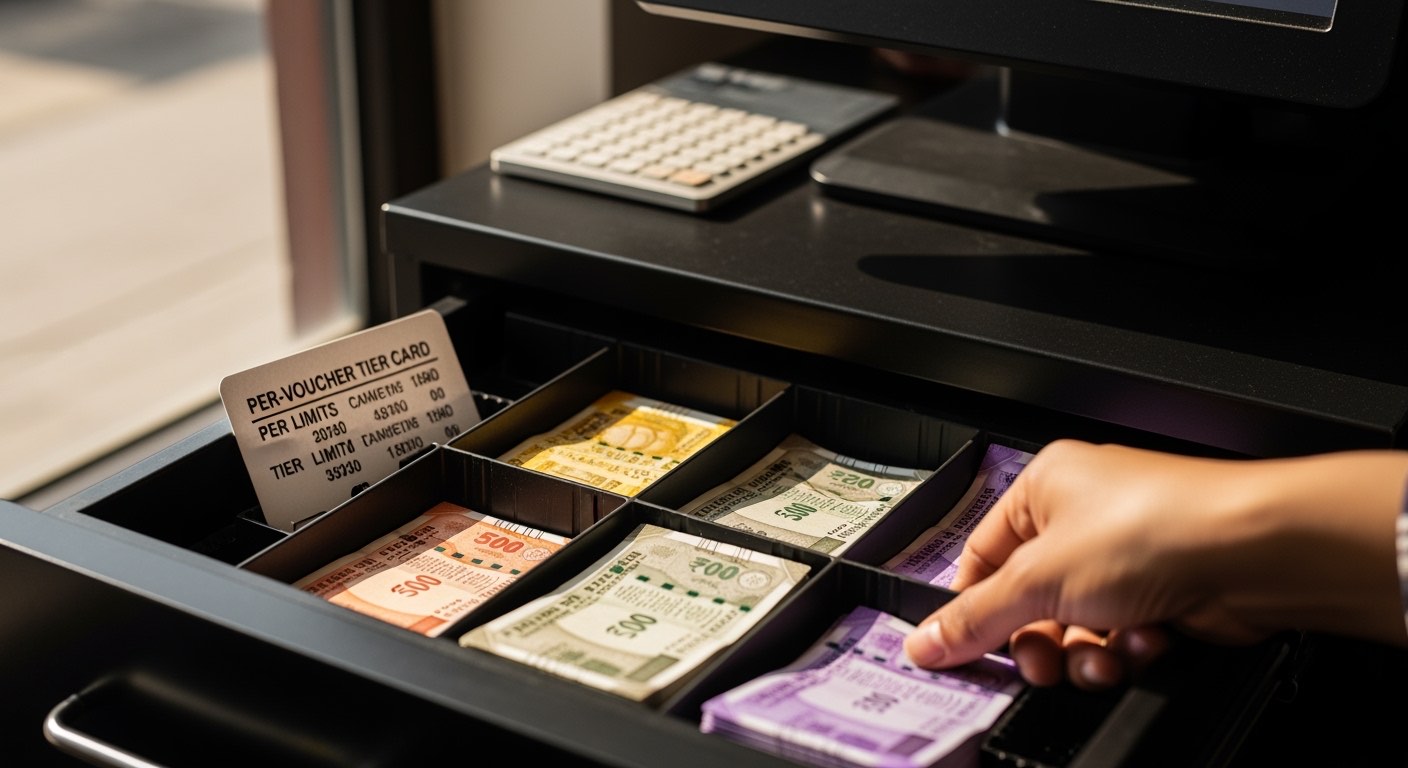
A policy that lives in a binder in the office is invisible at the moment of decision — when the cashier is at the till deciding whether a ₹1,800 spend needs approval. Print the limit row from Section 2 on a small laminated card and keep it inside the cash drawer. The decision then happens with the policy in front of the cashier, not in their memory.
Pitfall 2 — Approval tiers nobody honours
If Tier 3 says "owner approval above ₹3,000" but in practice the manager regularly approves ₹4,000 spends and tells the owner later, the tier is fiction. Either tighten the tier (₹4,500 owner-approval) or formalise the manager's authority (raise Tier 2 ceiling). The worst state is a stated tier that's routinely breached — it teaches everyone that the policy isn't real.
Pitfall 3 — Category caps without category vouchers
If the PCV pad doesn't have GL category checkboxes, you can't enforce category caps. Reissue the pad first, then the policy. See petty cash voucher format India for the field layout.
Pitfall 4 — Quarterly review skipped
Policies drift out of relevance as the outlet evolves. A new menu, a new vendor, a renovation — each changes the spend mix. Calendar the quarterly review with the audit (see petty cash audit checklist). 30 minutes, four times a year.
A worked example — 50-cover NCR QSR
Pulled from a typical anonymised operator data set:
- 90-day petty cash spend: ₹1,62,000 (₹1,800/day average)
- Median voucher: ₹420
- Largest single PCV: ₹2,400
- Top vendor (vegetable supplier): ₹14,500/month
- Top category (cleaning + repairs combined): ₹19,000/month
Policy numbers that emerge:
| Field | Value |
|---|---|
| Per-voucher limit | ₹1,500 |
| Per-vendor monthly | ₹17,500 |
| Mode cutover | ₹4,000 |
| Cleaning monthly cap | ₹11,000 |
| Repairs monthly cap | ₹13,500 |
| Tier 1 (cashier) | ₹0–₹500 |
| Tier 2 (manager) | ₹501–₹2,000 |
| Tier 3 (owner) | Above ₹2,000 |
This policy bites only on outliers — most spends sail through Tier 1. The Tier 3 bar at ₹2,000 forces an owner touch on the few largest spends a month, which is also where the largest leakage risk sits.
Multi-outlet variant — group policy with outlet-level caps
For an Anjali running 3–5 outlets, the policy structure splits in two:
- Group-level rules (Sections 1, 4, 5, 6, 7) — same across all outlets
- Outlet-level limits (Sections 2, 3) — vary by outlet revenue and spend mix
The benefit is a single document type for the group with an outlet-specific schedule. Audits across outlets become apples-to-apples — different category caps but same authorisation discipline.
Don't try to standardise category caps across outlets of different sizes. A 30-cover cafe and a 90-cover dinner-heavy outlet have legitimately different cleaning spends. Standardise the rules (tiers, evidence, review cadence), let the amounts vary.
Communicating the policy to staff
Three-step roll-out for an existing outlet:
- Owner + Manager sign and date the policy. Two copies — one filed, one posted.
- 15-minute briefing with cashier(s). Walk through Sections 2, 4, 5. Show the laminated drawer card. Answer questions.
- First two weeks — manager double-checks every Tier 2 voucher within 24 hours. Calibrates the tiers. Flag anything that feels too tight or too loose.
After the calibration window, the policy runs itself. Cashier knows when to escalate. Manager knows what they own. Owner knows what reaches them.
Where this fits with the rest of petty cash discipline
The policy is the agreed-rules layer above the operational layers:
- Sized float — how much petty cash to hold
- Voucher format — petty cash voucher format India
- Cashier accountability form — the staff declaration
- Quarterly audit — petty cash audit checklist
Stack all four and the petty cash function moves from owner-dependent to system-dependent. The owner can travel; the discipline doesn't.
What to do this week
Pull 90 days of PCV data on Saturday. Fill the template. Print, sign, post. Print the laminated drawer card. Brief the cashier on Monday morning. Review in 90 days.
Related on Restaurant Daily
- Petty cash voucher format India — free template — the voucher that supports the policy
- Petty cash audit checklist — 12-point quarterly — the quarterly review the policy references
- Income Tax Rule 6DD for restaurants — the statutory ceiling the policy enforces
One operator playbook a week, in your inbox.
Cash close, petty cash, payroll, compliance, unit economics — sent every Monday morning. No spam, no upsell drip. Unsubscribe in one click.
Sent from noreply@restaurantdaily.ai. We never share your address.
Related reading
Rule 6DD restaurant — when ₹10,000 cash limit applies (and doesn't)
Rule 6DD restaurant guide — when the ₹10,000 single-day cash limit applies under §40A(3), exceptions, daily-ops impact, and the workflow that keeps you safe.
Cashier accountability form — free template for Indian restaurants
Cashier accountability form for Indian restaurants — free declaration template + how to deploy it without alienating staff. Operator-grade controls.
Petty cash audit checklist India — 12-point quarterly review for restaurants
Petty cash audit checklist India — 12-point quarterly review for Indian restaurants. Voucher integrity, GST, Rule 6DD, control gaps. Free printable checklist.
Imprest vs floating petty cash — which fits a single-outlet restaurant
Imprest vs floating petty cash systems compared for Indian restaurants. Reconcilability, control overhead, fit by outlet size — with the rule for which to choose.
GST petty cash expense for restaurants — input credit, RCM, Rule 6DD
GST on petty cash expense for Indian restaurants — what you can claim as input credit, when reverse charge kicks in, and how Rule 6DD interacts with cash spends.