GST petty cash expense for restaurants — input credit, RCM, Rule 6DD
GST on petty cash expense for Indian restaurants — what you can claim as input credit, when reverse charge kicks in, and how Rule 6DD interacts with cash spends.
Last updated 9 Aug 2026

About this piece. Petty cash is where GST and Income Tax compliance most often quietly slips at SMB Indian restaurants. The amounts are small, the vendors are mixed (some GST-registered, many not), and the cashier is not the accountant. This piece walks through what input credit you can actually claim from petty spends, when reverse charge applies, how Rule 6DD intersects, and the three voucher-side disciplines that keep the books defensible. Not tax advice — sanity-check with your CA for your specific case.
The three legal threads that cross at the petty drawer
Every petty cash payment touches three different laws at once:
- CGST Act §16-17 — when you can claim input tax credit (ITC) on a cash spend.
- CGST §9(3) / §9(4) — when reverse charge mechanism (RCM) is triggered for goods or services bought from unregistered persons.
- Income Tax Rule 6DD — the ₹10,000 single-day single-party cash limit that determines whether the expense is deductible at all.
Most petty cash leakage we see at compliance level is from these three running into each other unexamined. You either claim ITC you can't substantiate, miss ITC you could have claimed, or pay cash above the Rule 6DD limit on something the law disallows.
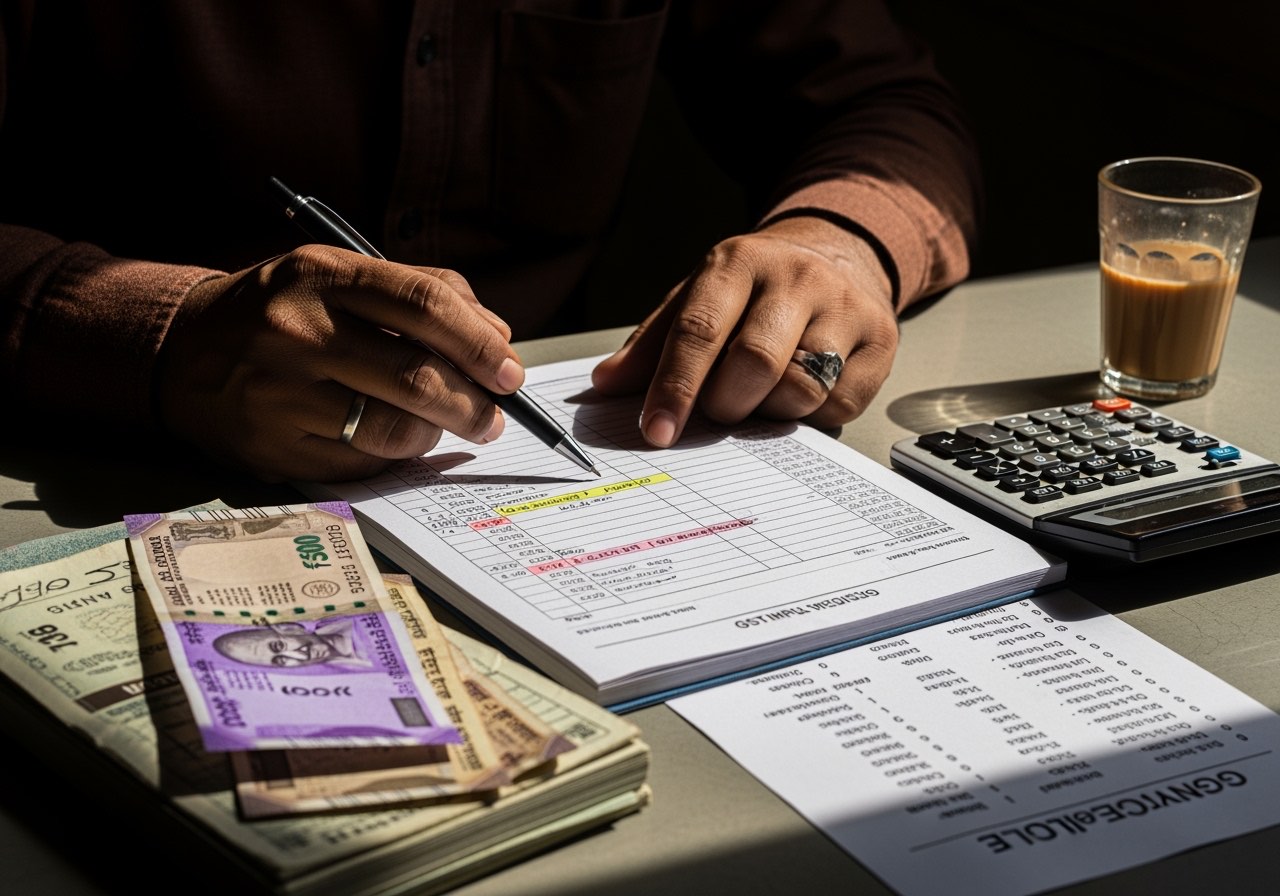
What petty spends are ITC-eligible (and which are blocked)
The crucial blocking provision is CGST §17(5) — the "blocked credits" list. For restaurants, the categories that typically do not qualify for input credit, even with a perfect tax invoice, include:
- Food and beverages purchased for staff (unless it's a statutorily required canteen — most restaurants don't qualify)
- Outdoor catering received as input
- Health services — staff medical reimbursements
- Membership of clubs, health, and fitness centres
- Motor vehicles used for non-business movement
- Goods or services used for personal consumption
The petty spends that do typically qualify (subject to the §16 conditions — valid tax invoice, supplier filed their GSTR-1, goods/services received, etc.) are:
| Petty cash category | Typical ITC eligibility | Caveat |
|---|---|---|
| Cleaning supplies | Yes | Vendor must be GST-registered, valid invoice |
| Repairs & maintenance (kitchen, FOH) | Yes | Capital vs revenue distinction matters |
| Stationery, printing | Yes | Standard input |
| Gas refill (commercial LPG) | Yes | Commercial connection invoice |
| Office utilities top-ups | Yes | Receipt with GSTIN |
| Pest control | Yes | Service invoice with GSTIN |
| Vegetable / fresh produce (unbranded) | N/A | Exempt — no GST charged |
| Petrol / diesel | No | Outside GST currently |
| Staff tea / snacks | No | §17(5) blocked |
| Local autorickshaw fare | No | Mostly unregistered, no invoice |
| Tip-outs, gifts | No | Personal / non-business |
A surprising amount of monthly petty spend at most restaurants is in the "yes" column — cleaning supplies, repairs, stationery, gas — and is being left unclaimed because the cashier didn't capture the vendor's GSTIN on the voucher.
The §16 conditions — the four that actually matter at the voucher stage
CGST §16(2) lists the conditions for claiming ITC. At the petty cash voucher stage, four matter:
- Possession of a valid tax invoice — the bill must show the vendor's GSTIN, your GSTIN, taxable value, CGST/SGST or IGST split, and HSN/SAC code where applicable.
- Receipt of goods/services — the goods physically arrived; the service was rendered. The voucher signature trail is your evidence.
- Tax actually paid to the government by the supplier — i.e., the supplier filed their GSTR-1 and the credit reflects in your GSTR-2B. This is the modern reconciliation step most owners miss.
- Payment to the supplier within 180 days — usually moot for petty cash (same-day payment), but matters for cash payments to vendors with credit terms.
The voucher itself is the artefact your CA needs to flow these into GSTR-3B. Without the GSTIN and the tax split on the voucher, the ITC trail breaks.
Practical rule: any petty cash voucher above ₹250 to a vendor who might be GST-registered, the cashier asks for a tax invoice (not just a kachcha bill). The two-second question — "GSTIN bill milega?" — recovers a measurable amount of ITC per month at most outlets.
When reverse charge (RCM) kicks in on petty spend
CGST §9(3) lists specific services where the recipient pays GST instead of the supplier — typical examples for restaurants include:
- Goods transport agency (GTA) services — if you hire a GTA to move bulk supplies
- Legal services from advocates / firms
- Services of director (where applicable)
- Renting of motor vehicles for passenger transport (under certain conditions)
§9(4) on RCM for unregistered purchases by registered persons was narrowed in 2017 and currently applies only to a notified list (real estate inputs, etc.) — for most restaurant petty spend from unregistered vegetable vendors or local autos, RCM does not apply today. But there are two reasons to still capture the data on the voucher:
- The notified list has changed before and may change again.
- If your GST consultant later finds a specific RCM trigger, the audit trail is needed retrospectively.
Hence the discipline: even for petty spends from unregistered vendors, the voucher captures the vendor's name and address. If RCM doesn't apply, you've lost 10 seconds of cashier time. If it does and you don't have the data, you've lost the deduction.
How Rule 6DD interacts — the ₹10,000 cash limit
Income Tax Rule 6DD disallows business expenditure (under §40A(3)) where a single payment to a single party in a single day exceeds ₹10,000 in cash. The threshold is ₹35,000 for payments to transporters. There are limited exceptions (banking holidays, specific village conditions, etc.) but for petty cash purposes assume the ₹10,000 limit is hard.
What this means at the voucher level:
- A single PCV cannot be ≥ ₹10,000 if the recipient is one party.
- Two PCVs to the same party on the same day, totalling ≥ ₹10,000, also trigger disallowance.
- The fix is not to split into multiple smaller PCVs — that's exactly what Rule 6DD was designed to catch. The fix is to pay via UPI / bank transfer / cheque for any single-day single-party spend ≥ ₹10,000.
Petty cash voucher templates should flag any voucher amount above ₹10,000 at the time of filling — conditional formatting in the Excel version, a printed warning line in the paper version. See our petty cash voucher format for the field layout that supports this.
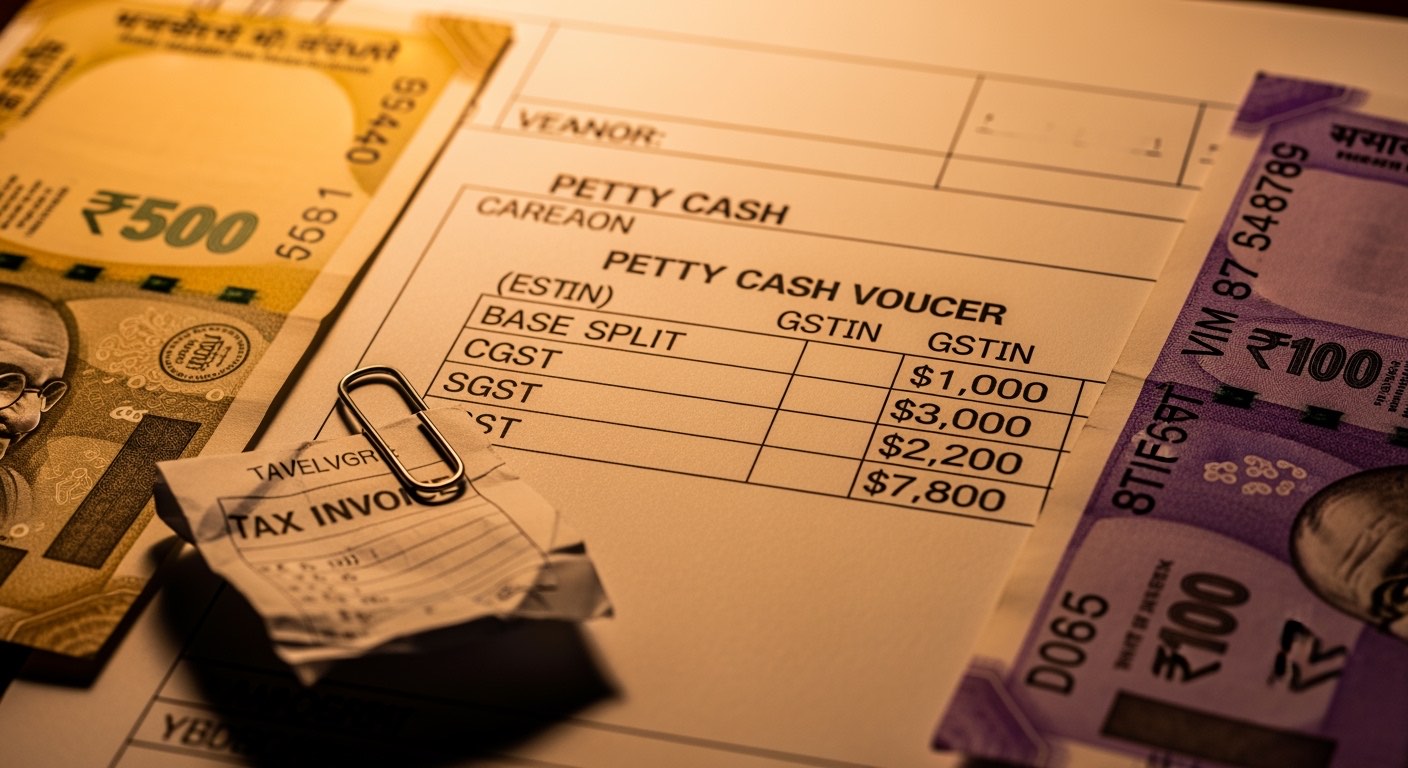
The three voucher-side disciplines
Three disciplines, run consistently, make petty cash compliance a 5-minute monthly task instead of a quarterly forensic exercise.
Discipline 1 — Capture GSTIN on every voucher where the vendor is registered
The cashier asks for a tax invoice. The voucher records:
- Vendor GSTIN
- Base amount, CGST, SGST (or IGST for inter-state) — three fields
- Invoice / bill reference number
If the vendor isn't GST-registered, those fields are left blank with a tick in a "unregistered vendor" box. The format itself prompts the right behaviour.
Discipline 2 — Map every voucher to a GL category that ties to ITC eligibility
The category list on the voucher pad should distinguish ITC-eligible categories from blocked ones. A 7-row example:
| GL category | ITC-eligible? |
|---|---|
| Cleaning & sanitation | Yes |
| Repairs (kitchen / FOH) | Yes |
| Stationery & printing | Yes |
| Commercial gas / utility | Yes |
| Staff welfare / meals | No (§17(5)) |
| Petrol / diesel | No (outside GST) |
| Local transport | No (unregistered) |
End of month, the accountant adds up only the "yes" rows to feed GSTR-3B Table 4(A).
Discipline 3 — Monthly reconciliation against GSTR-2B
The single check that closes the loop: compare the GSTIN-bearing petty vouchers against the auto-populated GSTR-2B. Three outcomes:
- Vendor invoice present in 2B and on PCV. Clean — claim the ITC.
- Vendor invoice on PCV but missing from 2B. Hold the ITC; follow up with vendor. If vendor doesn't file, the ITC is lost — adjust on the next GSTR-3B.
- Vendor invoice in 2B but no matching PCV. Investigation — either a missing voucher (control problem) or an invoice claimed against a different payment mode.
The 2B reconciliation is the single most useful monthly habit for petty cash GST. It takes ~30 minutes for a typical SMB outlet. Without it, ITC mismatches accumulate quietly and surface as scaling notices.
Common mistakes that cost the most
Three patterns we see frequently:
- Claiming ITC on staff meal / staff welfare spend. §17(5) explicitly blocks this. The reversal at audit is painful.
- Splitting a single ₹15,000 cash payment into two PCVs on the same day. Rule 6DD treats it as one — disallowed.
- No GSTIN field on the voucher pad at all. ITC is left on the table every month for spends that would have qualified.
A 5-minute monthly close for petty cash GST
End of every month:
- Pull all PCVs for the month. Separate by ITC-eligible category vs blocked.
- Sum the GST splits on ITC-eligible vouchers. Hand the total to the accountant for GSTR-3B Table 4(A).
- Open GSTR-2B for the month. Match line-by-line against the PCV stack. Note mismatches.
- Flag any PCV ≥ ₹10,000 to a single party for review — Rule 6DD watch.
- File the PCV stack in the month's compliance folder.
Where this fits with the rest of compliance
Petty cash GST is one slice of the wider compliance posture:
- Voucher format that captures the data — petty cash voucher format India
- Rule 6DD deep-dive — Income Tax Rule 6DD for restaurants
- GSTR-3B filing walkthrough — GSTR-3B for restaurants
Get the voucher right, and Rule 6DD + GST input credit are 30-minute monthly habits. Get it wrong and they're quarterly emergencies.
What to do this week
Reprint your PCV pad with three GST-split fields (Base / CGST / SGST), a Vendor GSTIN field, and a "₹10,000+ flag" warning. Train the cashier to ask "GSTIN bill?" on every spend above ₹250. Run a single GSTR-2B reconciliation at month-end this month. The first cycle is slow; by month three it's a 30-minute task.
Related on Restaurant Daily
- Income Tax Rule 6DD for restaurants — when ₹10,000 applies — the cash-limit deep dive
- Petty cash voucher format India — free Excel + PDF — the voucher that supports GST capture
- Petty cash audit checklist — 12-point quarterly review — the quarterly check that catches ITC mismatches
One operator playbook a week, in your inbox.
Cash close, petty cash, payroll, compliance, unit economics — sent every Monday morning. No spam, no upsell drip. Unsubscribe in one click.
Sent from noreply@restaurantdaily.ai. We never share your address.
Related reading
Rule 6DD restaurant — when ₹10,000 cash limit applies (and doesn't)
Rule 6DD restaurant guide — when the ₹10,000 single-day cash limit applies under §40A(3), exceptions, daily-ops impact, and the workflow that keeps you safe.
Petty cash voucher format India — free Excel + Google Sheets template
Petty cash voucher format for Indian restaurants — 9 fields covering Income Tax Rule 6DD + GST input credit. Free Excel, Google Sheets, and printable PDF templates.
Petty cash limit company policy — single-page template for restaurants
Petty cash limit company policy template for Indian restaurants — what limits to set per voucher, per category, per month. Single-page, free, ready to deploy.
Petty cash audit checklist India — 12-point quarterly review for restaurants
Petty cash audit checklist India — 12-point quarterly review for Indian restaurants. Voucher integrity, GST, Rule 6DD, control gaps. Free printable checklist.
Cashier accountability form — free template for Indian restaurants
Cashier accountability form for Indian restaurants — free declaration template + how to deploy it without alienating staff. Operator-grade controls.