How much petty cash in restaurant — formula, ranges, common mistakes
How much petty cash should an Indian restaurant hold? The PCH formula, three sized examples, and the four mistakes that quietly inflate the working float.
Last updated 9 Aug 2026
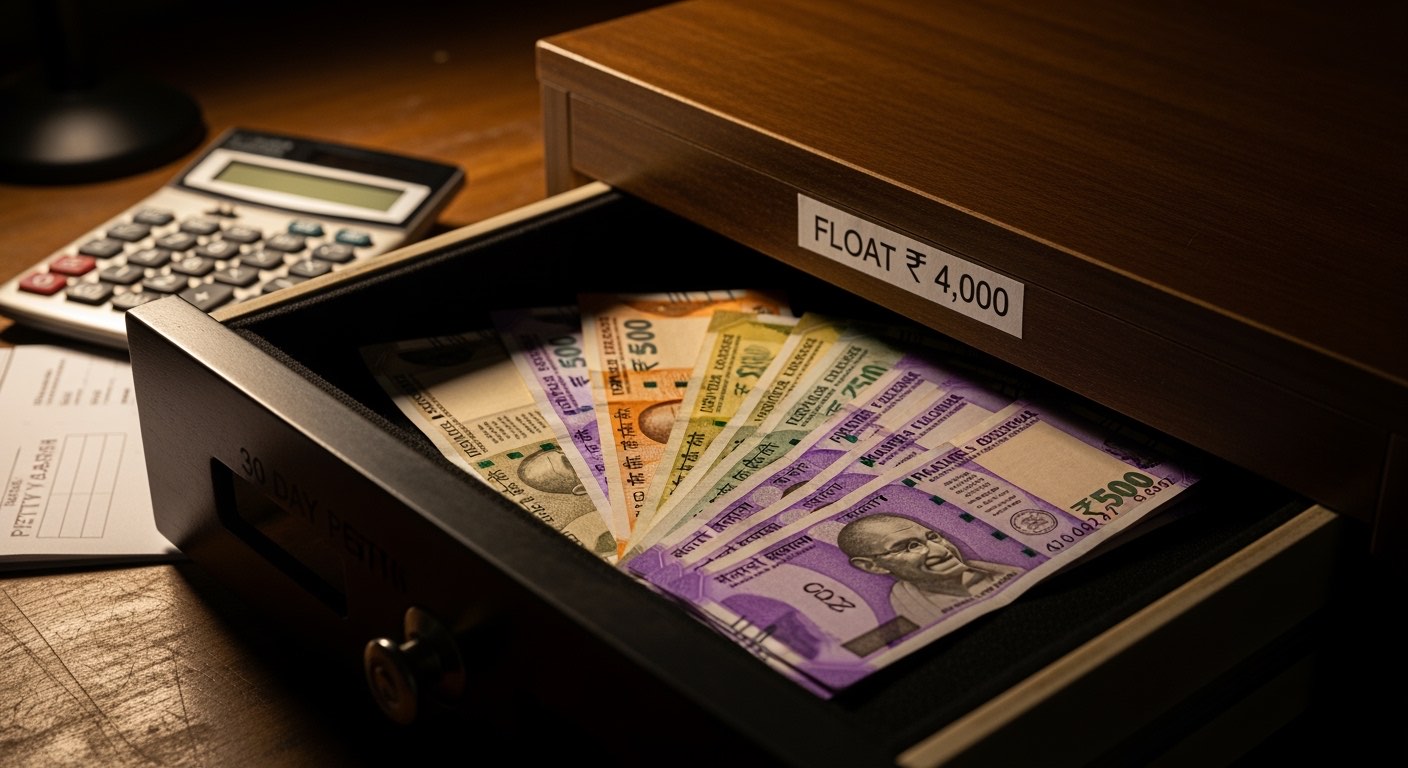
About this piece. The single most common question we get from first-time owners on operator WhatsApp groups is some version of "yaar, kitna cash drawer mein rakhna chahiye?" The honest answer is: not a vibe, a formula. This piece gives you the formula, three worked sizes for typical Indian outlet shapes, and the four mistakes that turn a healthy float into a slow leak.
The wrong way to set the petty cash number
Most single-outlet owners we've spoken to in NCR, Pune, and Bangalore set the petty cash drawer using one of three patterns:
- The round-number gut feel. "₹5,000 rakhte hain, theek hai." No reference to spend velocity, no reference to the largest single PCV in the last 30 days.
- Yesterday's leftover. Whatever cash sat in the drawer at last night's close becomes today's float. The number drifts daily.
- The vendor-day spike. Float gets sized to the worst day — the day the gas refill, the dhobi bill, and a surprise plumber arrived together. Most days the drawer is half-empty of working capital.
All three are expensive in different ways. Pattern 1 over-floats: ₹2,000–₹3,000 of dead capital sits in the drawer earning nothing and quietly disappearing 1–2% a year as variance. Pattern 2 makes reconciliation impossible — there is no reference number to count against. Pattern 3 over-floats and still runs short on the day the spike actually happens, because the cashier is conservative about spending the visible cash.

The PCH formula
The size of the petty cash holding (PCH) is governed by three numbers — your average daily petty spend, the cycle between top-ups, and a buffer for the spike day.
PCH = (D × C) + B
Where:
PCH= petty cash holding (₹)D= average daily petty-cash spend over the last 30 days (₹/day)C= top-up cycle length in days (1 if topped daily, 2 if alternate-day, etc.)B= spike buffer = 1.5 × the largest single PCV in the last 30 days
D is what your DSR or notebook actually shows, not what you remember. Pull last 30 days of petty vouchers, sum them, divide by 30. If you don't have 30 days of vouchers, this is the first thing to fix — see our petty cash voucher format piece for the format to deploy this week.
C is your operating choice. Most disciplined SMB outlets we see top up daily — C = 1. Some owner-operators only top up Mon/Wed/Fri to limit drawer access — C = 2.5 (rounded). Going beyond C = 3 starts to require a too-large float and is usually an excuse for not being on premises.
B is the part owners under-weight. The dhobi bill that lands once a month, the plumber who turned up after the geyser leak, the LPG refill that came a day early — these single-payment spikes are where a thin float fails publicly. Use 1.5× the largest PCV from the last 30 days, not the average.
Three worked examples
| Outlet shape | D (₹/day) | C (days) | Largest PCV | B (₹) | PCH (₹) |
|---|---|---|---|---|---|
| 25-cover tier-2 cafe, daily top-up | 1,200 | 1 | 1,800 | 2,700 | 3,900 |
| 50-cover NCR QSR, alt-day top-up | 1,800 | 2 | 2,500 | 3,750 | 7,350 |
| 80-cover dinner-heavy, daily | 2,800 | 1 | 4,000 | 6,000 | 8,800 |
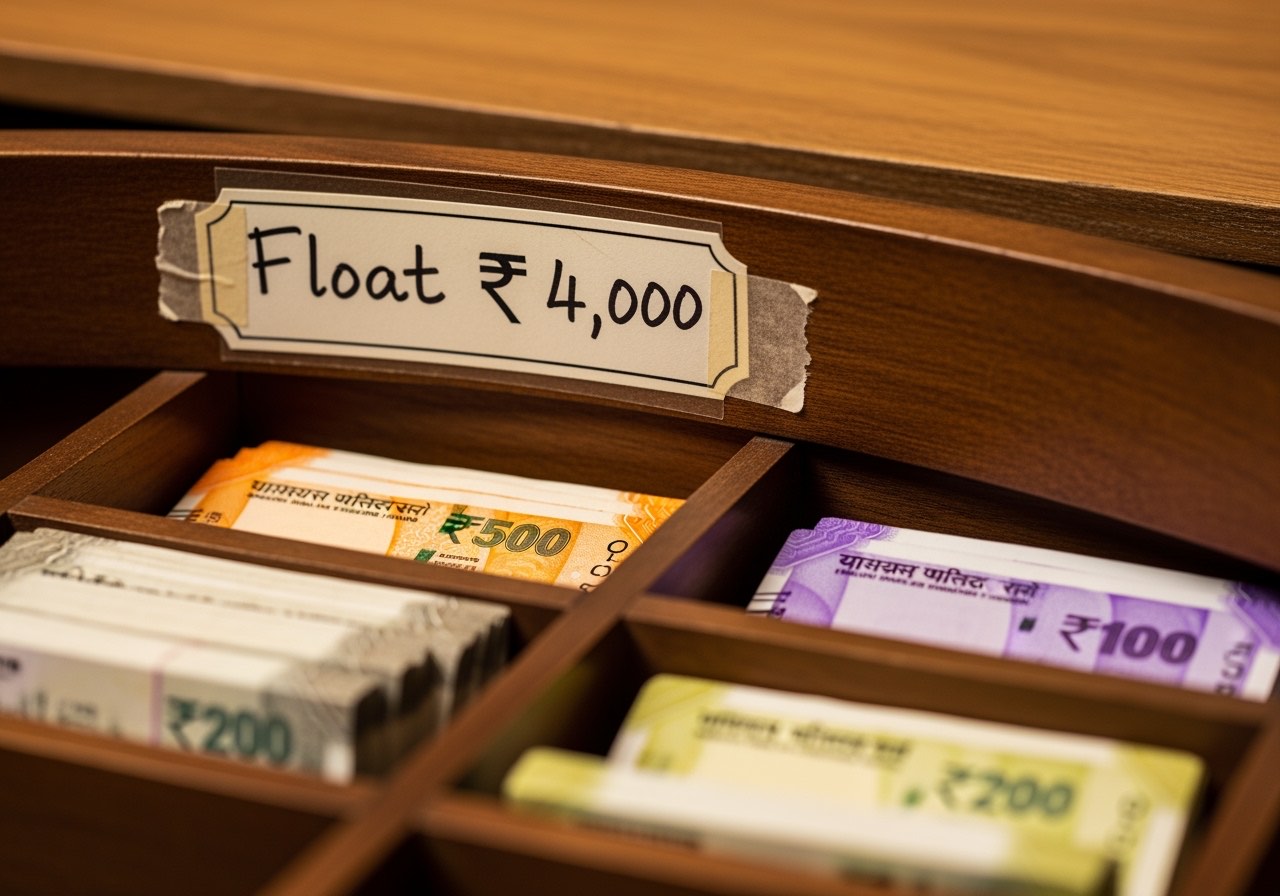
Round each result to the nearest ₹500 for ease of denominations: ₹4,000, ₹7,500, ₹9,000. That's the number that goes on the label inside the drawer, never to drift without a written reason.
A clean way to think about this: the float covers a normal day plus a one-spike day, between top-ups. If you can show your accountant the formula and the inputs, you've done more than 90% of single-outlet operators in India.
Why the formula beats a flat range
You'll find articles online that suggest a flat range — ₹5,000 to ₹10,000 — for "any" small restaurant. That range is fine as a sanity check, but it ignores three things:
- Volume. A 25-cover cafe and a 100-cover dhaba should not hold the same float. The ratio of PCH to monthly revenue should sit in the 0.4%–1.2% band. Above 1.2% is over-floated; below 0.4% will cause cashier-pocket top-ups (a separate process leak).
- Top-up cadence. Daily top-up halves the working float versus alternate-day. If you're choosing one over the other for control reasons, choose with the formula in front of you.
- Spike profile. A pure dine-in outlet has small, predictable PCVs (mostly veg, gas, cleaning). A catering operation or an event-heavy outlet has 3–5 spike events a month that single-handedly redefine the buffer.

The four mistakes that quietly inflate the working float
Even owners using a formula make these. Catching them recovers 1–3% of monthly petty-cash holding back into operating capital.
- Counting top-up cash into the drawer instead of replacing vouchers with cash. The right pattern: cashier hands manager the voucher bundle worth ₹X; manager hands back ₹X cash. Drawer is back to PCH. The wrong pattern: manager adds ₹500 because "drawer looks low" without removing any vouchers — the float silently grows.
- Carrying yesterday's variance forward. A ₹40 short on Monday becomes part of the float baseline by Wednesday. Variance must be reset at top-up time — written down with reason, then absorbed into operating cash.
- Holding the staff-meal collection in the petty drawer. Mixed pots are unreconcilable. Staff meal money has its own envelope or its own line in the DSR. Same for tip pool.
- Letting the cashier "borrow back" advance against salary from the petty drawer. Salary advances run through the salary advance format, not through PCH. Once the petty drawer becomes a personal credit line, the float is uncountable.
A 7-day sizing exercise you can run this week
If you're not sure your current PCH number is right, run this:
- Day 1 (Monday). Pull the last 30 days of petty vouchers. Sum them, divide by 30 — that's
D. Note the largest single voucher — that's the input toB. - Day 2. Decide
Chonestly. Are you on premises every morning? If yes,C = 1. If you visit alternate days,C = 2. - Day 3. Compute PCH = (D × C) + (1.5 × largest PCV). Round to nearest ₹500.
- Day 4 (Friday). At end of shift, count out the new PCH in mixed denominations. Excess goes to deposit envelope. Write the number on a label inside the drawer.
- Days 5–7. Run the new float for a full weekend cycle. Reconcile every shift. Note any short-falls — these point to inputs you under-counted.
- Day 8. If two days in the week required emergency top-up, your
Bis too low — the largest PCV in the next 30 days will likely be larger than the last 30. Adjust upward by ₹500.
The sizing exercise is the cheap part. The expensive part is the discipline of holding the float at that number after week one. The label inside the drawer is your single best protection against drift.
Common mistakes when reading the formula
Dis petty-cash spend only, not total cash drawer activity. Don't include cash sales, change for ₹2,000 notes, or staff salary handouts.Cis top-up cycle, not banking cycle. If you bank deposits twice a week but top-up petty cash daily from the office cash box,C = 1.Buses the largest single PCV, not the largest day's total. If three small vouchers totalled ₹3,000 on a busy Friday, that's not a spike — that's normal volume.
Where this fits with the rest of cash management
The PCH number is the anchor for two adjacent disciplines:
- Imprest float discipline — the rule that the float never drifts (the imprest piece)
- Petty cash voucher format — the per-spend audit trail (the PCV format)
- Daily cash close process — the end-of-day reconciliation that proves PCH is intact (the cash close hub)
Stack all three on top of a correctly-sized PCH, and your cash hygiene moves from "owner-dependent" to "process-dependent". The owner can travel for a week without the drawer drifting.
What to do this week
Pull 30 days of petty vouchers on Saturday. Compute D. Compute the new PCH. Reset on Monday morning. Tell the cashier the new number out loud and stick it inside the drawer. From there, the only number that matters is float = PCH, always.
Related on Restaurant Daily
- Imprest cash float for Indian restaurants — the discipline that keeps PCH intact
- Petty cash voucher format India — free template — the per-spend record that feeds the formula
- Petty cash leakage in restaurants — 8 patterns — what to watch when PCH starts drifting again
One operator playbook a week, in your inbox.
Cash close, petty cash, payroll, compliance, unit economics — sent every Monday morning. No spam, no upsell drip. Unsubscribe in one click.
Sent from noreply@restaurantdaily.ai. We never share your address.
Related reading
Imprest vs floating petty cash — which fits a single-outlet restaurant
Imprest vs floating petty cash systems compared for Indian restaurants. Reconcilability, control overhead, fit by outlet size — with the rule for which to choose.
Petty cash voucher format India — free Excel + Google Sheets template
Petty cash voucher format for Indian restaurants — 9 fields covering Income Tax Rule 6DD + GST input credit. Free Excel, Google Sheets, and printable PDF templates.
Rule 6DD restaurant — when ₹10,000 cash limit applies (and doesn't)
Rule 6DD restaurant guide — when the ₹10,000 single-day cash limit applies under §40A(3), exceptions, daily-ops impact, and the workflow that keeps you safe.
Petty cash limit company policy — single-page template for restaurants
Petty cash limit company policy template for Indian restaurants — what limits to set per voucher, per category, per month. Single-page, free, ready to deploy.
Cashier accountability form — free template for Indian restaurants
Cashier accountability form for Indian restaurants — free declaration template + how to deploy it without alienating staff. Operator-grade controls.