Petty cash leakage prevention — 8 patterns Indian restaurants miss
Petty cash leakage prevention for Indian restaurants — 8 leakage patterns we see again and again, with the specific control fix for each. Operator-grade.
Last updated 9 Aug 2026
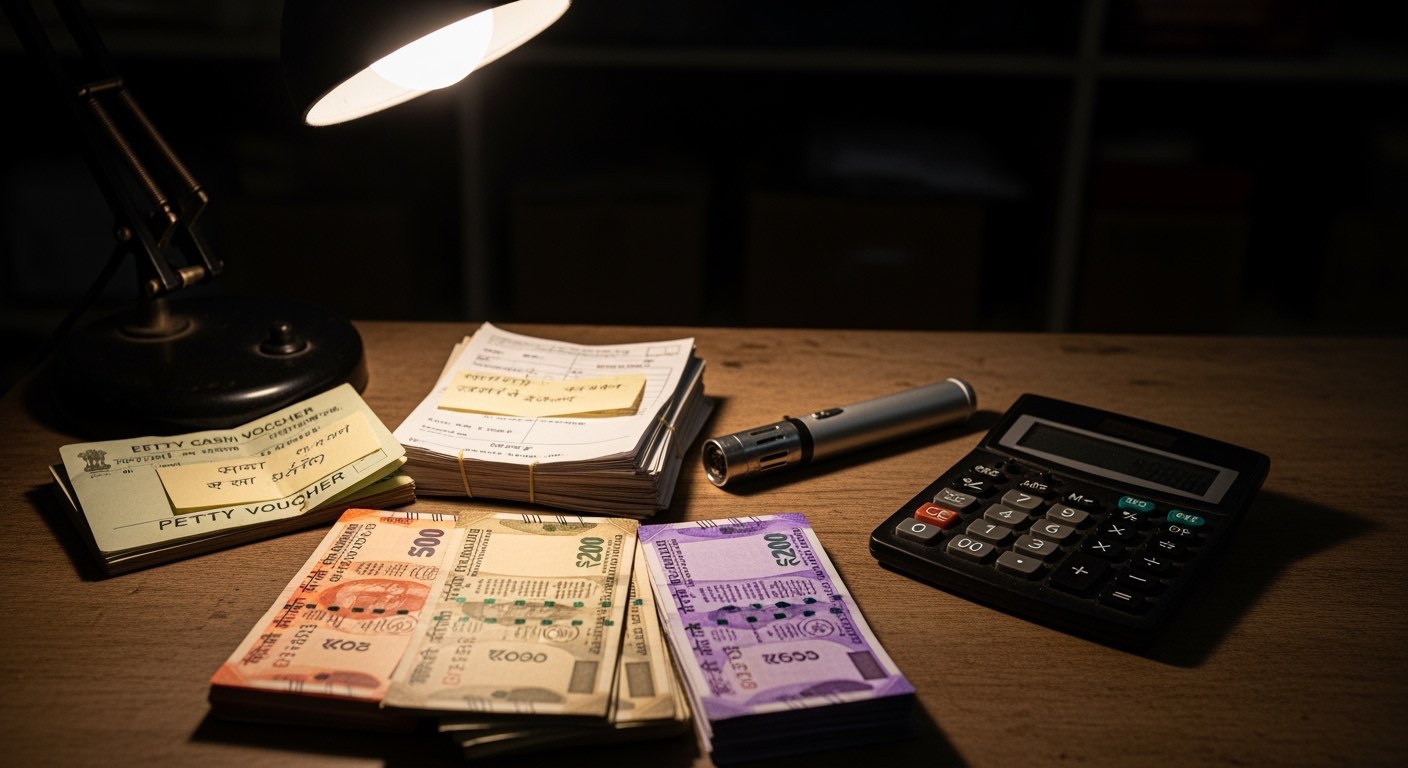
About this piece. Across operator networks we've spent time in, the question is rarely "is there leakage?" — there almost always is some. The useful question is which pattern is bleeding, because each pattern has a specific, low-friction fix. This piece names the eight patterns we see most often in single- and multi-outlet Indian restaurants, and the exact control to plug each one. No moralising. No "trust your team" platitudes. Just controls.
Why "leakage" is a category, not a single problem
When an owner says "I think we have leakage," they usually mean one of three very different things: cash going missing in absolute terms, vouchers being written for spends that didn't happen, or vendor prices being inflated. Each is a separate forensic problem with a separate fix. The shared symptom — petty cash spend creeping up faster than covers — hides the actual cause.
Industry studies of Indian SMB F&B (the Crisil F&B SME margin study, 2023 and the NRAI India Food Services Report, 2024) put unrecovered cash leakage at 3%–8% of revenue for single-outlet restaurants. For a ₹35L/year outlet that's ₹1L–₹2.8L a year — most of which is reachable by tightening petty cash, before you ever look at inventory.
The eight patterns below cover roughly 90% of what we see. The fixes are deliberately simple. If a fix needs software you don't have, it isn't here.

The 8 patterns
| # | Pattern | Where you see it | Typical monthly drag |
|---|---|---|---|
| 1 | Round-number vouchers | "₹500 sabzi", "₹1,000 cleaning" | ₹1,500–₹3,000 |
| 2 | Same-vendor PCVs every day | Single vendor named on 25+/30 vouchers | ₹2,000–₹5,000 |
| 3 | Voucher without recipient signature | Bottom-right field blank | ₹1,000–₹4,000 |
| 4 | Mid-shift "borrow" against salary | Staff name on PCV with no advance ledger entry | ₹1,500–₹6,000 |
| 5 | GL "miscellaneous" > 8% of total | Category column blank or "Other" overused | ₹500–₹2,000 (visibility loss) |
| 6 | Voucher number gaps | Sequence skips; pad numbers don't reconcile to DSR | Hard to size |
| 7 | Vendor bill date ≠ voucher date | PCV says today, attached bill is 3 days old | ₹500–₹2,500 |
| 8 | Staff-meal cash mixed with petty drawer | Single drawer holds two pots | ₹1,000–₹3,000 |
The numbers are typical ranges from operator interviews — your outlet may be tighter or looser. The point is that no single pattern is decisive on its own; it's the stack of three or four running simultaneously that creates the 5%-of-revenue feeling.
Pattern 1 — Round-number vouchers
The signal. Every PCV reads ₹500, ₹1,000, ₹200. No vouchers for ₹187 or ₹423. The spend has been rounded — usually up — at the moment of the PCV.
Why it leaks. Rounding ₹187 to ₹200 thirty times a month is ₹390 — invisible per-event, structural in aggregate. Worse, rounding signals that the PCV is being filled after the cash is taken, not at the point of spend.
The fix. Two-line rule: the figure on the voucher must match the figure on the attached bill. No bill, no rounding allowed — the cashier must write the exact amount paid, with a witness countersign. After 60 days of this, round-number vouchers should be a small minority.
Pattern 2 — Same-vendor PCVs every day
The signal. One vendor name appears on 25+ of 30 monthly vouchers — usually the local kirana, the dhaniya supplier, or a "general store" with no GSTIN.
Why it leaks. Single-vendor concentration is where price inflation hides. There's no comparison anchor — whatever the vendor charges becomes the price. A 10–15% inflation on a ₹400/day spend is ₹1,200–₹1,800/month.
The fix. Quarterly vendor rotation review. Pick the top three vendors by spend. Run a one-week price-check against an alternative supplier. If the alternative is 8%+ cheaper at comparable quality, rotate. Even the threat of rotation tightens prices on the incumbent.
Pattern 3 — Voucher without recipient signature
The signal. PCV stack reviewed at month-end shows 20–40% of vouchers missing the bottom-right signature. Cashier signature present; recipient signature blank.
Why it leaks. A voucher signed by only one person is, in audit terms, a piece of paper from someone to themselves. There's no proof the cash left the till and reached the named recipient. This is the highest-yield single fix in petty cash — and the one most operators skip because "the staff trust each other."
The fix. Two-signature rule, enforced at top-up. At morning top-up, the manager refuses to replenish any voucher missing a recipient signature. The cashier eats the variance for that voucher. Three weeks of this and signatures appear consistently.
The two-signature rule is also a DPDPA-friendly control — no biometrics, no logging of personal data, just a counter-signature on a paper voucher. Compare with thumb-impression registers some operators try, which create a separate compliance question.
Pattern 4 — Mid-shift "borrow" against salary
The signal. A PCV with a staff member's name as the recipient, no vendor, no bill — labelled "advance" or just blank.
Why it leaks. Salary advances run through their own ledger so they can be deducted at month-end. When they leak into the petty drawer, two failures happen: (a) the petty float now includes a receivable, not cash, so reconciliation breaks; (b) the deduction often gets forgotten.
The fix. Petty drawer never funds advances. Hard rule. If a staff member needs an advance, the manager opens the safe, makes the entry in the salary advance register (template here), and hands cash from operating funds — not from PCH.

Pattern 5 — GL "miscellaneous" > 8% of total
The signal. Month-end PCV summary shows "Other / Miscellaneous" as 8%+ of total petty spend.
Why it leaks. This is a visibility leak more than a cash leak — but visibility loss is itself expensive. Once 8%+ of spend is uncategorised, the owner can't see which vendor categories are inflating, can't see waste in cleaning vs repairs, can't act on the data.
The fix. Re-engineer the category list. If "Other" is being over-ticked, the existing categories are wrong. Run a one-week tally of what people would tick if they had the right options. Add the top two as named categories. Re-print the voucher pad.
Pattern 6 — Voucher number gaps
The signal. Voucher pad sequence shows gaps. Vouchers numbered 217, 218, 220, 222 in one shift — where are 219 and 221?
Why it leaks. Gaps mean voided vouchers were thrown away instead of marked CANCELLED and retained. Each missing voucher is either (a) a legitimate spoiled voucher that's missing audit trail, or (b) a written voucher that left the pad with cash but never made it back as a chit.
The fix. Spoiled-voucher rule. Every spoiled or cancelled voucher stays in the pad, marked diagonally CANCELLED with a reason and the cashier's initials. End-of-month, pad sequence reconciles: every number from 1 to N is accounted for as either a paid voucher or a cancelled-and-retained voucher.
Pattern 7 — Vendor bill date ≠ voucher date
The signal. Random sample of 20 vouchers; on 4–5, the attached bill is dated 2–4 days before the voucher date.
Why it leaks. Either the cashier is paying old bills out of new shifts (a control problem — the bill should have been paid the same shift it arrived), or — worse — old bills are being recycled across shifts to inflate spend.
The fix. Date-match check at owner's Sunday review. Owner picks 10 random vouchers from the week, checks bill date vs voucher date. Tolerance is 24 hours (vendor delivers Friday evening, paid Saturday morning). Anything beyond, flag for explanation. Two weeks of this and the gap closes.
Pattern 8 — Staff-meal cash mixed with petty drawer
The signal. Cashier counts ₹4,200 in the drawer at end of shift; PCH is ₹3,500; difference of ₹700 is "from staff meal money."
Why it leaks. Mixed pots are unreconcilable. The variance between PCH and counted cash should always equal vouchers spent — never a third pot. Once two pots share a drawer, neither can be tightened.
The fix. Separate envelope rule. Staff meal money goes into its own labelled envelope inside the drawer or, better, into its own line in the DSR. PCH is reconciled cleanly against vouchers; staff meal is reconciled separately against the meal register.
A 30-day leakage-tightening sprint
If you suspect leakage but don't know where, run this:
- Week 1. Print fresh PCV pads with sequential numbers, named GL categories, two signature lines. Install the voucher pad.
- Week 2. Owner does the Sunday 10-voucher random sample (date-match + signature check). Flag patterns 1, 3, 6, 7.
- Week 3. Surprise mid-week drawer audit. Variance + count of un-signed vouchers + count of round-number vouchers logged.
- Week 4. Vendor rotation review: top three vendors price-checked against one alternative each.
- Day 30. Compare petty spend / cover ratio vs same metric 60 days ago. A 10–20% reduction is typical for a previously-loose outlet.
The sprint produces a number you can tell your accountant. Going from "I think there's leakage" to "we tightened ₹X over 30 days" is the difference between a worry and a working control.
Where this fits with the rest of petty cash discipline
Leakage prevention is a downstream check on the upstream disciplines:
- Right-sized float — see how much petty cash to hold
- Voucher format — see petty cash voucher format India
- Audit cadence — see petty cash audit checklist (12-point quarterly)
A right-sized float with the right format and a quarterly audit closes most of the leakage surface. The patterns above are what to look for when you do the audit.
What to do this week
Pull last 30 days of vouchers. Run the eight-pattern check yourself in 45 minutes. Pick the top two patterns by estimated drag. Implement the fix for those two only. Come back to the next two next month. Sequencing matters — five fixes at once is no fix at all.
Related on Restaurant Daily
- How much petty cash should a restaurant hold — formula — sizing the float that the controls protect
- Petty cash audit checklist for Indian restaurants — the quarterly review
- Cashier accountability declaration form — the staff-side document for these controls
One operator playbook a week, in your inbox.
Cash close, petty cash, payroll, compliance, unit economics — sent every Monday morning. No spam, no upsell drip. Unsubscribe in one click.
Sent from noreply@restaurantdaily.ai. We never share your address.
Related reading
Petty cash limit company policy — single-page template for restaurants
Petty cash limit company policy template for Indian restaurants — what limits to set per voucher, per category, per month. Single-page, free, ready to deploy.
Cashier accountability form — free template for Indian restaurants
Cashier accountability form for Indian restaurants — free declaration template + how to deploy it without alienating staff. Operator-grade controls.
Petty cash audit checklist India — 12-point quarterly review for restaurants
Petty cash audit checklist India — 12-point quarterly review for Indian restaurants. Voucher integrity, GST, Rule 6DD, control gaps. Free printable checklist.
Imprest vs floating petty cash — which fits a single-outlet restaurant
Imprest vs floating petty cash systems compared for Indian restaurants. Reconcilability, control overhead, fit by outlet size — with the rule for which to choose.
Petty cash voucher format India — free Excel + Google Sheets template
Petty cash voucher format for Indian restaurants — 9 fields covering Income Tax Rule 6DD + GST input credit. Free Excel, Google Sheets, and printable PDF templates.