Labour registers Indian restaurants must keep — 7 forms + PDF templates
Labour registers Indian restaurants are statutorily required to maintain: 7 forms across Shops Act, Factories Act, Minimum Wages Act with free PDF templates and inspector-ready format.
Last updated 9 Aug 2026
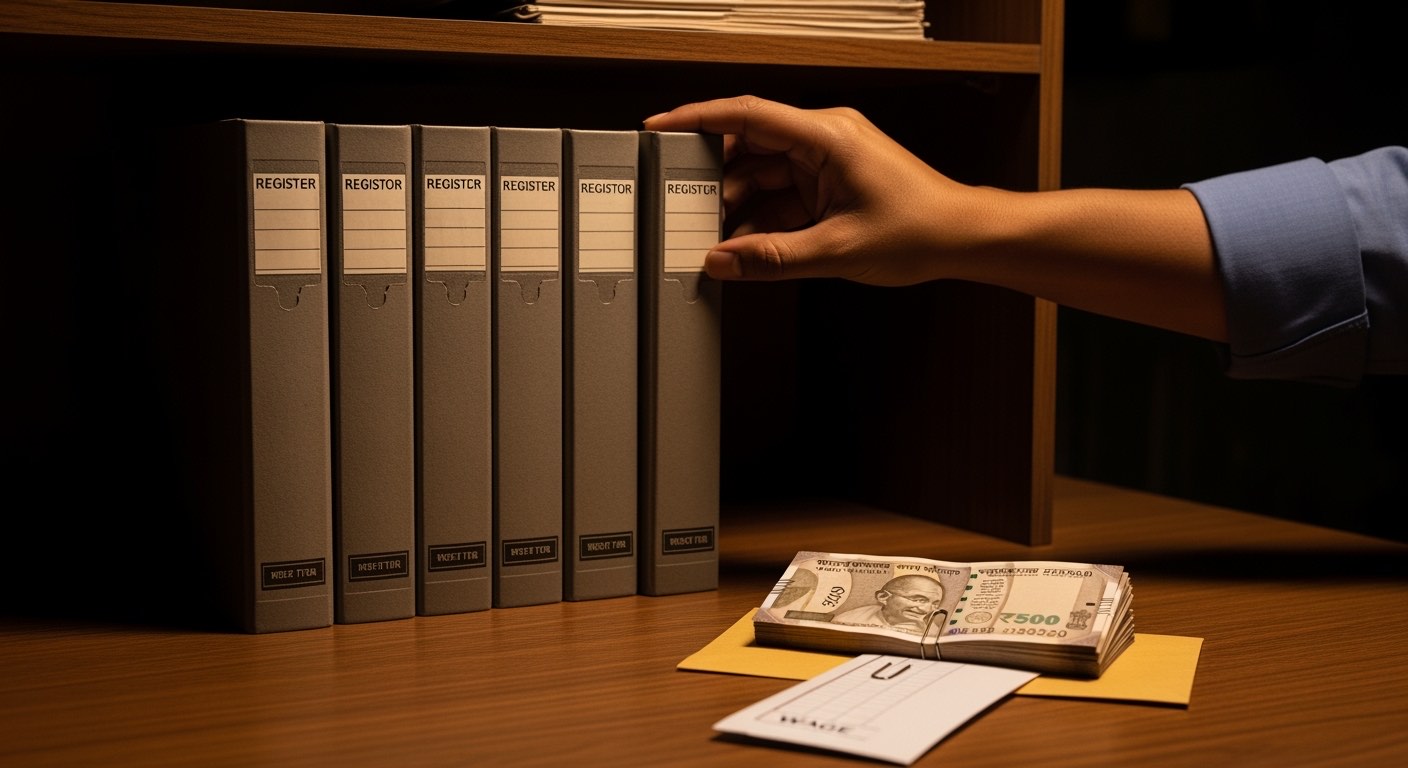
About this piece. When a labour inspector walks into your restaurant, the question is not "are you paying minimum wage" — it's "show me the register". Indian labour law is enforced through paper artefacts. Seven specific registers cover the common ground for a single-outlet restaurant; multi-state chains and outlets above 10/20 staff add more. This piece is the field-level guide to which registers, which Act, which format, and what an inspector actually flips through.
Which Act, which register — the short map
A standalone restaurant in India is governed by a stack of overlapping statutes. The four that drive register obligations:
| Act | Applies to | What it covers |
|---|---|---|
| Shops & Establishments Act (state-specific) | All commercial establishments | Hours, leave, holidays, basic registers |
| Minimum Wages Act, 1948 | All scheduled employments (restaurants are scheduled in most states) | Wage payment, deductions, overtime |
| Payment of Wages Act, 1936 | Wages below threshold (₹24,000/month in most states) | Wage timing, deductions |
| Factories Act, 1948 | Premises with > 10 workers + power, or > 20 without | Working hours, safety, welfare |
Most single-outlet restaurants live primarily under Shops & Establishments + Minimum Wages. Larger outlets and central kitchens with mechanised cooking equipment can fall under the Factories Act, which is a heavier compliance regime.
State variation matters. The seven registers below cover the common floor; check your specific state's labour department circulars before printing the templates.
The 7 registers, in inspector order
1. Register of Employment (Form 25 / Muster Roll)
Daily attendance with name, designation, time in, time out, hours worked, signature/thumb impression. Filed monthly, retained for 3 years.
| Field | Notes |
|---|---|
| Employee name | Full name |
| Father/spouse name | As on identity record |
| Designation | Cook, server, cashier, dishwasher, etc. |
| Date | Daily |
| Time in / time out | Both shifts if double-shift |
| Total hours | Calculated |
| Overtime hours | Hours beyond 9/day or 48/week |
| Signature/thumb | Self-attested |
This is the register an inspector asks for first. It cross-references with the wage register: if the muster shows 26 days worked but the wage register paid 22 days, you owe an explanation in writing.
2. Register of Wages (Form 17)
Monthly wages paid, by employee, with a break-down: basic, DA (where applicable), HRA, overtime, deductions (PF, ESI, advance, fines), net paid. Cross-references with salary slips.
| Field | Notes |
|---|---|
| Employee details (ID, name, designation) | Match to muster |
| Period (month) | Calendar month |
| Days worked | From muster |
| Gross wages | Basic + allowances + OT |
| Deductions (PF, ESI, advance, others) | Itemised |
| Net wages paid | Cash / bank |
| Mode of payment | Cash receipt or bank credit reference |
| Date of payment | Per Payment of Wages Act |
3. Register of Overtime (Form 10)
Required where overtime is worked. Records the date, hours, rate (overtime rate is 2x base under Factories Act, varies under Shops Act by state), and signature.
Overtime calculation under Factories Act 1948 Section 59: workers who work more than nine hours in a day or forty-eight hours in a week are entitled to overtime at twice the ordinary rate of wages.
4. Register of Leave with Wages (Form 15)
Records earned leave, casual leave, sick leave taken and balance carried forward. Most state Shops Acts grant 12–18 days earned leave per year, accrued on a 1-day-per-20-days-worked basis.
| Field | Notes |
|---|---|
| Employee details | Match across registers |
| Opening balance (1st of period) | Carried from prior period |
| Earned during period | Per state Act |
| Availed during period | With dates |
| Closing balance | Plain arithmetic |
5. Register of Fines and Deductions (Form 1)
Required even if you never deduct. Fines for damage/loss must be approved as per Payment of Wages Act Section 8, must not exceed 3 percent of monthly wages, and must be recorded.
If you have no fines, the register exists with an entry "Nil" per period, signed by the manager.
6. Register of Advances (variable form)
Salary advances made to staff, with date, amount, recovery schedule, and current outstanding balance. Critical for restaurants because salary advances are common — staff request loans against next month's salary and the recovery is netted in the wage register.
| Field | Notes |
|---|---|
| Employee details | Match to muster |
| Date of advance | Calendar |
| Amount advanced | ₹ |
| Recovery schedule | Lump-sum or instalments |
| Recovery to date | Running total |
| Outstanding | Difference |
7. Register of Holidays (Form 9)
National holidays + festival holidays granted (most state Acts mandate 3 national holidays — 26 Jan, 15 Aug, 2 Oct — plus 5–8 festival holidays). Record date, occasion, paid/unpaid status.

Additional registers when staff cross thresholds
| Threshold crossed | Add register |
|---|---|
| Staff > 10 (in most states) | ESIC contribution register |
| Staff > 20 | EPF contribution register |
| Staff > 50 | Maternity benefit register |
| Premises classed as factory | Form 11 (cooling), Form 12 (humidification), accident register |
| Contract labour | Register of contractors, register of contract workmen |
The threshold counts include all staff — kitchen, FOH, cleaning, security — not just "core" staff. Misclassifying contract dishwashers as "not staff" is a common audit finding.
The inspector's typical 12-minute walk-through
In our compliance reviews of multi-outlet chains, the labour inspection follows a predictable script:
- Display board check. Is the abstract of the relevant Acts displayed in the work area in English + the state language? (1 min)
- Muster roll review. Pulls 3 random days from the past 30. Counts heads against people present. (3 min)
- Wage register cross-check. Picks 2 employees, asks to see their wage records for the last 2 months. Compares against muster days worked. (3 min)
- Salary slip verification. Asks 1–2 staff members to show their last salary slip on phone or paper. (2 min)
- Overtime register. If staff are visibly working past 9pm and the muster shows 9-hour days, asks to see overtime records. (1 min)
- Leave register. Spot-checks leave balance for 1 employee. (1 min)
- Welfare facilities. First-aid box, drinking water, washing facility, urinal, rest room (last two for staff > 10). (1 min)
Total: about 12 minutes. The non-compliance findings nearly always cluster around three things: muster vs wage mismatch, overtime worked but not recorded, and missing/unsigned salary slips. Get these three right and the inspection ends well.
The most-missed register: overtime
Indian restaurant kitchens routinely run shifts past 9 hours. Many operators "absorb" this in monthly salary without recording overtime, on the assumption that the salary already covers it. That's not how the law reads.
Under Minimum Wages Act Section 14 and Factories Act Section 59, any work beyond statutory daily/weekly hours requires overtime pay at the prescribed rate. Whether the salary already "includes" overtime is a contractual question between employer and employee, but the register obligation is statutory and independent — even if you treat OT as part of monthly compensation, the hours must be recorded.
The fix is mechanical:
- Capture daily in/out times accurately on the muster.
- The wage register has a column for OT hours.
- The OT register copies that data with the calculated rate.
If your monthly salary is structured to include OT, pay slip should show it as a line item: "Overtime (X hours @ Y rate) = Z", with monthly base + OT = monthly salary. That keeps the contractual structure intact and the register honest.
Indian restaurants are not under-paying staff at the rates published — most pay at or above minimum wage. They are under-documenting. The compliance gap is a paperwork gap, not a wage gap. Closing the paperwork gap is two hours a month and removes the single largest source of inspection-driven penalties.
Digital registers — what's allowed
Several states (Karnataka, Maharashtra, Telangana, Delhi NCR among them) now permit digital labour registers under their respective Shops Act amendments and the Industrial Relations Code provisions. The conditions:
- The register must be maintained in real-time (not back-filled monthly).
- It must be exportable on inspector demand within 24 hours.
- Signatures (employee + employer) must be captured digitally with timestamps.
- The data must be retained for the same period as paper registers (typically 3 years, longer for some).
The state notification matters. Check your state's labour commissioner circulars before going fully digital — some states accept digital + monthly print-out, some need both maintained in parallel for the first year of transition.

A worked example: 18-staff casual-dine in Delhi
Here's the register set for a typical 18-staff outlet:
Required registers (Delhi Shops Act + Minimum Wages):
  1. Muster roll (Form B / state form)         daily entries, monthly print
  2. Wage register (Form 17 equivalent)         monthly
  3. Overtime register                          monthly
  4. Leave register                             rolling
  5. Fine & deduction register                  monthly (often "nil")
  6. Salary advance register                    rolling
  7. Holiday register                           annual + per-occurrence
  8. ESIC contribution register (since > 10)    monthly with challan ref

Display: abstract of Delhi Shops Act + Minimum Wages Act in English + Hindi
Welfare: first aid box, drinking water, washing facility, urinal
Filing: monthly hard-copy print, signed by manager, retained 3 years
A single binder per month, 8 tabs, signed at month-end. Two hours' work. Inspection-ready year-round.

Where this fits in the compliance stack
Labour registers are the daily-evidence layer for everything else. They feed:
- Salary slips — derived from wage register
- Salary advance ledger — derived from advance register
- Payroll filings (EPF, ESIC, PT) — derived from wage register
- Income Tax TDS — derived from wage register
- Audit trail for disputes — every register
Get the registers right and the rest of the labour-compliance stack is mechanical. Get them wrong and every downstream filing carries the same error.
Related on Restaurant Daily
One operator playbook a week, in your inbox.
Cash close, petty cash, payroll, compliance, unit economics — sent every Monday morning. No spam, no upsell drip. Unsubscribe in one click.
Sent from noreply@restaurantdaily.ai. We never share your address.
Related reading
Shop & Establishment Act for restaurants — registration, hours, holidays
Shop & Establishment Act registration for Indian restaurants — state-by-state hours, weekly off rules, leave entitlements, registers, fees, and renewal cadence.
Food handler health card for restaurant staff — FSSAI medical rule + flow
Food handler health card for Indian restaurant staff — FSSAI medical fitness rule under Schedule 4, test list, renewal cadence, joining-day workflow, and inspector-ready format.
Liquor license types for Indian restaurants — L-1 to L-19 explained
Liquor license types for Indian restaurants explained — L-1 to L-19 across states, eligibility, fees, daily ops obligations, and the operator's working comparison table.
Fire NOC for restaurants in India — when needed, documents, renewal
Fire NOC for Indian restaurants — when applicable by area and storey, the 11-document checklist, equipment requirements, state renewal cadence, and the inspection script.
CCPA service charge rules for Indian restaurants — daily ops impact
CCPA 2022 service charge guidelines for Indian restaurants — what's banned, what's allowed, the menu disclosure rules, complaint redressal, and the 5 daily-ops changes operators have to make.