Multi-outlet restaurant management in India — what changes between 1 and 5
Multi-outlet restaurant management in India — what changes between 1 outlet and 5, the four operating phases, role structure, and the cost of getting it wrong.
Last updated 9 Aug 2026

About this piece. The single biggest jump in Indian restaurant operations is not from 0 outlets to 1. It is from 1 outlet to 2. The owner who could be everywhere is now in one place at a time. The systems that were "in the head" become things that have to live somewhere else. This is the operator's view: what changes, in what order, and what to put in place at outlet 2, 3, and 5 to keep the chain runnable without the owner being on-floor.
The four operating phases
Indian SMB restaurant chains move through four distinct operating phases. The system needs at each phase are not gradual — they are step-changes.
| Phase | Outlets | Owner role | Core operating challenge |
|---|---|---|---|
| 1. Solo | 1 | On-floor operator | Cash, staff, stock visibility |
| 2. Owner-with-manager | 2-3 | Multi-outlet floater | Standardisation, manager trust |
| 3. Area-manager-led | 4-7 | Strategy + finance | Centralised reporting, hiring |
| 4. Multi-area / chain | 8+ | CEO function | Brand consistency, central kitchen, capital |
Most SMB chains stall at the transition from phase 2 to phase 3. The owner is still trying to be everywhere; the manager-per-outlet model has not been backed by an area-manager layer; the data is still in WhatsApp groups.
What changes between outlet 1 and outlet 2
The single hardest transition. Three things break that worked at outlet 1:
- Owner cash visibility. At one outlet, the owner counted the till. At two, one till is being counted by someone else. The trust required is now a system requirement, not a relationship.
- Stock movement. At one outlet, stock came in and went out at one place. At two, you start moving stock between outlets (the inter-store transfer becomes a daily document).
- Staff scheduling. At one outlet, the owner knew who was where. At two, the same head cook cannot cover both lunch services. Roster has to be planned ahead, not reactive.
The systems you have to put in place at outlet 2 — even if you only have 2 outlets ever:
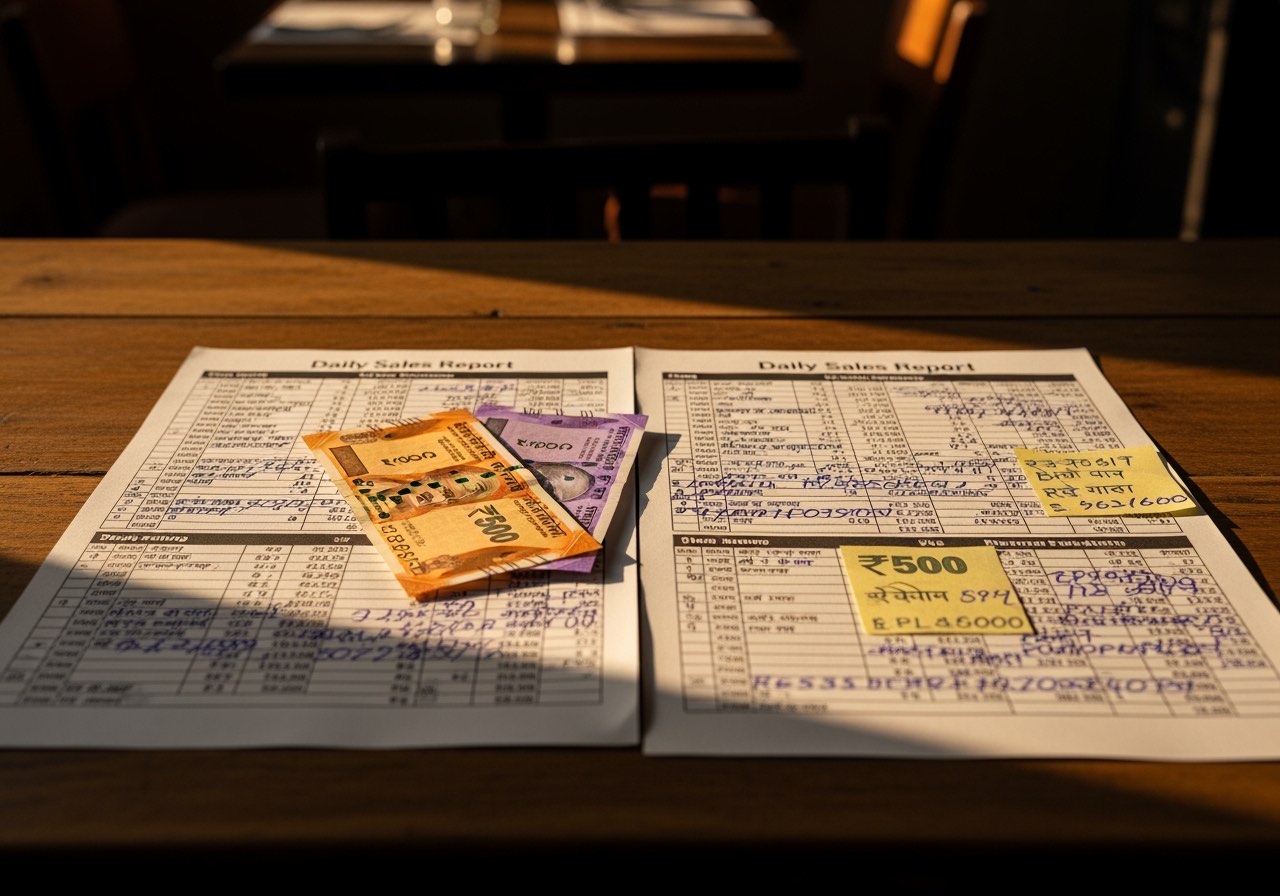
- A standardised daily sales report (DSR) across both outlets
- A reconcilable cash close at each outlet (imprest float, signed PCV stack)
- A central WhatsApp / app channel for inter-store transfers with a paper trail
- A weekly margin review with both DSRs side by side
What changes between outlet 2 and outlet 4
The phase-3 transition. Outlet 2 to 3 is incremental; outlet 3 to 4 is structural. By outlet 4, the owner cannot personally visit every outlet weekly. The systems shift accordingly.
| Lever | At outlet 2 | At outlet 4 |
|---|---|---|
| Owner physical presence | Daily, splits between outlets | Weekly review, monthly deep-dive per outlet |
| Cash close | Owner sees both DSRs nightly | Area manager sees DSRs nightly; owner sees rollup |
| Staff hiring | Owner interviews | Area manager interviews; owner approves senior |
| Vendor management | Owner negotiates per outlet | Centralised vendor list; per-outlet ordering |
| Inventory | Per-outlet count | Central kitchen + per-outlet store; IST documents |
| Reporting cadence | Daily DSR, weekly margin | Daily flash, weekly P&L, monthly P&L by outlet |
The non-obvious change: the owner's job changes from running outlets to running managers. The skill set is different. Most SMB owners overestimate how much they can keep doing both, and underestimate how long it takes to hire and train an area manager who can be trusted with cash.
The role structure that scales
A working role structure for a 4-7 outlet chain in India:
                  Owner / CEO
                       │
                       │
              ┌────────┴────────┐
              │                 │
       Area Manager        Finance/CA
        (operations)       (compliance)
              │
   ┌──────────┼──────────┐
   │          │          │
Outlet 1  Outlet 2  Outlet 3 …
   │          │          │
Outlet     Outlet     Outlet
Manager    Manager    Manager
   │          │          │
Cooks/     Cooks/     Cooks/
service    service    service
team       team       team
Three principles baked into this:
- Area manager owns operations. Cash, staff, stock, customer escalations. They are the owner's eyes on the ground.
- Finance / CA reports to owner separately. Compliance, payroll, GST, audits. Independent line so a single area manager cannot bury a problem.
- Outlet manager owns the four walls. Daily sales, daily cash, daily stock, daily roster. Reports up to the area manager.
The structure works at 4-7 outlets. Beyond 7 you usually add a second area manager and a central kitchen / commissary head.
The five reports a multi-outlet owner needs
At one outlet, the owner ran on observation. At three or more, the owner runs on five reports:
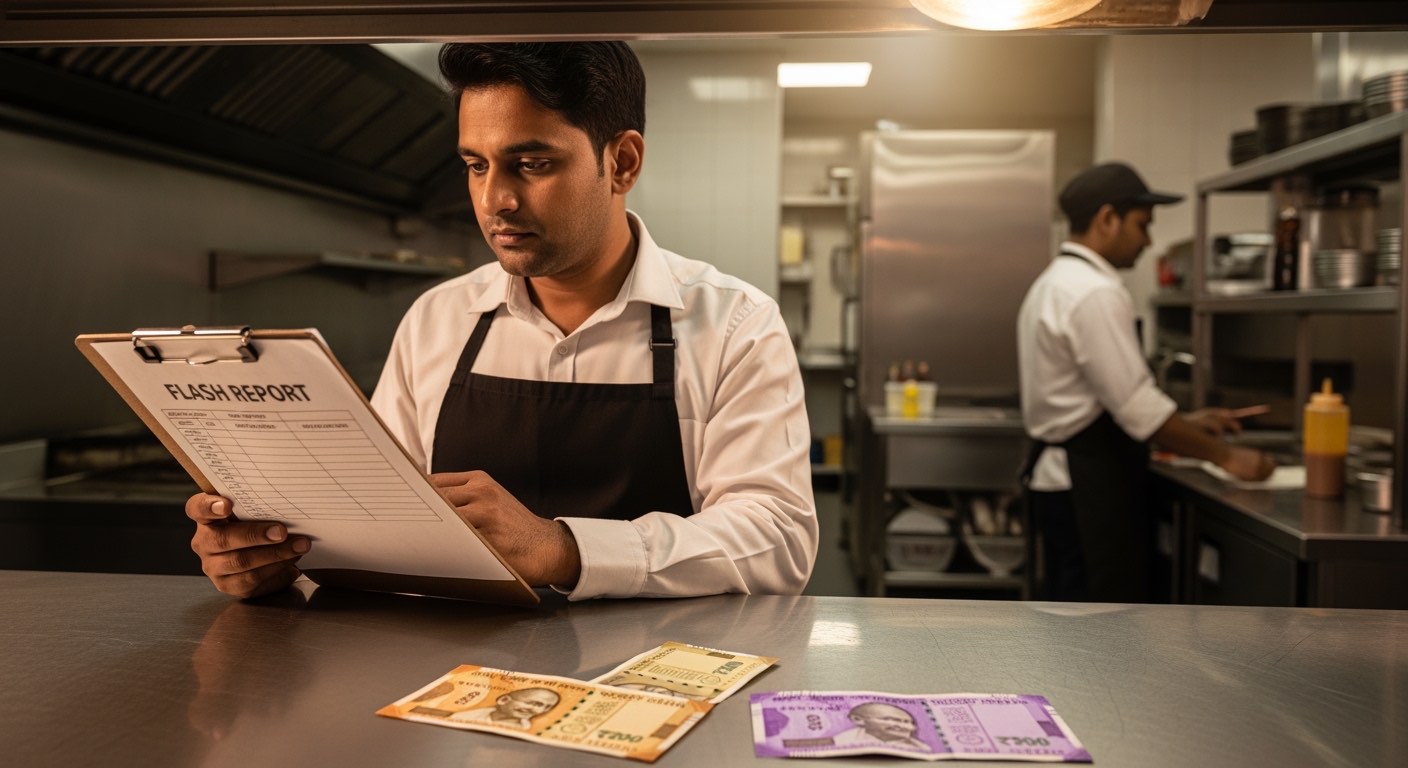
- Daily flash report — one row per outlet, key metrics (revenue, covers, food cost %, labour %, cash variance)
- Weekly margin — per-outlet operating margin against target
- Monthly P&L by outlet — full revenue and cost stack
- Monthly central P&L — outlets rolled up + central overhead
- Quarterly variance — actuals vs plan, root-cause for any outlet outside +/- 2% of plan
If any of these is not in place at the right cadence, the chain is operating on lag. By the time the owner sees a problem at Outlet 3 it is six weeks old and the same problem has spread to Outlet 5.
The standardisation question
Multi-outlet operators ask early: how much should be standardised across outlets versus left to each outlet's manager? The working answer:
- Standardise: menu, recipes, vendor list, cash-close process, DSR format, roster format, salary structure, statutory compliance calendar, brand assets
- Localise: daypart pricing (some outlets do early-bird), local marketing tactics, vendor sub-list (different butcher per city), staff hiring (local labour pool)
Why this split works: the central things compound — same recipe at 5 outlets means central buying power, same DSR format means consolidated reporting in 5 minutes. The local things adapt — Bangalore breakfast economics are not Hyderabad breakfast economics, and over-standardising kills outlet-level margin.
The cost of getting multi-outlet wrong
A 5-outlet chain operating without phase-3 systems typically loses 2-4% of revenue to friction the owner cannot see:
- Cash variance at outlets without daily reconciliation: ~1.5% of cash sales
- Inter-store transfer leakage without IST documents: ~0.8% of stock value
- Labour over-staffing at off-peak outlets without centralised roster review: ~1% of revenue
- Vendor price drift without centralised purchasing: ~0.5-1% of food cost
Stack the four and a ₹3 crore/year revenue chain leaks ₹6-12L annually to invisible costs. The fix is the phase-3 system stack — not heroic owner attention.
What to build first if you are at outlet 2 right now
If you are running 2 outlets and planning a 3rd in the next 12 months, build these four things in this order:
- Standardised DSR across both outlets — same fields, same daily cadence
- Imprest float + PCV at each outlet — independently reconcilable cash
- Weekly margin review — owner sees both outlets side by side every Monday
- Documented SOPs for cash close, opening, closing — written down so a future area manager can train a new outlet manager from them
These four make outlet 3 an addition, not a reinvention.
Where this fits in the multi-outlet stack
Multi-outlet management is the parent topic. Spokes:
- POS choice — single-tenant POS at outlet 1; multi-location POS by outlet 3
- Daily flash report — the owner's morning read across all outlets
- Inter-store transfer — the document that captures cross-outlet stock movement
- Franchise audit — for chains that move into franchise mode
- Central kitchen — typically considered at outlet 5+
Each spoke has a piece linked below.
Related on Restaurant Daily
One operator playbook a week, in your inbox.
Cash close, petty cash, payroll, compliance, unit economics — sent every Monday morning. No spam, no upsell drip. Unsubscribe in one click.
Sent from noreply@restaurantdaily.ai. We never share your address.
Related reading
How to manage multiple restaurant outlets — a week-by-week operating rhythm
How to manage multiple restaurant outlets — the area manager's week-by-week operating rhythm, daily/weekly/monthly cadence, and the four habits that keep quality even.
Inter-store transfer format for restaurants — IST template + GST handling
Inter-store transfer format for restaurants in India — free IST template, GST handling for stock movement between outlets, and the audit trail that protects you.
Multi-location restaurant POS for India — 6 systems compared
Multi-location restaurant POS systems compared for India — Petpooja, Posist, Limetray, RD POS, Toast, Pine Labs Bharat POS — on consolidation, taxes, sync.
Restaurant chain operations software — 5 tools compared on multi-outlet roll-ups
Restaurant chain operations software compared — 5 tools (Petpooja, Posist, Limetray, RD multi-outlet, Toast) on roll-ups, consolidated reporting, multi-outlet workflow.
Central kitchen vs distributed kitchen for Indian restaurant chains
Central kitchen vs distributed: cost, ops, quality trade-offs for Indian restaurant chains. Break-even outlet count, FSSAI implications, and the IST overhead nobody prices in.