Central kitchen vs distributed kitchen for Indian restaurant chains
Central kitchen vs distributed: cost, ops, quality trade-offs for Indian restaurant chains. Break-even outlet count, FSSAI implications, and the IST overhead nobody prices in.
Last updated 9 Aug 2026
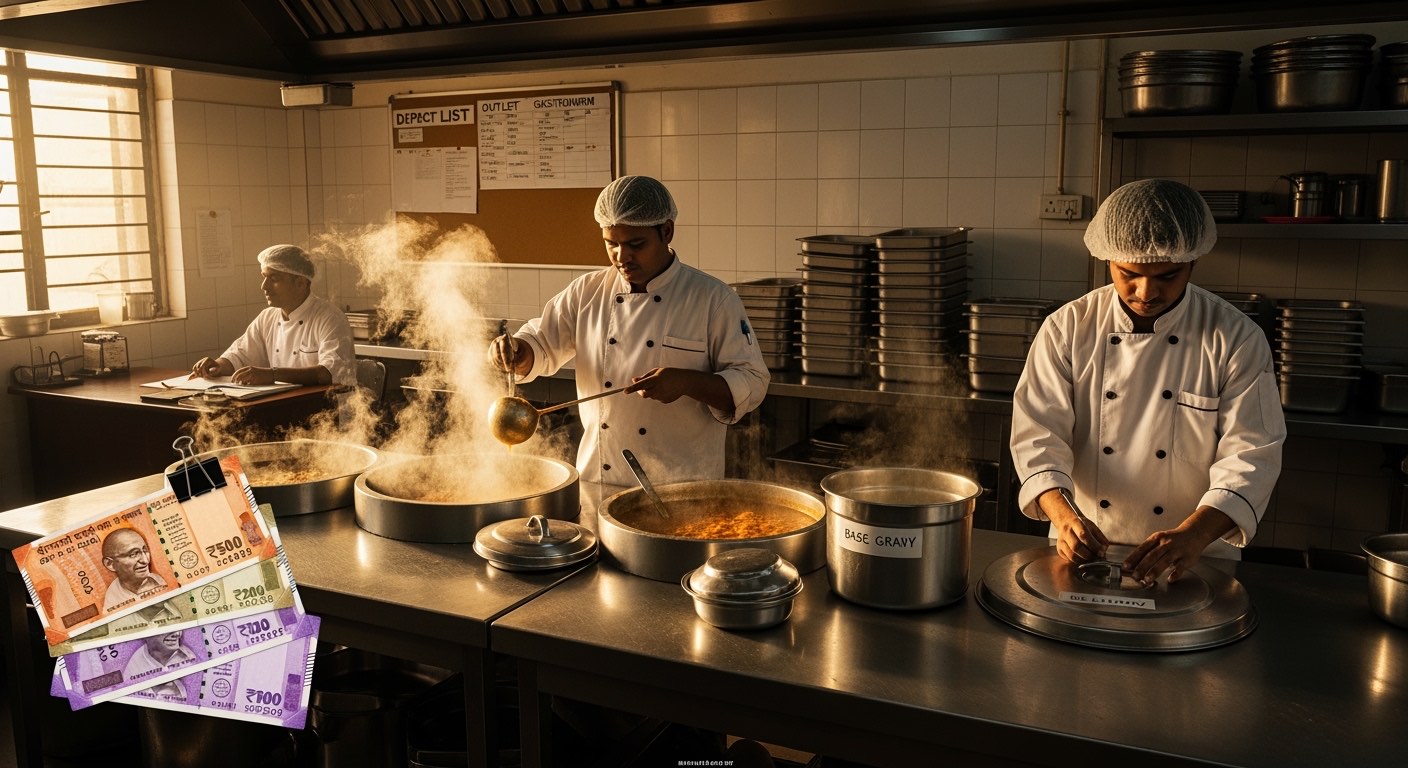
About this piece. The "should we go central kitchen?" question shows up at every Indian restaurant chain between outlet 3 and outlet 6. The answer is rarely a clean yes or no — it's a function of menu complexity, distance, FSSAI licensing for the hub, and the inter-store transfer (IST) overhead nobody prices in until they're living it. This piece lays out the trade-offs in numbers, the break-even outlet count, and the questions to answer before signing a 5-year lease on a hub kitchen.
What we mean by central vs distributed
A central kitchen (also called a CPU — central production unit, or a commissary) is a separate FSSAI-licensed facility that prepares some or all of a chain's food, then ships it to outlets in batches. Outlets reheat, plate, and serve. Some operators also call this a "hub-and-spoke" model.
A distributed kitchen is the default: every outlet has a full prep + cook line. Each outlet is a self-contained production unit. Most independents and chains under five outlets in India run this model whether they realised they're choosing it or not.
A hybrid (the most common reality at scale) splits the work. The hub does base gravies, marinades, sauces, sweets, and any SKU that benefits from batching. Outlets do a la carte cooking, finishing, and anything that doesn't survive the cold chain.
The choice isn't binary. The right question is which SKUs go where.
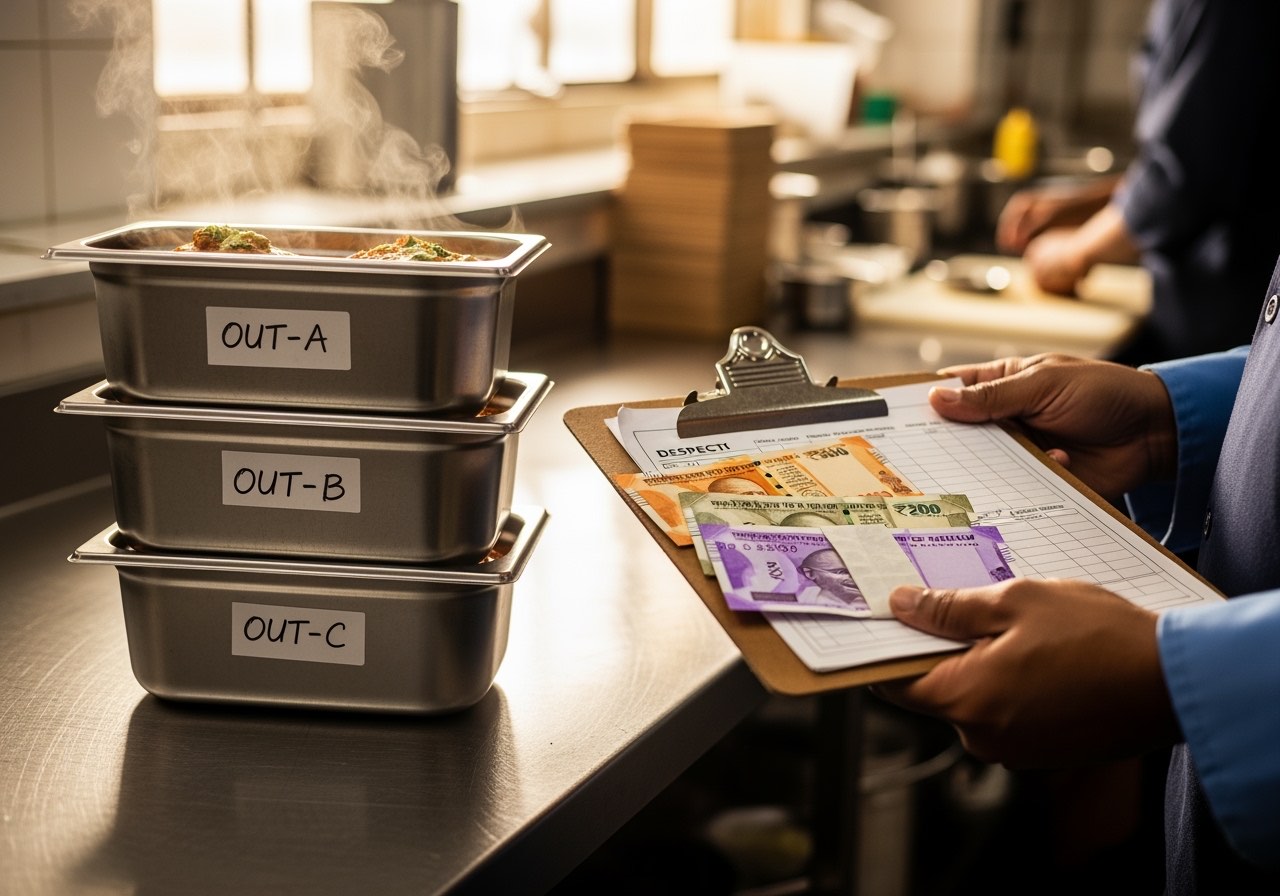
The cost trade-off in one table
For a 5-outlet QSR doing around the ₹35–45 lakh/month/outlet range across NCR, the rough split looks like this:
| Cost line | Distributed (per outlet) | Central + spokes (per outlet) | Why it moves |
|---|---|---|---|
| Kitchen rent share | ₹0 (in outlet rent) | ₹15,000–₹35,000 | Hub rent allocated across outlets |
| Hub staff (allocated) | ₹0 | ₹40,000–₹70,000 | 8–12 hub staff split 5 ways |
| Outlet kitchen staff | ₹1.4L–₹1.8L | ₹70,000–₹1L | Smaller outlet brigade |
| Cold chain + transport | ₹0 | ₹25,000–₹45,000 | Refrigerated van + diesel + driver |
| Wastage on prep | 4–6 percent of food cost | 2–3 percent of food cost | Batching tightens yield |
| FSSAI hub licence (allocated) | ₹0 | ₹2,000–₹5,000 | State licence ~₹5,000/yr, central ~₹7,500/yr |
| Outlet fit-out (one-time) | ₹18L–₹25L | ₹10L–₹14L | Smaller kitchen footprint |
Net per-outlet operating cost is usually in the range of 4–9 percent lower with a hub once you're past five outlets. Below five, the hub cost line items dominate and the math goes the other way.
The break-even outlet count — the formula
There isn't a universal number, but the structure of the calculation is:
Break-even outlets N = (Hub fixed cost / month) / (Per-outlet savings / month)
Worked example for a north-Indian QSR chain:
- Hub fixed cost: rent ₹1.8L + 10 hub staff ₹3.5L + utilities ₹40,000 + cold-van EMI ₹65,000 + FSSAI + maintenance ₹25,000 = ₹6.6L/month
- Per-outlet savings (smaller brigade + lower wastage + tighter food cost): ₹1.1L/month/outlet
- Break-even N = 6.6 / 1.1 = 6 outlets
Below six, the hub is a cost centre paying you back in consistency (not cash). At six outlets it's neutral. At eight to ten outlets the hub is generating ₹2L–₹4L/month of structural margin that distributed operators can't access.
The hub-and-spoke break-even is not the moment you "should" build the hub. It's the moment you can afford one. Most chains that build a hub at outlet 3 are buying consistency they couldn't otherwise get — they're paying for it out of equity, not cash flow. That's a strategic choice, not an operational one. Be honest about which one you're making.
When a hub kitchen makes sense — the 5 questions
Before signing a hub lease, answer these:
- How many SKUs benefit from batching? Base gravies, marinades, dough, sweets, sauces, pickles — these batch beautifully. Tandoori grills, dosas, fresh-tossed salads, anything that lives or dies on a la carte timing — these don't. If less than 40 percent of your menu (by revenue) batches well, the hub will struggle to earn its rent.
- Are your outlets within a 90-minute cold-chain radius? Cooked sauces and marinades hold for 4–6 hours in a properly refrigerated van under FSSAI cold-chain rules. Two hours of transit each way leaves no buffer if the van breaks down.
- Is your menu stable? Hubs are tooled for repetition. If you change 30 percent of your menu every quarter, the hub becomes a bottleneck — re-tooling for new SKUs takes weeks.
- Do you have an SOP-disciplined chef? A hub runs on standard operating procedures. If your head chef cooks "by feel", that doesn't survive the abstraction of a hub. Either the chef adapts or the hub fails.
- Can you absorb 4–6 months of negative cash before it pays back? Hub fit-out is in the ₹40–₹80 lakh range one-time. Operational losses while you're scaling outlets to break-even are another ₹6–₹15 lakh. Have the runway before the lease is signed.
If three or more of these are no, run distributed. If three or more are yes, the hub will likely earn its keep by outlet 6.
The IST (inter-store transfer) overhead nobody prices in
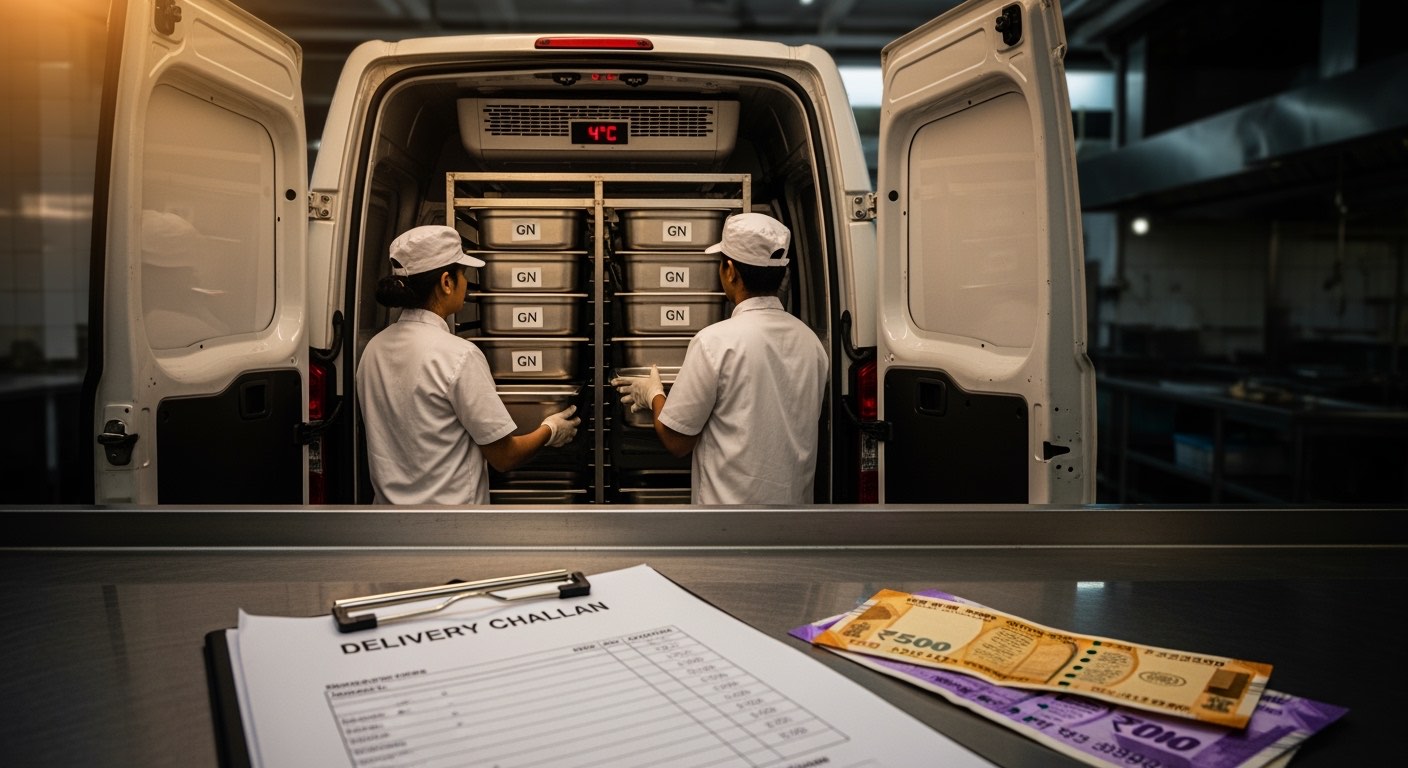
The hub-and-spoke model creates a new operational artefact: the inter-store transfer. Every batch leaving the hub to an outlet is a goods movement. Under GST law, an IST between two registered places of business of the same legal entity within the same state is a non-taxable stock movement that still requires a delivery challan; an IST between two states is a taxable supply requiring an invoice and an e-way bill (when consignment value exceeds the state threshold).
In daily operations this means:
- A delivery challan format with date, hub address, outlet address, item description, quantity, and signature must travel with every dispatch.
- An e-way bill is generated for inter-state movements above the relevant value threshold (commonly the ₹50,000 / consignment level).
- A daily IST register must be reconciled at each outlet on receipt — short-receipts and damages need a same-day note, otherwise variance accumulates and books drift.
- Food safety SOPs require temperature logs at dispatch and at receipt for all cooked and high-risk items, per FSSAI Schedule 4 cold-chain requirements.
Operators who skip the documentation and "just send the van" find out at the first GST audit that they have unsubstantiated stock movements between locations. The fix is administrative, not philosophical: budget one full-time hub coordinator for documentation and reconciliation. That's another ₹25,000–₹35,000/month that needs to land in the per-outlet allocation.
FSSAI licensing — what changes with a hub
A central kitchen requires its own FSSAI registration, separate from each outlet's licence:
| Facility | Annual turnover trigger | Licence type | Approx fee |
|---|---|---|---|
| Outlet (single) | > ₹12 lakh | State licence | ₹2,000–₹5,000/year |
| Hub (intra-state distribution) | > ₹20 crore aggregate | Central licence | ₹7,500/year |
| Hub (inter-state distribution) | Any volume | Central licence | ₹7,500/year |
| Hub (food in transit) | If transporting | Add transporter registration | ~₹100/year |
Always check current FSSAI fee tables before applying — the structure is stable but specific amounts revise. The licence for the hub is in addition to, not instead of, the outlet licences.
A worked decision: 4-outlet QSR considering hub
Here's a typical decision for a four-outlet chain in Pune doing about ₹38L/month/outlet of north-Indian QSR food:
Current state:
  4 outlets, distributed kitchens
  Per-outlet kitchen brigade: 6 staff @ ₹28,000 avg = ₹1.68L/month
  Wastage on prep: ~5 percent of food cost (~₹95,000/month/outlet)
  Total kitchen labour + wastage: ₹2.63L x 4 = ₹10.52L/month

Hub-and-spoke projection:
  4 outlets, smaller brigades (4 staff each) = ₹1.12L x 4 = ₹4.48L
  Hub staff: 9 staff @ ₹32,000 = ₹2.88L
  Hub rent: ₹1.6L
  Cold-van + driver + diesel: ₹85,000
  IST coordinator: ₹30,000
  Wastage drop to 2.5 percent: saves ~₹47,500/month/outlet x 4 = ₹1.9L
  Hub utilities + maintenance: ₹35,000

  New monthly cost: 4.48 + 2.88 + 1.6 + 0.85 + 0.30 + 0.35 = ₹10.46L
  Wastage savings: ₹1.9L
  Net: ₹8.56L/month
  Saving vs distributed: ₹1.96L/month
That's about ₹23.5L/year of operating saving — but against ₹55L of hub fit-out + ₹12L of working capital float for cold-chain SKUs + a 5-year hub lease commitment. Payback ~3.4 years on cash, on paper.
In practice, payback is faster because consistency between outlets goes up, single-outlet "bad days" drop, and customer-facing complaints about "the food tastes different at this branch" disappear. Those are real margin defenders that don't show up in the spreadsheet — but they're also why most chains do the hub one outlet too early, not one outlet too late.
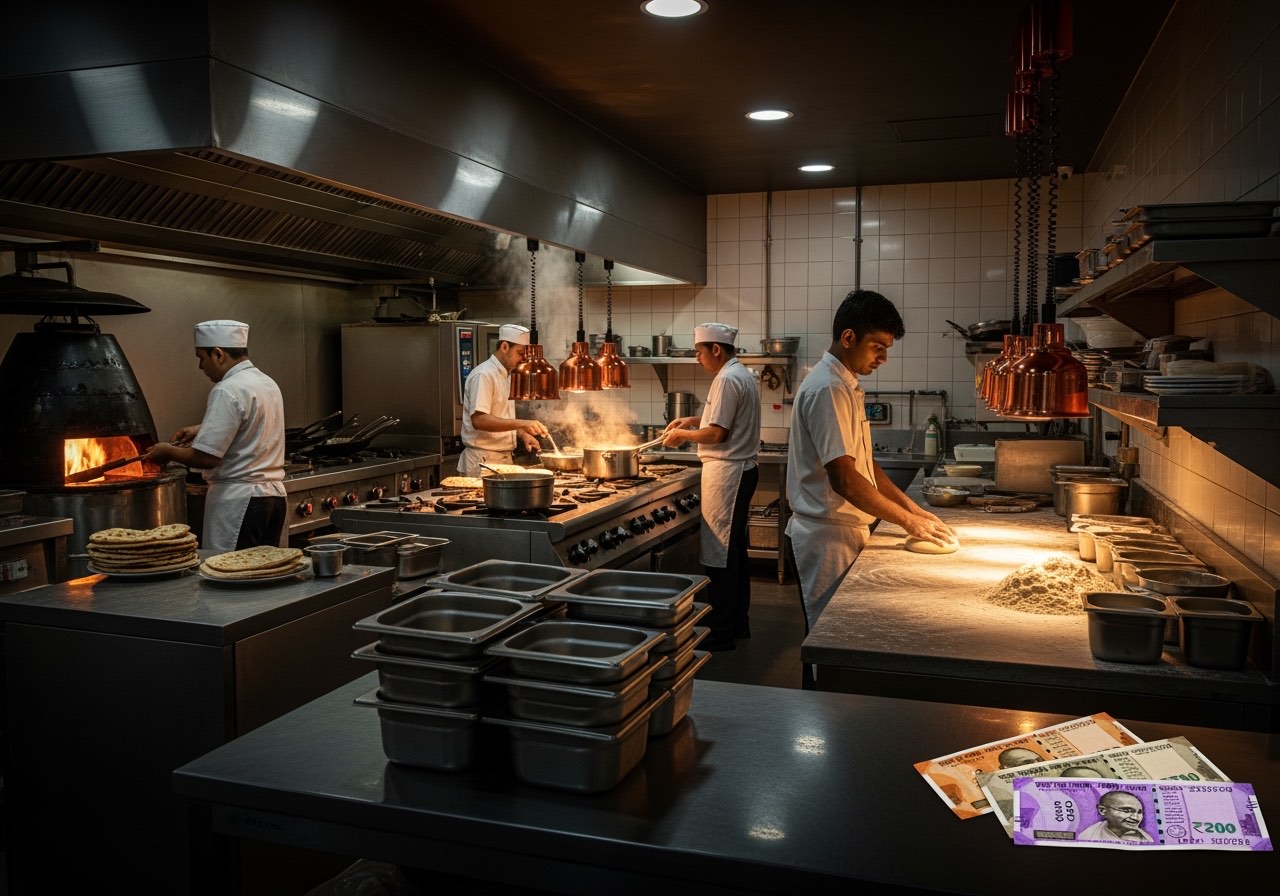
When distributed wins — and stays winning
Three categories of restaurants are better off distributed indefinitely:
- Fine-dine and casual-dine where a la carte timing is the product. A grilled fish that travels 40 minutes is a different dish than one cooked to order. Hubs serve QSR and packaged formats; they degrade fine-dine.
- Chains under five outlets in a single city. The hub fixed cost is too heavy to spread over fewer than five outlets.
- Highly localised menus. If outlet A is a north-Indian thali and outlet B is a south-Indian breakfast spot operating under the same parent brand, you don't have a chain — you have a portfolio. Hubs serve chains.
A standard rule for the early years: don't build the hub until you have six committed outlets in the cold-chain radius and 12+ months of stable menu. Anything earlier is buying consistency with equity, which is a valid choice but should be made with eyes open.
Where this fits with multi-outlet ops
Hub-vs-distributed is the largest single decision in the multi-outlet operator's first three years. It connects to:
- Inter-store transfer documentation — the daily artefact the hub generates (IST formats)
- Multi-outlet daily flash report — the rollup that surfaces hub-vs-spoke variance the next morning (flash report template)
- Restaurant chain operations software — the tooling decision that determines whether your hub becomes a black hole or a transparent unit (software comparison)
Hubs work when the daily-ops loop around them works.
Related on Restaurant Daily
One operator playbook a week, in your inbox.
Cash close, petty cash, payroll, compliance, unit economics — sent every Monday morning. No spam, no upsell drip. Unsubscribe in one click.
Sent from noreply@restaurantdaily.ai. We never share your address.
Related reading
Multi-outlet daily flash report — single-page rollup for area managers
Free multi-outlet daily flash report template for Indian restaurant chains. The 11 fields, the 8am cadence, and the variance flag rules that catch a bad outlet before lunch.
How to manage multiple restaurant outlets — a week-by-week operating rhythm
How to manage multiple restaurant outlets — the area manager's week-by-week operating rhythm, daily/weekly/monthly cadence, and the four habits that keep quality even.
Multi-outlet restaurant management in India — what changes between 1 and 5
Multi-outlet restaurant management in India — what changes between 1 outlet and 5, the four operating phases, role structure, and the cost of getting it wrong.
Ghost kitchen multi-brand operations — running 5 cloud brands from one kitchen
Ghost kitchen multi-brand operations in India — how to run 5 cloud brands from one kitchen, allocate cost cleanly, prevent SKU collision, and decide when to kill a brand.
Inter-store transfer format for restaurants — IST template + GST handling
Inter-store transfer format for restaurants in India — free IST template, GST handling for stock movement between outlets, and the audit trail that protects you.