Overtime calculation for restaurant staff in India — rules + free calculator
Overtime calculation for restaurant staff in India — Factories Act vs Shops & Establishments Acts, double-rate rule, worked examples, and a free calculator.
Last updated 9 Aug 2026
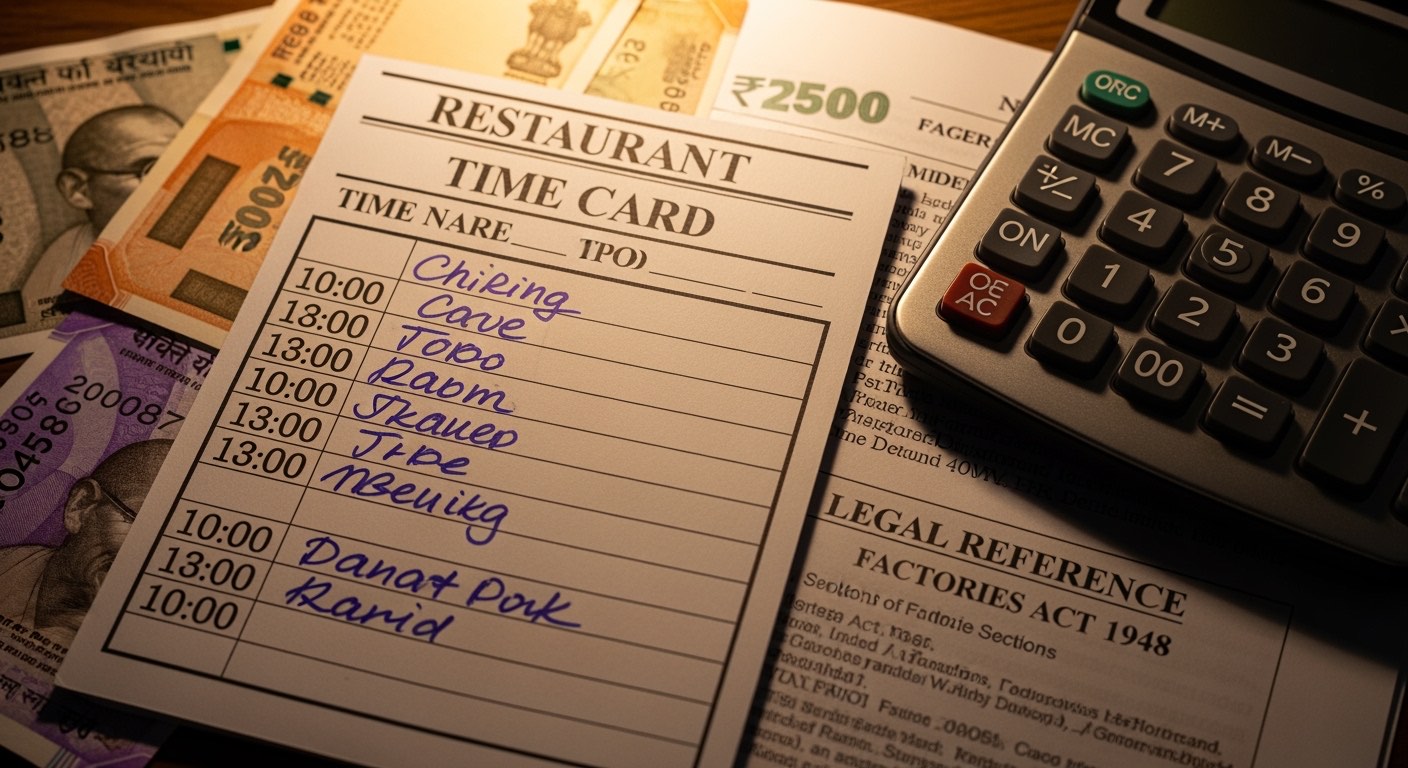
About this piece. Almost every Indian restaurant pays some form of overtime — for the wedding-season banquet, for the chef who covered when the second cook called in sick, for the cashier who closed at 1am instead of 11pm. Most owners pay a flat figure that "feels right" instead of the rate the statute prescribes. This piece is the rule, the maths, and a calculator format you can run on a phone.
Which act applies to your restaurant
Two statutes define overtime for restaurant staff:
- The Factories Act, 1948 — applies to your central kitchen or commissary if it qualifies as a "factory" (10+ workers with power, 20+ without). Most single-outlet restaurants are not factories; central kitchens for a chain often are.
- The state Shops and Establishments Act — applies to the dine-in outlet, the QSR, the cafe. Each state has its own version with its own working-hours and overtime provisions.
For most operators, the Shops & Establishments Act is what you live under. The Factories Act becomes relevant when you set up a CK or commissary. Both have the same broad overtime principle but differ on caps and exemptions.
The core rule — double the ordinary rate
Both the Factories Act and most state Shops & Establishments Acts converge on one principle: overtime is paid at twice the ordinary rate of wages. The rule lives in section 59 of the Factories Act, 1948 and in the equivalent section of each state Shops Act (Maharashtra, Karnataka, Delhi, Tamil Nadu — all align on the 2x rate).
What "ordinary rate" means in payroll terms:
Ordinary hourly rate = (basic + DA) / (working days in month × daily working hours)
Overtime hourly rate = ordinary hourly rate × 2
Two clarifications operators routinely get wrong:
- Ordinary rate is on basic + DA, not on gross. Allowances such as HRA and conveyance are not part of the OT base in most state interpretations.
- The 2x is a floor, not a ceiling. A restaurant can choose to pay more (some chains pay 2.5x for festival weeks). It cannot pay less.
Working hours and the OT trigger
Across most state Shops Acts, the trigger is one of:
- More than 9 hours in a day, or
- More than 48 hours in a week, whichever is more favourable to the staff member.
Maximum overtime is typically capped at 50 hours per quarter under the Factories Act, with state variations. Many state Shops Acts cap weekly total (overtime + ordinary) at 60 hours.
| Concept | Factories Act | Typical state Shops Act |
|---|---|---|
| Trigger | >9 hrs/day or >48 hrs/wk | >9 hrs/day or >48 hrs/wk |
| OT rate | 2x ordinary | 2x ordinary |
| Max OT | 50 hrs/quarter | 50 hrs/quarter (varies) |
| Max total weekly hours | 60 (incl. OT) | 60 (incl. OT) |
| Spread-over | 10.5 hrs/day | 10.5–12 hrs/day (varies) |
A worked example — the cook who stayed late
A skilled tandoor cook in a Bangalore QSR.
- Basic + DA: ₹16,000/month
- Working days in month: 26
- Daily working hours: 9
- Standard total monthly hours: 26 × 9 = 234
Ordinary hourly rate = 16,000 / 234 = ₹68.38
Overtime hourly rate = 68.38 × 2  = ₹136.75
In June the cook does 14 overtime hours across the month — 4 hours on a Saturday banquet, 6 hours over three midweek shifts that ran past 9 hours, and 4 hours on the last Sunday for a private booking.
OT pay   = 14 × 136.75 = ₹1,914.50
Round to = ₹1,915
Total gross for June = 16,000 + 1,915 = ₹17,915 (basic+DA only; allowances on top)
That is the right figure on the salary slip. Most outlets pay an "extra ₹1,000" instead. The staff member knows it is short. The owner knows it is short. The next labour-law training the staff member attends, the gap becomes a complaint.
A free calculator — Excel / Sheets format
The format that fits on one screen:
| Column | Field | Formula |
|---|---|---|
| A | Staff name | (input) |
| B | Basic + DA (₹/mo) | (input) |
| C | Working days in month | (input, default 26) |
| D | Daily working hours | (input, default 9) |
| E | OT hours in month | (sum from muster) |
| F | Ordinary hourly rate | =B/(C*D) |
| G | OT hourly rate | =F*2 |
| H | OT pay | =E*G |
| I | Total earned (B+OT) | =B+H |
The download links live at the bottom. The calculator is just the formula on a sheet — what makes it useful is the muster roll feeding column E.
Three patterns that cost money
"We do not pay overtime. We adjust with comp-off." — common, and partially compliant. Comp-off is allowed under most state Shops Acts only if it is taken within a defined window (often 2 months). Roll it for longer and it becomes back-pay.
- Flat festive bonus instead of OT. Diwali week the chef does 30 hours of OT and gets a ₹3,000 "Diwali bonus" instead. At the rate above, the OT alone is ₹4,100. The bonus is below the statutory entitlement and is also taxable; the OT is a separate line.
- OT computed on gross, not basic+DA. Either over-paying because the gross is much larger, or under-paying because allowances were excluded from "basic" in a way that does not match the state Shops Act definition. Read the act's "wages" definition.
- No OT log. OT happens, owner pays a round number, no entry in the muster roll. When a staff member exits, claims the difference, and you cannot prove how many hours were worked.
Who is exempt — the management exclusion
Most state Shops Acts and the Factories Act exempt staff in "managerial or confidential capacity" from the working-hours and overtime provisions. For a restaurant this typically means:
- The restaurant manager / outlet manager — exempt
- The head chef / executive chef — usually exempt
- Cashiers, waiters, cooks below head, helpers, cleaners — covered
The exemption is by function, not by salary grade. A "manager" who in practice runs the till and waits tables is not exempt because of the title. Document the role honestly; the exemption sticks only when the function matches.
The owner's monthly OT rhythm
A working OT rhythm that takes 20 minutes a month:
- Daily — supervisor signs the muster roll at end of shift. OT hours are a separate column, signed by the staff member.
- Weekly — owner sums OT hours per staff member. If anyone is at 12+ OT hours in a single week, flag for the next week's roster.
- Month-end — payroll picks up the OT column from the muster roll. Calculator does the maths. Salary slip shows OT as a separate line.
- Quarter-end — total OT per staff member against the 50-hour cap. If anyone is approaching, the next quarter's roster needs adjustment.
Where this fits in the payroll loop
- Muster roll — captures OT hours
- Overtime calculation — converts hours to ₹ at 2x ordinary rate (this piece)
- Salary slip — shows OT as a discrete line, not folded into "bonus"
- Salary calculation hub — the broader gross-to-net flow
Get OT right and you have removed the largest source of salary disputes for ops-heavy weeks.
Related on Restaurant Daily
One operator playbook a week, in your inbox.
Cash close, petty cash, payroll, compliance, unit economics — sent every Monday morning. No spam, no upsell drip. Unsubscribe in one click.
Sent from noreply@restaurantdaily.ai. We never share your address.
Related reading
Month-end payroll input checklist for restaurants — what owners must close
Month-end payroll input checklist for Indian restaurants — every input owners must close before salary day, with a 22-item printable list and the three-day rhythm.
Salary slip format for restaurant staff — free Excel + PDF (India 2026)
Salary slip format for restaurant staff in India — what every slip must show, free Excel + PDF templates, and the small-print that makes it audit-proof.
Minimum wage for restaurant staff in India — state-by-state 2026 rates
Minimum wage for restaurant staff in India — state-by-state 2026 rates for unskilled, semi-skilled, skilled categories, with the legal frame and operator implications.
How to calculate restaurant staff salary in India — gross to net guide
How to calculate restaurant staff salary in India — gross to net, PF, ESI, advances, deductions, with a worked example for a 12-person outlet.
Shift roster planning for Indian restaurants — 7-day grid + 6 staffing patterns
Shift roster planning for Indian restaurants — a 7-day grid template, 6 staffing patterns by format, and the rules that keep cost in line without breaking service.