Shift roster planning for Indian restaurants — 7-day grid + 6 staffing patterns
Shift roster planning for Indian restaurants — a 7-day grid template, 6 staffing patterns by format, and the rules that keep cost in line without breaking service.
Last updated 9 Aug 2026

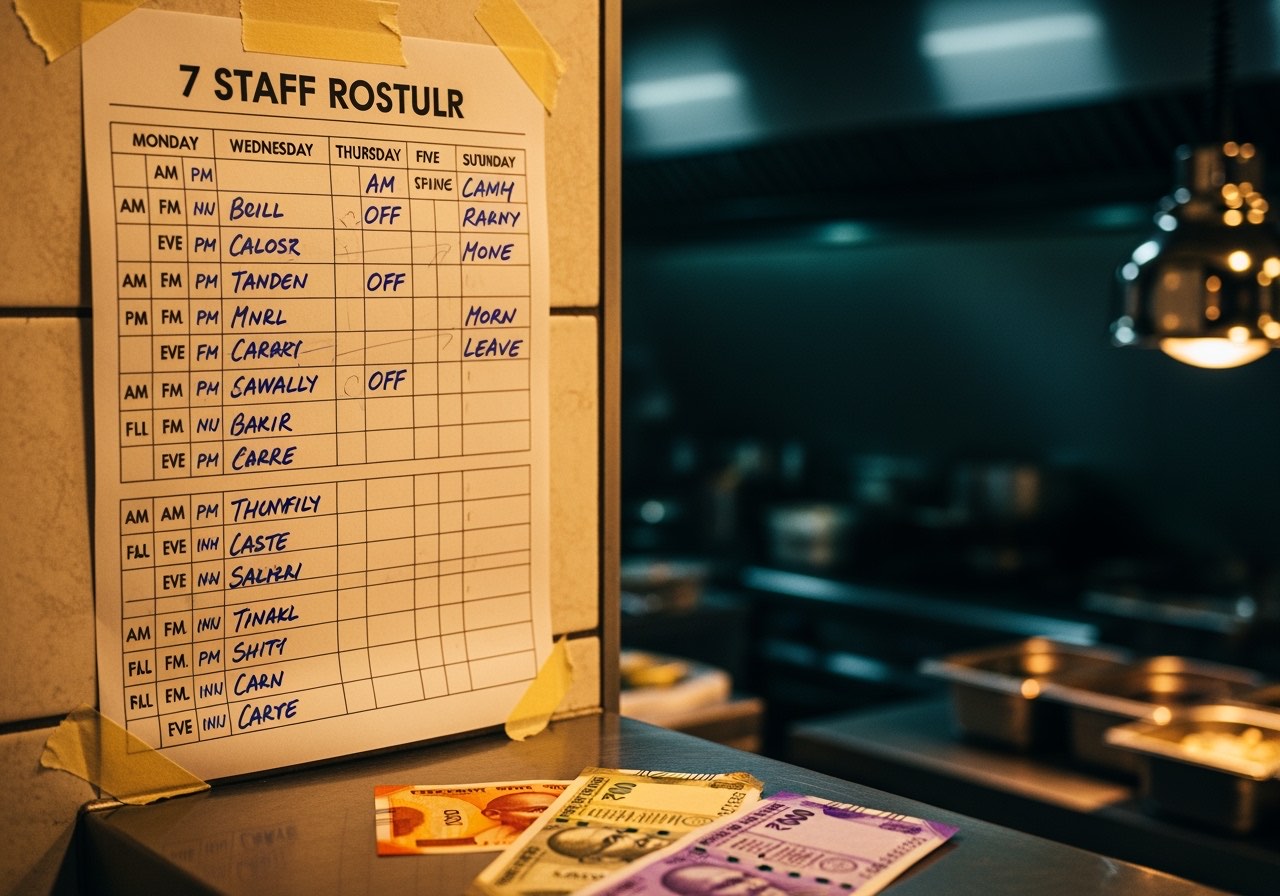
About this piece. A shift roster is the most expensive Excel sheet in a restaurant. Every wrong cell is either ₹500 of unbudgeted labour cost or one disappointed table. Most owners we have spoken to draw the next week's roster on a Thursday evening, around the till, by talking to the head cook and writing names on a whiteboard. This piece is a 7-day grid template, six staffing patterns mapped to format and weekday cycle, and the four rules that keep the roster running when reality changes mid-week.
The job a roster does
A shift roster has to balance three things, every week:
- Service load — covers, delivery orders, banquets, peak vs lull hours
- Statutory ceilings — weekly off, daily working hours, overtime caps
- Cost ceiling — labour-cost target as % of revenue (typically 18–24% for Indian SMB restaurants — NRAI 2024 benchmarks)
Get the roster wrong and one of the three takes the hit. Most rosters drawn on a Thursday whiteboard fail on (3) — labour cost climbs because of ad-hoc shifts and overtime, and the owner discovers it at month-end.
The 7-day grid template
The format every roster eventually converges to:
Outlet: ______       Week of: ______ to ______
Shift codes: M = morning (10-3) · A = afternoon (3-8) · E = evening (8-12) · D = double · O = off

Staff           | Mon | Tue | Wed | Thu | Fri | Sat | Sun | Hrs | OT |
----------------|-----|-----|-----|-----|-----|-----|-----|-----|----|
Manager         |  D  |  D  |  O  |  D  |  D  |  D  |  D  | 60  |  6 |
Head cook       |  D  |  D  |  D  |  O  |  D  |  D  |  D  | 60  |  6 |
Cook 2          |  M  |  E  |  M  |  E  |  M  |  D  |  D  | 50  |  2 |
Tandoor cook    |  E  |  E  |  E  |  E  |  E  |  E  |  O  | 30  |  0 |
Helper 1        |  M  |  M  |  M  |  M  |  M  |  D  |  D  | 45  |  0 |
Helper 2        |  A  |  A  |  A  |  O  |  A  |  D  |  D  | 40  |  0 |
Cashier         |  D  |  D  |  O  |  D  |  D  |  D  |  D  | 60  |  6 |
Waiter 1        |  M  |  E  |  M  |  E  |  M  |  D  |  D  | 50  |  2 |
Waiter 2        |  A  |  M  |  E  |  M  |  E  |  D  |  D  | 50  |  2 |
Cleaner         |  M  |  M  |  M  |  M  |  M  |  M  |  O  | 30  |  0 |
Steward         |  E  |  E  |  E  |  E  |  E  |  E  |  O  | 30  |  0 |
Delivery exec   |  A  |  A  |  A  |  O  |  A  |  D  |  D  | 40  |  0 |
A few rules are baked into the layout:
- One weekly off per staff member — non-negotiable under most state Shops Acts
- No more than one D (double) for staff below manager grade per week — keeps OT under the 50-hour quarterly cap
- At least one M and one E covered every day — service continuity
- Saturday and Sunday have more D shifts — peak load
Six staffing patterns by format and weekday cycle
A 30-cover QSR does not staff like a 90-cover dine-in. Below are six working patterns, each tuned to a format. Use as starting templates, then adjust to your own day-of-week curve.
| Format | Weekday pattern | Weekend pattern | Notes |
|---|---|---|---|
| QSR (30 covers) | 1 cook + 1 helper + 1 cashier + 1 cleaner | + 1 helper | Doubles only Sat/Sun |
| Casual dine-in (60 covers) | 2 cooks + 2 helpers + 1 cashier + 2 waiters + 1 steward | + 1 waiter + 1 helper | E shift heavier than M |
| Fine dine (40 covers, dinner only) | 0 morning, full team E shift | full team E + lunch on Sun | Single dinner peak |
| Cafe (50 covers, all-day) | 2 cooks + 2 baristas + 1 cashier (rotating) | + 1 cashier | M heavier than E |
| Cloud kitchen | 2 cooks + 1 packer + 1 dispatcher (rotating shifts) | + 1 cook + 1 packer | Peak at 12-2 and 8-10 |
| Banquet/catering | Skeleton crew daily + event-day surge | depends on bookings | OT-heavy on event weeks |
The mapping is a starting point, not a prescription. The day-of-week curve at your outlet is the real input. Track it for two weeks before you commit a roster pattern.
The labour-cost equation a roster must respect
Weekly labour cost = sum across staff of (hours × hourly rate)
                   + OT hours × ordinary rate × 2
                   + statutory loadings (employer EPF + ESI)
Target: weekly labour cost ÷ weekly revenue ≤ 22% for casual dine-in, 18% for QSR, 28% for fine-dine.
If your roster as drawn breaks the target, three levers in order of preference:
- Move D shifts off mid-week to Saturday/Sunday — the revenue per OT hour is higher
- Replace one D with an A or E for a staff member close to OT cap
- Defer a hire if the roster is consistently fine without the new role
What you should not do: cut weekly off (illegal under Shops Act), or drop a service-critical role on a peak day (drives the ratio worse, not better, because revenue falls more than cost).
The four rules that survive a mid-week change
A roster drawn on Thursday survives Friday. By Sunday someone has called in sick, someone has asked for a swap, and the weekend banquet is bigger than expected. Four rules keep the roster usable when reality moves:
- Rule of two backups per shift. Every shift has two named backups. When the primary cannot show, the manager calls backup 1, then backup 2. No "find someone".
- Swaps are written, not verbal. Two staff members swap a shift — both initial the roster. The owner sees the change at end-of-day. No "but I told the cook" conversations.
- Overtime is pre-approved. Any shift that would push a staff member past 9 daily hours or 48 weekly hours needs the owner's approval before the staff member starts the OT. Otherwise the cost surprises you on payroll day.
- The roster is one source of truth. WhatsApp messages, whiteboard scribbles, "I told the steward verbally" — none of them count. The roster grid is the record.
The Sunday-evening rhythm
A 4-step rhythm that takes 30 minutes a week:
- Sunday 6pm — owner pulls the previous week's actual hours from the muster roll. Compares to roster as drawn.
- Sunday 6:30pm — owner sketches next week's roster on the grid template. Uses the staffing pattern for the format. Marks D and O.
- Sunday 7pm — head cook and senior waiter review. Adjust for known absences (someone going to a wedding Wednesday).
- Sunday 8pm — final roster goes on the wall + WhatsApp group. Backups confirmed.
Done before the start of the week, the roster has 30 hours to absorb pushback before Monday's first shift.
What multi-outlet operators do differently
If you run 3+ outlets, the roster moves from a per-outlet sheet to a centralised template that the area manager owns. Three things change:
- Cross-outlet backups. A senior cook at Outlet A can cover a sick day at Outlet B. The pool widens.
- Standard staffing pattern per outlet type. All your QSRs run the QSR pattern; all your dine-ins run the dine-in pattern. New-outlet onboarding is faster.
- Centralised OT visibility. The area manager sees OT hours rolling up across all outlets. Anyone approaching the quarterly cap gets flagged for the next week's roster.
Where this fits in the payroll loop
- Shift roster — plans hours and shifts (this piece)
- Muster roll — captures actual hours worked
- Overtime calculation — converts OT hours to ₹
- Salary calculation — gross to net
- Salary slip — issued to the staff member
Roster is the input. Slip is the output. Everything in between is arithmetic.
Related on Restaurant Daily
One operator playbook a week, in your inbox.
Cash close, petty cash, payroll, compliance, unit economics — sent every Monday morning. No spam, no upsell drip. Unsubscribe in one click.
Sent from noreply@restaurantdaily.ai. We never share your address.
Related reading
Month-end payroll input checklist for restaurants — what owners must close
Month-end payroll input checklist for Indian restaurants — every input owners must close before salary day, with a 22-item printable list and the three-day rhythm.
Salary slip format for restaurant staff — free Excel + PDF (India 2026)
Salary slip format for restaurant staff in India — what every slip must show, free Excel + PDF templates, and the small-print that makes it audit-proof.
Overtime calculation for restaurant staff in India — rules + free calculator
Overtime calculation for restaurant staff in India — Factories Act vs Shops & Establishments Acts, double-rate rule, worked examples, and a free calculator.
Minimum wage for restaurant staff in India — state-by-state 2026 rates
Minimum wage for restaurant staff in India — state-by-state 2026 rates for unskilled, semi-skilled, skilled categories, with the legal frame and operator implications.
How to calculate restaurant staff salary in India — gross to net guide
How to calculate restaurant staff salary in India — gross to net, PF, ESI, advances, deductions, with a worked example for a 12-person outlet.