Food cost percentage restaurant India — targets by format (QSR, casual, fine)
Food cost percentage benchmarks for Indian restaurants by format — QSR, casual dine, fine dine, bar, cloud kitchen — plus how to measure it correctly and where leakage hides.
Last updated 9 Aug 2026
About this piece. Ask ten Indian restaurant owners what their food cost percentage is and you'll get six honest "I'm not sure", three who quote the number their accountant put in last year's P&L, and one who has actually counted closing stock this week. This piece sets out target food cost percentage by format for the Indian market, the formula that gives you a number you can trust, and the four leakage paths that quietly push food cost past the target band.
The formula — and why your accountant's number is usually wrong
Food cost % = COGS (food only) / Net food sales

COGS = Opening food stock + Food purchases – Closing food stock
The number your accountant produces from the books is usually purchases divided by sales — a proxy that ignores opening and closing stock. In a steady month with stock levels unchanged, the proxy is roughly right. In any month where you've stocked up for a festival or run down to clear inventory before a refurbishment, it's off by 3–6 points.
Three rules for a clean number:
- Beverages are tracked separately. Bar COGS sits at 18–25%; food COGS sits at 28–35%. Mixing them gives you a useless blended number.
- Net food sales is pre-GST and net of aggregator commission. Reporting on gross aggregator sales is the most common cause of an artificially low food cost %.
- Closing stock is counted, not estimated. Same scale, same containers, same person if possible — counting discipline matters more than counting day.
Target bands by format — Indian context
These are the bands operators we've spoken to settle into after 6–12 months of clean tracking. Above the upper bound is a margin trap. Below the lower bound usually means under-portioning, low-quality ingredients, or under-counted closing stock.
| Format | Food cost % target | Typical real number | Why it sits there |
|---|---|---|---|
| QSR (counter-service) | 28 – 33% | 30 – 32% | Tight portioning, high-volume SKUs, low garnish complexity |
| Cloud kitchen | 28 – 34% | 32 – 35% | Packaging adds 1–2 points on top of food |
| Casual dine | 30 – 35% | 32 – 36% | Higher menu breadth, more wastage, garnish-heavy plating |
| Fine dine | 32 – 38% | 35 – 40% | Premium ingredients, lower volume, higher wastage on prep |
| Bar / pub (food side) | 30 – 36% | 33 – 38% | Lower food velocity, higher prep waste, late-night portion drift |
| Sweets / takeaway counter | 35 – 45% | 38 – 45% | Commodity-heavy (milk, ghee, dry fruit), low value-add |
Bar / beverage cost sits separately at 22 – 28% blended, with spirits 18–22%, beer 35–45%, wine 30–40%, and non-alcoholic 18–25%.
How to measure it correctly — the monthly cycle
Run this on the same date every month. Skipping a month makes the next month's number useless because the variance has nowhere to land.
- Day -1 evening. Manager pulls the previous month's purchases total from the books. Cross-checks with the petty-cash voucher bundle for ingredient buys not in the supplier ledger.
- Day 0 morning before service. Two people count closing stock together — one calls out, one writes. Use a printed sheet with all SKUs pre-listed, not a blank notebook.
- Day 0 evening. COGS is calculated on the worksheet. Food cost % is computed against the month's net food sales (pre-GST, post-aggregator commission).
- Day +1. Review variance vs the previous month. If movement is over 2 points either direction, pull the top three SKU contributors by spend and inspect.
"Counted, not estimated" is the rule that separates a number you can act on from a number you guess at. Once you start estimating, the variance loses meaning.
Where the leakage hides — the four big paths
When food cost drifts above the target band, the cause is almost always one or more of these four. None require sophisticated tooling to find.
1. Yield variance
The recipe says 1 kg of paneer makes 12 portions. The actual yield in your kitchen is 10 portions because the chef is over-portioning by 17 g per plate to "be generous". Over a month at 30 plates a day, that's 15.3 kg of paneer over-served — at ₹400/kg that's ₹6,120 in invisible food cost. Multiply by 8–10 dishes with similar drift and you have 2–3 points of food cost.
Fix: standardised portion scales for the top 10 dishes by volume. Weigh the first portion of each shift in front of the chef.
2. Wastage not separated
If wastage isn't a line on the daily kitchen sheet, it isn't managed. Spoilage from over-prep, returned plates, sample serves — all of it is in COGS but invisible. A typical Indian casual-dine outlet runs 3–5% wastage of food cost. Cutting that to 2% recovers 1–1.5 points of food cost.
Fix: add a wastage column to the daily kitchen sheet. End-of-week roll-up. Review with the head chef on Monday morning.
3. Closing stock under-count
The single biggest source of noise in the number. Half-used containers get rounded down. Frozen items in the back of the freezer get missed. Bar bottles open get counted as "0.5" without measurement. Each rounded-down item inflates COGS this month and deflates it next month.
Fix: liquid bottles are weighed, not eyeballed. A printed pre-listed SKU sheet with no blank rows. Same two people counting each month so the methodology is consistent.
4. Aggregator accounting in the wrong column
If you book gross aggregator sales as revenue and the commission as a separate expense, your food cost % looks 3–5 points better than reality. The aggregator commission is effectively a reduction in your sales, not an operating expense.
Fix: revenue line is net of aggregator commission. Always.
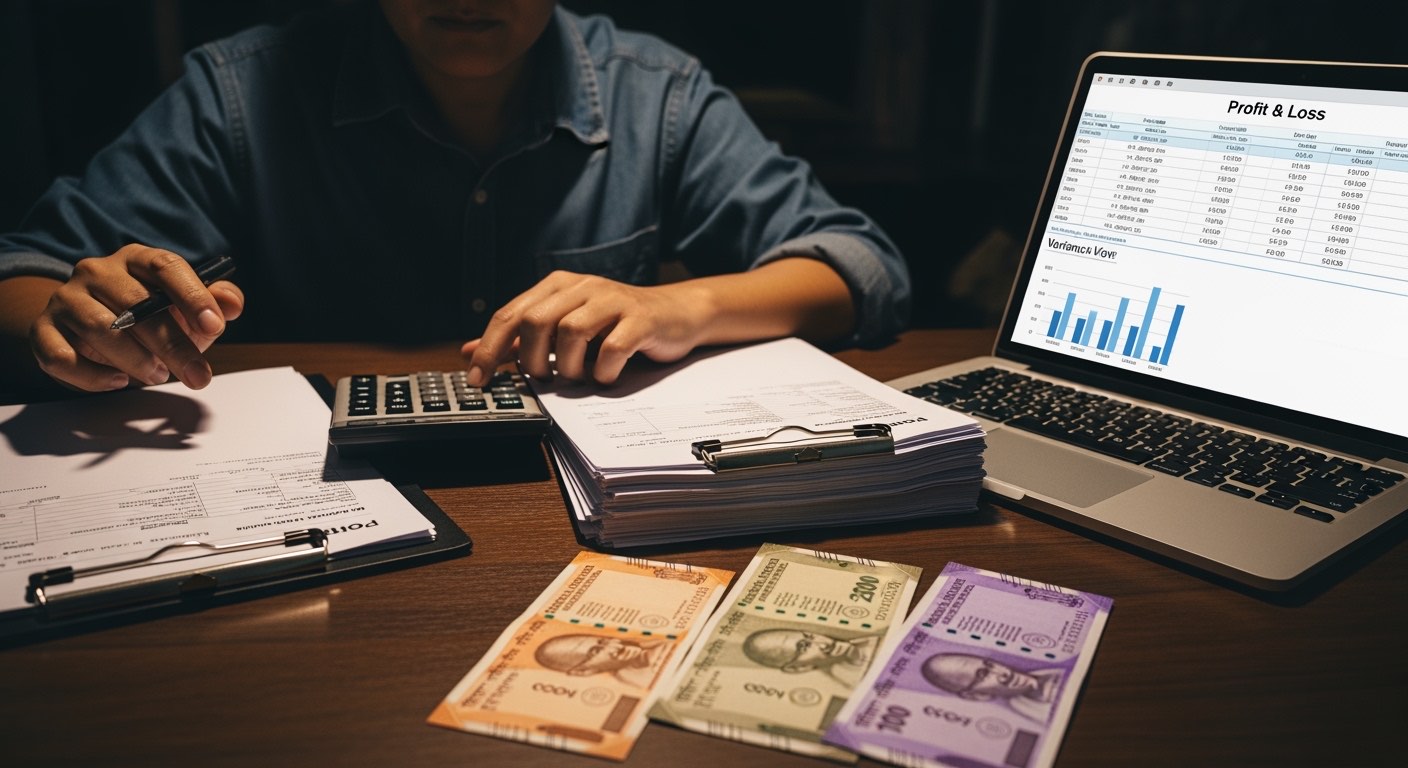
A worked variance — what a 4-point overshoot looks like
A composite Pune casual-dine outlet doing ₹15 lakhs net food sales sees food cost run at 36% (₹5.4 lakhs) instead of the 32% target band (₹4.8 lakhs). That's ₹60,000 / month of variance, or ₹7.2 lakhs / year — usually the difference between an outlet that funds the owner's draw and one that doesn't.
The investigation usually finds:
- 1.5 points from yield drift on the top 5 dishes (over-portioning)
- 1.0 points from spoilage not separated
- 1.0 points from closing stock under-count
- 0.5 points from aggregator commission being booked as expense not as a sales reduction
None of the four are dramatic individually. Stacked, they push the outlet from green to red.
What to do this month — the 14-day fix
If your food cost is sitting 3+ points above the target band:
- Day 1. Print pre-listed SKU sheets for closing stock. Pull the bar count out of the food count.
- Day 2. Add a wastage column to the daily kitchen sheet.
- Day 3. Re-portion the top 5 dishes by volume. Weigh the first plate of each shift.
- Day 7. Re-bid the top 3 SKUs by monthly spend with two alternate vendors. Lock the better price for 90 days.
- Day 14. Mid-month closing stock spot count on the top 5 SKUs by value. Compare with the systematic count due on Day 30.
- Day 30. Run the full month-end count. Calculate food cost %. Compare with prior month.
Two cycles of this and the food cost drift is usually visible and reversible. Three cycles and the discipline is muscle memory.
When the band is a bad target
The bands above are starting points. Three reasons to push beyond them:
- You are deliberately running a loss-leader category (e.g., catering / events) at higher food cost to win volume.
- You are positioning premium and accept higher food cost as part of the brand promise — but in that case track the contribution per cover, not just food cost %.
- You're transitioning — opening a new outlet, mid-renovation, or running down inventory. One quarter of variance is fine; sustained variance isn't.
The point of the target band is not to chase a single number — it is to surface a structural problem before three months of margin erosion.
Related on Restaurant Daily
One operator playbook a week, in your inbox.
Cash close, petty cash, payroll, compliance, unit economics — sent every Monday morning. No spam, no upsell drip. Unsubscribe in one click.
Sent from noreply@restaurantdaily.ai. We never share your address.
Related reading
COGS vs prime cost restaurant India — what each tells you and how to track both
COGS vs prime cost for Indian restaurants — what each metric tells you, the formulas, when each one is the right number to act on, and how to track both monthly.
Restaurant labour cost percentage India — benchmarks + how to bring it down
Restaurant labour cost percentage benchmarks for India by format, what to include in the number, and a 6-step playbook to bring it down without losing service quality.
Restaurant prime cost calculator India — formula + free worksheet
Restaurant prime cost calculator for India — formula, target bands by format, a worked example in INR, and a download-ready worksheet covering food cost + labour cost.
Occupancy cost restaurant India — rent, CAM, electricity benchmarks by city
Occupancy cost in Indian restaurants — rent, CAM, electricity benchmarks by city tier, what to negotiate at lease signing, and how to keep occupancy in the green band.
Menu engineering matrix for Indian restaurants — Stars, Plowhorses, Puzzles, Dogs
Menu engineering for Indian restaurants — Stars, Plowhorses, Puzzles, Dogs explained with a free template, worked example, and an action playbook for each quadrant.