Restaurant labour cost percentage India — benchmarks + how to bring it down
Restaurant labour cost percentage benchmarks for India by format, what to include in the number, and a 6-step playbook to bring it down without losing service quality.
Last updated 9 Aug 2026
About this piece. Labour cost is the second leg of prime cost — and the one operators are most reluctant to touch because the lever feels human. It is human, but the inefficiency rarely lives in headcount. It lives in the shape of the roster. This piece sets out labour cost percentage benchmarks for Indian restaurants by format, what the number should include, and a six-step operator playbook to bring it down without losing service quality.
What "labour cost" actually includes
Most operators report labour cost as wages divided by sales. That number is wrong by 4–8 points.
The full labour cost line in an Indian restaurant should include:
| Component | What goes in | Frequency |
|---|---|---|
| Gross wages | Kitchen + service + cleaning + helpers | Monthly |
| PF (employer share) | 12% of basic + DA up to wage ceiling | Monthly |
| ESI (employer share) | 3.25% of gross (where applicable) | Monthly |
| Bonus accrual | 8.33%–20% of basic, accrued monthly | Accrue monthly, pay annually |
| Gratuity accrual | ~4.81% of basic, accrued monthly | Accrue monthly |
| Manager / supervisor salary | Full, allocated to outlet | Monthly |
| Staff meals (at cost) | Daily food consumed by staff | Monthly |
| Uniforms + safety equipment | Annualised | Annualised, divided into 12 |
| Training + onboarding | Monthly average | Monthly |
| Casual / contract labour | Catering events, festival shifts | Monthly |
The single most common omission: PF and ESI are accrued only when the cheque is paid (often quarterly or annually). That makes labour cost % look 2–3 points better in non-payment months and worse in payment months. Accrue monthly.
Target bands by format
These are the bands operators settle into after 6–12 months of disciplined tracking. Above the upper bound, service quality is usually still fine but margin is bleeding. Below the lower bound, service quality is at risk.
| Format | Labour cost % target | Typical real number | Notes |
|---|---|---|---|
| QSR (counter-service) | 18 – 23% | 20 – 24% | Tight rosters, low service-staff need |
| Cloud kitchen | 14 – 20% | 16 – 22% | No service staff, heavy kitchen + packing |
| Casual dine | 22 – 28% | 25 – 30% | Service-heavy, peak/off-peak roster gap |
| Fine dine | 28 – 35% | 30 – 38% | High service:cover ratio, skilled chef pay |
| Bar / pub | 22 – 28% | 24 – 30% | Late-night premium, security included |
The variation within a format is wider than the variation across formats. A well-rostered casual dine can run at 24%; a poorly-rostered one with the same cover count can run at 32%. The headcount is similar — the shape of the roster is different.
The cover-per-labour-hour metric — sharper than %
Labour cost % moves with sales. In a strong sales month it looks great even if the roster is bloated; in a weak month it looks terrible even if the roster is tight. The sharper metric is:
Covers per labour hour = Total covers in period / Total labour hours in period
Indicative bands for Indian restaurants:
| Format | Covers per labour hour |
|---|---|
| QSR | 6 – 10 |
| Cloud kitchen | 8 – 12 (orders, not covers) |
| Casual dine | 2 – 4 |
| Fine dine | 1 – 2 |
| Bar / pub | 2 – 4 |
A casual dine running at 1.5 covers per labour hour is overstaffed regardless of what the labour cost % shows. A casual dine running at 5 covers per labour hour is understaffed regardless of how good the % looks.
The peak/off-peak gap — where labour quietly bleeds
Most labour overspend in Indian independent restaurants is not at peak. Peak is usually well-staffed because the operator can see the queue. Overspend is in the off-peak hours when the same headcount is on the floor with a quarter of the covers.
A typical Tier-1 casual-dine cover distribution:
12:00 - 14:00   25% of day's covers
14:00 - 17:00    8% of day's covers
17:00 - 19:00   12% of day's covers
19:00 - 22:30   55% of day's covers
If the kitchen + service roster is the same headcount across all four blocks, the 14:00–17:00 block is paying ~30% of daily wages for 8% of daily covers. That's where the rostering opportunity lives.
The dirty secret of Indian restaurant labour: most operators staff for peak and pay for the whole day. Splitting the off-peak block — staggered start times, late lunch break, prep-only afternoon shift — typically recovers 2–4 points of labour cost.
The 6-step playbook to bring labour cost down without losing service
This is the order operators we've spoken to use. Steps 1–3 are pure rostering; steps 4–6 are structural. Don't skip ahead.
1. Map covers by hour for 14 days
Pull the POS hour-by-hour cover count for two full weeks. Don't average — look at the shape. Most outlets have a clear bimodal pattern (lunch + dinner) with a 3-hour valley between. Some have a single-peak pattern (dinner-heavy or lunch-heavy).
2. Plot the roster against the cover map
For each hour, count how many staff are on the floor or in the kitchen. The gap between covers and headcount in the off-peak block is the rostering opportunity. Highlight any hour where covers/labour-hour drops below the format's lower bound.
3. Stagger start and break times
Two changes:
- Stagger start times in 30-minute increments so the full peak roster is on at peak and not before.
- Push lunch breaks into the off-peak valley instead of pre-peak or post-peak.
These two changes alone usually recover 1–2 points of labour cost in the first month. No headcount cut, no service degradation.
4. Cross-train one role each quarter
A service captain who can also expedite. A cook who can also handle packing. A cashier who can also greet. Each cross-trained skill removes one always-on dedicated headcount slot. Cross-training is slow — one role per quarter is realistic — but compounds.
5. Move variable shifts to a casual / contract pool
Festival weekends, banquet bookings, and seasonal peaks need extra hands but not extra full-time hires. Build a roster of 4–6 trusted casual workers paid per shift. Pay slightly above local market for casual labour to keep the pool reliable. The full-time roster shrinks; the variable roster grows.
6. Re-evaluate the manager structure
The operator's last lever — usually one too many supervisor / manager slots that grew during boom months and never got reviewed. A typical 60-cover casual dine needs one operations manager + one shift supervisor, not two managers. This is the most uncomfortable cut and the highest-yield.
Worked example — a casual dine moving from 30% to 26%
A composite Pune casual-dine outlet doing ₹15 lakhs net food sales is sitting at 30% labour cost (₹4.5 lakhs / month). The 6-step loop over 90 days produces:
| Step | Change | Monthly saving |
|---|---|---|
| Rostering — staggered starts + breaks | -1.5 points | ₹22,500 |
| Cross-training (cashier → host) | -0.5 points | ₹7,500 |
| Casual pool for weekend banquets | -0.8 points | ₹12,000 |
| Manager structure (two → one + supervisor) | -1.2 points | ₹18,000 |
| Total | -4.0 points | ₹60,000 / month |
That's ₹7.2 lakhs annualised. For an outlet running ~₹2 crore revenue, that's the difference between a stressed unit and one that funds the owner's draw plus reinvestment.
Where the cuts go wrong
- Cutting at peak. The queue grows, repeat business drops, the COGS:sales ratio worsens, and the labour saving is wiped out within two months.
- Cutting cleaning staff. False economy — hygiene incidents and poor restroom condition kill repeat covers faster than any service slip.
- Cutting the kitchen porter / dishwasher role. This role sits in the background but breaks the kitchen's flow when removed. Other staff slow down to compensate; effective labour cost actually rises.
- One-shot headcount cuts. A 15% headcount cut without rostering or cross-training first usually fails — the roster can't absorb the load. Always rosterise first, then size.
The number to live with
A casual dine running at:
- Below 22% labour cost — almost certainly under-staffed; check service quality and complaint rate.
- 22–28% — green zone, focus on rostering refinements.
- 28–32% — yellow, run the 6-step loop above.
- Above 32% — red, structural action needed in 90 days.
Labour cost is the lever you can actually move. Rent is signed for 5 years. Software is contracted. COGS depends on supplier markets. The roster is yours to redesign every Sunday evening.
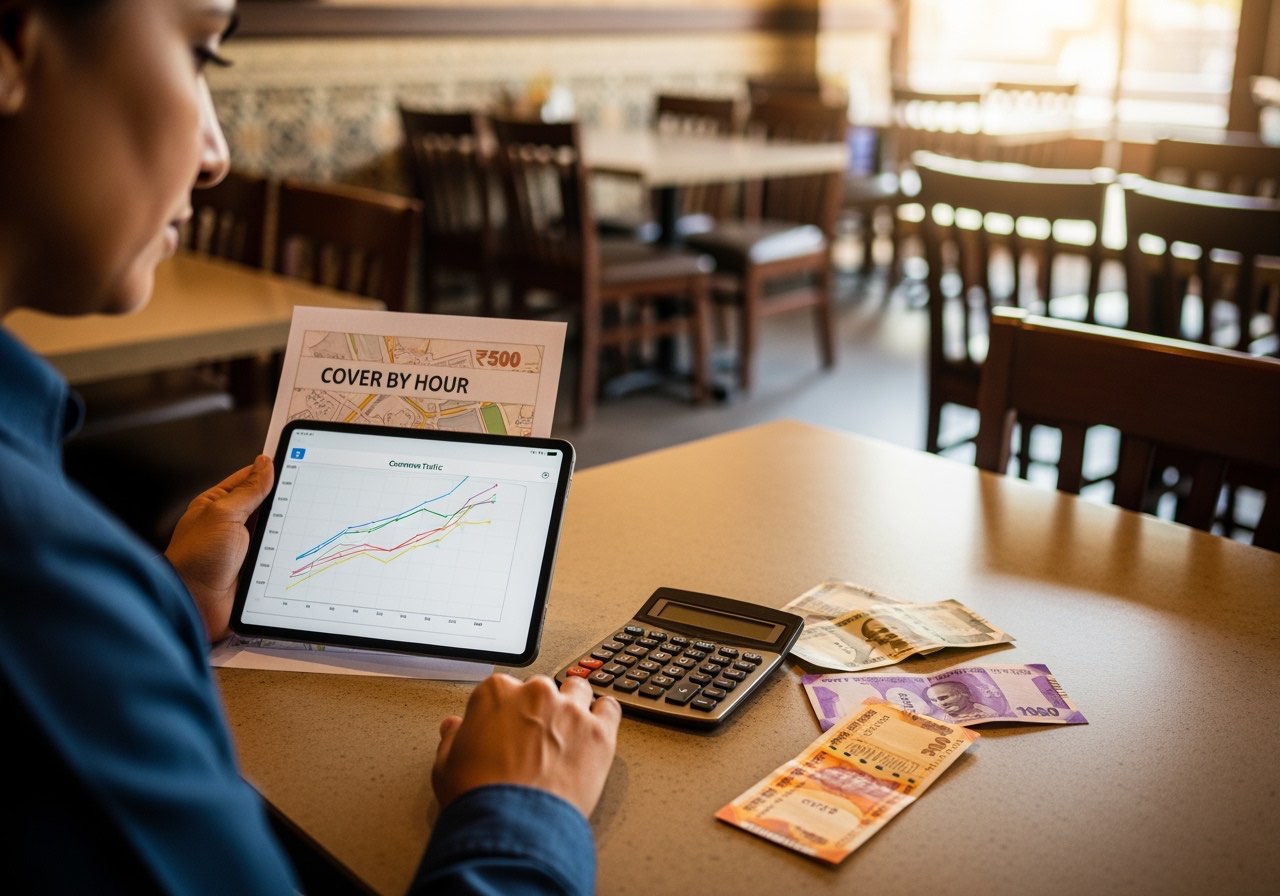
What to do this Sunday
- Pull last week's POS hour-by-hour cover count.
- Lay it next to last week's roster.
- Identify the worst-overlap hour (highest staff-to-cover ratio).
- Make one staggered-start change for next week.
- Repeat next Sunday.
Twelve Sundays of this and the labour cost line on the P&L moves 2–4 points. No drama, no cuts.
Related on Restaurant Daily
One operator playbook a week, in your inbox.
Cash close, petty cash, payroll, compliance, unit economics — sent every Monday morning. No spam, no upsell drip. Unsubscribe in one click.
Sent from noreply@restaurantdaily.ai. We never share your address.
Related reading
Food cost percentage restaurant India — targets by format (QSR, casual, fine)
Food cost percentage benchmarks for Indian restaurants by format — QSR, casual dine, fine dine, bar, cloud kitchen — plus how to measure it correctly and where leakage hides.
Restaurant prime cost calculator India — formula + free worksheet
Restaurant prime cost calculator for India — formula, target bands by format, a worked example in INR, and a download-ready worksheet covering food cost + labour cost.
COGS vs prime cost restaurant India — what each tells you and how to track both
COGS vs prime cost for Indian restaurants — what each metric tells you, the formulas, when each one is the right number to act on, and how to track both monthly.
Occupancy cost restaurant India — rent, CAM, electricity benchmarks by city
Occupancy cost in Indian restaurants — rent, CAM, electricity benchmarks by city tier, what to negotiate at lease signing, and how to keep occupancy in the green band.
Menu engineering matrix for Indian restaurants — Stars, Plowhorses, Puzzles, Dogs
Menu engineering for Indian restaurants — Stars, Plowhorses, Puzzles, Dogs explained with a free template, worked example, and an action playbook for each quadrant.