Signage license for restaurants in India — municipal rules, fees, pitfalls
Signage license for restaurant India — municipal advertisement rules, fees by city tier, common pitfalls in size, illumination, and renewal, plus an inspector-ready checklist.
Last updated 9 Aug 2026
About this piece. Of all the licences a restaurant in India needs, the signage license is the one operators discover last — usually when a municipal vehicle stops outside the outlet and a uniformed officer points at the storefront board. By that point you're negotiating a removal notice and an advertisement-tax demand at the same time. This piece explains who issues a signage license, what the municipal corporation actually wants on file, and how to design the storefront so the licence application is short and the renewal is uneventful.
What "signage license" actually means
There isn't a single national signage law in India. Every Urban Local Body — municipal corporation, council, or panchayat — frames its own Outdoor Advertisement and Hoarding Policy under the powers given to it by the state Municipalities Act. The federal trigger is consumer-facing protection under the CCPA 2022 guidelines for misleading advertisements; the local trigger is advertisement tax plus structural safety plus aesthetics.
In practice, three permissions overlap on the same storefront:
- Signboard / display board permission — for static boards over a defined size, mounted on the building façade or projecting from it.
- Illuminated sign permission — for any board with internal lighting, neon, LED, or external floodlighting after dusk.
- Glow / digital screen permission — for LED screens or moving display panels.
Tiny boards under ~1 sq metre, painted directly on the shutter or wall, sometimes fall outside the licence requirement depending on the city's policy. Anything above that is almost always licensable.
Why the municipality cares (and why you should too)
The municipal corporation cares about three things in roughly this order:
- Advertisement tax revenue. Most policies levy a per-square-foot annual tax. The signage license is the mechanism to assess and collect it.
- Structural safety. A poorly mounted board falling onto the footpath is a civic liability. The licence application usually requires a structural certificate from a registered engineer for boards over a threshold size.
- Aesthetic / heritage zoning. Heritage zones, market complexes, and arterial roads have signage restrictions on size, colour, illumination type, and projection from the building line.
The operator-side reasons to care are simpler: an unlicensed board can be removed by the municipal team, with the cost of removal billed back to the outlet, and the outlet can be served an arrears notice for the entire period the board has been up without a licence.
City-by-city — the broad shape (verify on the ULB portal)
The numbers below are indicative — fee schedules change every fiscal year. Confirm on your municipal corporation's website before budgeting. Use this table only to size the expected order of magnitude.
| City tier | Typical advertisement tax basis | Indicative annual cost for a ~6×3 ft façade board |
|---|---|---|
| Metro (Mumbai, Delhi, Bengaluru, Chennai, Kolkata, Hyderabad) | Per sq ft per annum, slabs by zone | ₹3,000 – ₹15,000 |
| Tier-1 (Pune, Ahmedabad, Jaipur, Lucknow) | Per sq ft per annum, flat or zoned | ₹1,500 – ₹6,000 |
| Tier-2 (most state capitals & large district HQs) | Per sq ft or per board flat | ₹800 – ₹3,000 |
| Tier-3 | Per board flat, nominal | ₹300 – ₹1,500 |
Illuminated boards typically attract a higher rate than non-illuminated. Digital LED screens are in a separate (much higher) bracket and often need additional clearance.
The paperwork the ULB will ask for
A typical signage licence application bundle:
- Application form from the municipal corporation portal.
- KYC of the applicant — proprietor PAN, photo ID, GSTIN.
- Proof of premises — lease agreement or ownership documents.
- Trade licence / Shops & Establishment certificate.
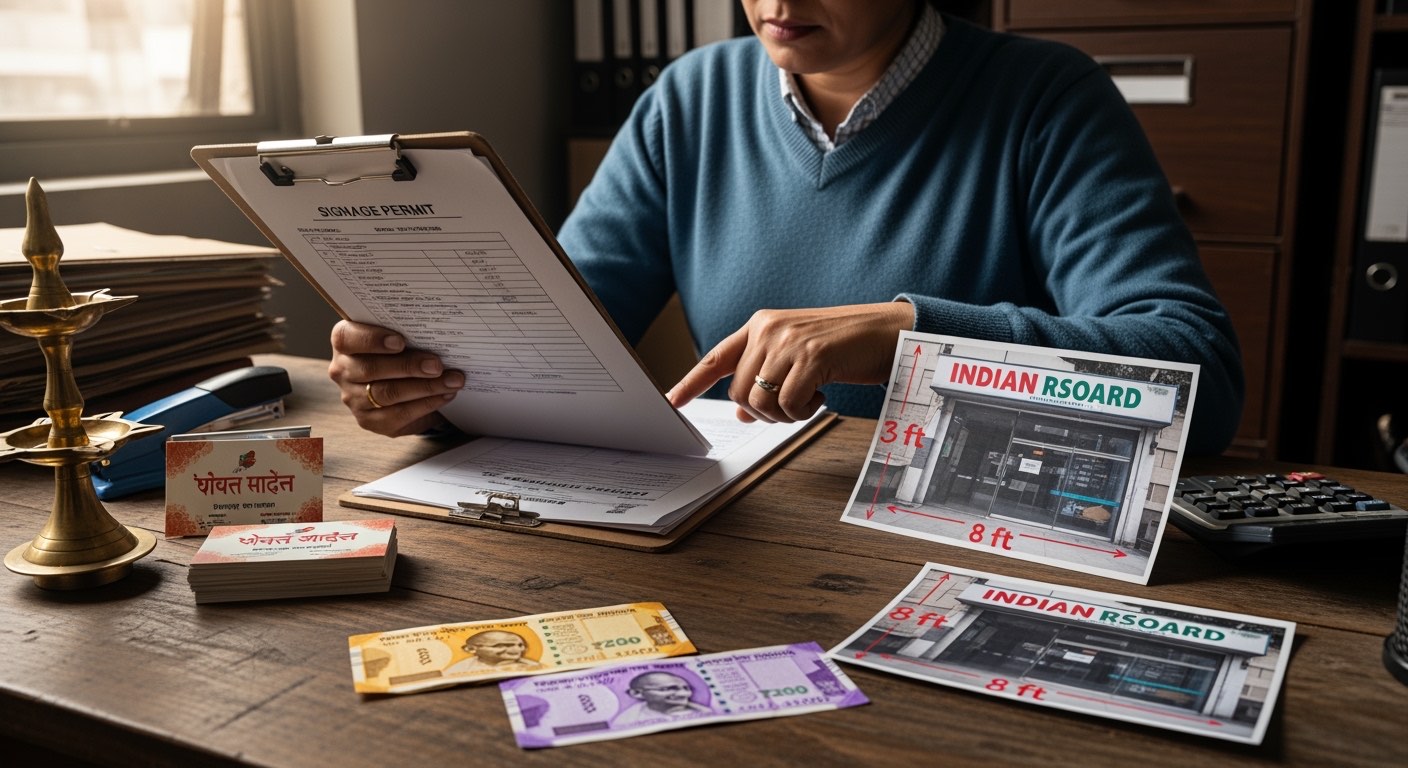
- Photograph of the existing or proposed signboard with dimensions marked.
- Site plan showing the position of the board relative to the building line and footpath.
- Structural stability certificate from a registered structural engineer, for boards above the threshold size set by the local policy.
- Electrical safety certificate for illuminated boards, signed by a licensed electrician.
- NOC from the building owner if the premises is rented.
- Fee payment receipt.
The first-time licence cycle, in our composite operator's experience across NCR and Maharashtra outlets, takes 4 to 10 weeks depending on the ULB's digitisation level.
The seven pitfalls
Every operator we've spoken to has tripped over at least one of these:
- Putting the board up first, applying second. The board exists. The licence doesn't. Removal notices arrive before approvals.
- Measuring the board wrong. Advertisement tax is on the total external dimensions, not the printed area. A 6 ft × 3 ft board with a 4 inch frame is taxed on 6 ft × 3 ft.
- Forgetting the illumination upgrade. Adding a backlit LED to a previously plain board changes the category. The licence has to be amended; many operators don't.
- Projection beyond permissible limits. Most municipal policies cap projection from the building line — usually 12 to 24 inches. Side-mounted projecting boards trip this often.
- Skipping the structural certificate. For larger boards, the application is incomplete without it. Files sit in queue.
- Letting the renewal lapse. Most signage licences are annual. A lapsed licence is treated as no licence — you're charged arrears, not pro-rata.
- Wrong applicant name. The licence must match the legal entity that holds the trade licence. Mismatch between proprietor name and signage application is a routine rejection cause.
What to design at the start to make compliance cheap
The cheapest signage licence is one for a board that doesn't trip any of the high-fee triggers. When designing the storefront:
- Stay under the per-square-foot slab threshold if the policy has one. A board that's 5 ft × 2.5 ft can be cheaper than a 6 ft × 3 ft board not because of area but because of slab boundaries.
- Avoid digital LED screens unless the marketing case is overwhelming — they're in a separate, expensive licence category and need additional structural and electrical clearances.
- Keep illumination external rather than internal in zones where the policy distinguishes — externally illuminated boards (small spotlights) sometimes sit in a cheaper bracket than back-lit boards.
- Lock the design before the licence application, so the photo-of-existing-board in the file matches what's actually up. Mid-licence redesigns are renewals, not amendments, in many ULBs.
The renewal calendar
Treat signage licence renewal like an FSSAI renewal — calendar-driven, not reactive.
| Trigger | Action |
|---|---|
| Licence issue date – 45 days from expiry | Pull current licence + payment receipt |
| – 30 days | File renewal on ULB portal, pay fee |
| – 14 days | Re-verify photo matches current board (no informal additions, no extra panels) |
| Day 0 | Save renewed licence to compliance folder + manager's phone |
| Day +30 | Add the next expiry to the team calendar |
A renewal that lapses by even one day shows up as unpaid arrears for the entire renewal year in many municipal systems — pay the renewal a fortnight before expiry, not after.
What if you get a removal notice
If a municipal team has served a removal notice or sealed the board:
- Don't argue at the site. Take a photo of the notice, note the issuing officer's name and designation, and ask for the time window for response.
- Check the notice category. Is it unlicensed-board, oversize, illumination-without-permission, or structural-unsafe? The remedy differs.
- File a regularisation application within the response window — most ULBs allow regularisation with payment of arrears + penalty, provided the underlying design is licensable.
- Engage a local consultant for ULB-portal work if the corporation has a paper-heavy process. Confirm flat fees in writing — open-ended consultant retainers on signage work usually drift.
In one composite NCR case we've looked at, a 5 ft × 4 ft illuminated board that had been up for 14 months without licence ended up costing about ₹40,000 in combined arrears + penalty + structural certificate + consultant fee — versus an estimated ₹6,000 had it been licensed cleanly from day one.
Related on Restaurant Daily
One operator playbook a week, in your inbox.
Cash close, petty cash, payroll, compliance, unit economics — sent every Monday morning. No spam, no upsell drip. Unsubscribe in one click.
Sent from noreply@restaurantdaily.ai. We never share your address.
Related reading
Weights and measures licence for restaurants in India — when it applies
Weights and measures licence for restaurants in India — when it applies, who needs it under Legal Metrology Act 2009, renewal timeline, fees, and inspection checklist.
Food handler health card for restaurant staff — FSSAI medical rule + flow
Food handler health card for Indian restaurant staff — FSSAI medical fitness rule under Schedule 4, test list, renewal cadence, joining-day workflow, and inspector-ready format.
Liquor license types for Indian restaurants — L-1 to L-19 explained
Liquor license types for Indian restaurants explained — L-1 to L-19 across states, eligibility, fees, daily ops obligations, and the operator's working comparison table.
Fire NOC for restaurants in India — when needed, documents, renewal
Fire NOC for Indian restaurants — when applicable by area and storey, the 11-document checklist, equipment requirements, state renewal cadence, and the inspection script.
Shop & Establishment Act for restaurants — registration, hours, holidays
Shop & Establishment Act registration for Indian restaurants — state-by-state hours, weekly off rules, leave entitlements, registers, fees, and renewal cadence.