Tally vs Zoho Books for restaurant accounting in India — which fits which scale
Tally Prime vs Zoho Books for Indian restaurant accounting — GST filing, multi-outlet, CA workflow, and where each fits the size of your operation.
Last updated 9 Aug 2026

Verdict in one paragraph
For an Indian restaurant in 2026, Tally Prime is the right choice if your accountant or CA is already on Tally — which they almost certainly are. Zoho Books is the right choice if you want a cloud-first, multi-outlet-friendly system, and you're willing to either find a Zoho-fluent CA or train your existing one. Tally has the install base; Zoho has the modern UX and the multi-user / multi-outlet collaboration story. Both file GSTR-1 and GSTR-3B. Both are India-grade. Pick by the constraint that matters most to your operation: CA continuity (Tally) or multi-user cloud collaboration (Zoho Books).
Why this comparison matters for restaurants
Restaurants generate accounting volume that surprises new operators: daily sales entries, supplier bills (often dozens per week — vegetables, dairy, meat, packaging), staff salary, GST split (CGST/SGST or IGST for inter-state catering), TCS/TDS on aggregator deposits, ITC on inputs, advance and security deposit handling. Whichever tool you pick is going to live in the back office for years and shape how your CA charges you. Pick well.
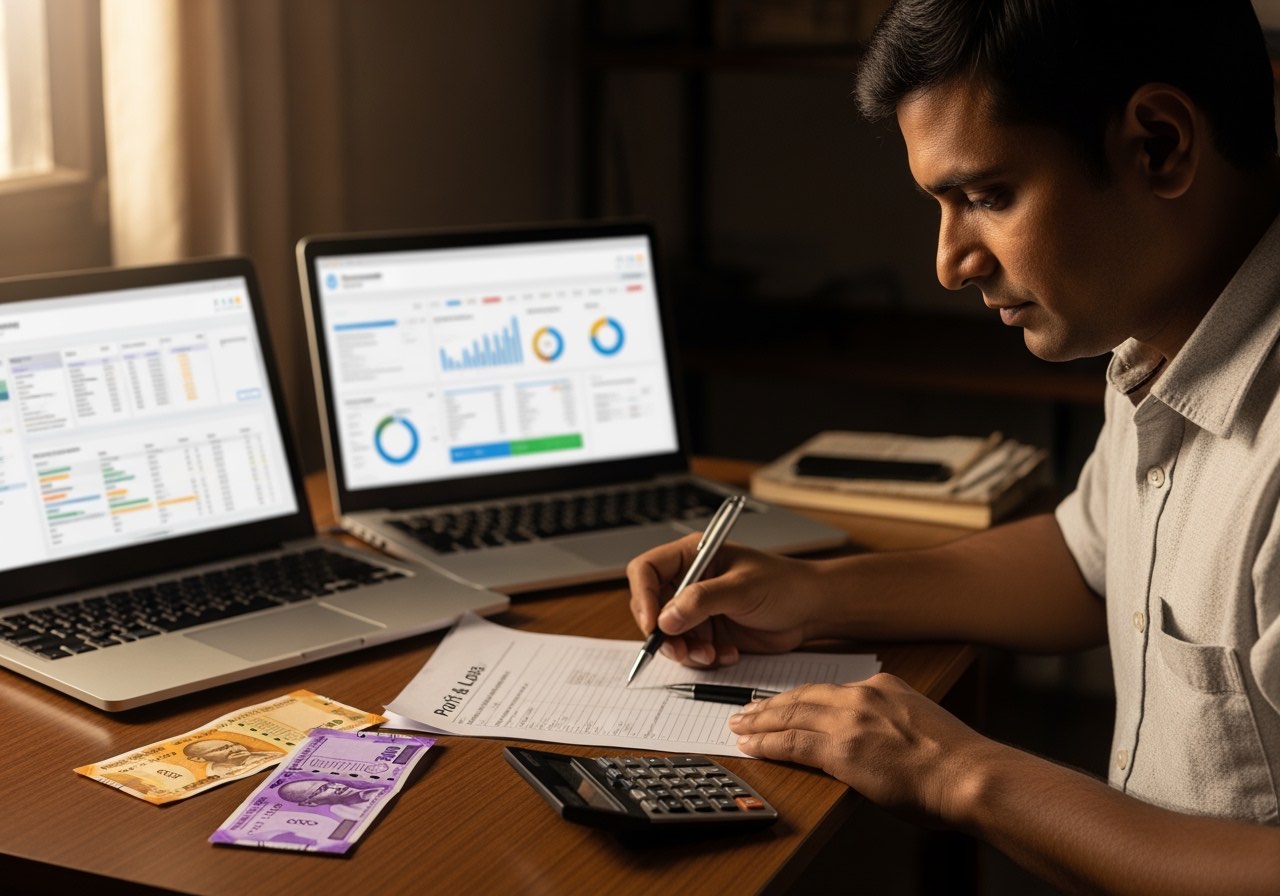
Side-by-side feature comparison
| Feature | Tally Prime | Zoho Books | Notes / Verdict |
|---|---|---|---|
| Origin | India (Bangalore, Tally Solutions) | India (Chennai, Zoho Corp) | Both India-bred |
| Deployment | Desktop-first; cloud via Tally on AWS or third-party | Cloud-native | Zoho wins if cloud is the requirement |
| GSTR-1 / GSTR-3B filing | Native | Native | Tie |
| GSTR-2B reconciliation | Strong | Strong | Tie |
| Multi-user concurrent access | Possible but cumbersome (Tally Server / cloud-hosted) | Native, cleanly priced | Zoho wins |
| Multi-outlet (cost-centre / branch) | Possible — cost centres, branches | Native — branches feature | Zoho wins for clarity |
| CA familiarity in India | Near-universal | Growing fast, still smaller | Tally wins |
| Mobile / phone access | Via cloud-hosted Tally only | Native mobile app | Zoho wins |
| Banking integration | Manual or via add-ons | Native bank feeds (selected banks) | Zoho wins |
| Customisation depth | Very deep (TDL scripts) | Moderate (workflows, custom fields) | Tally wins for power users |
| Learning curve | Steep — keyboard-driven | Gentler — UI-driven | Zoho wins for non-accountants |
| Offline operation | Native (desktop) | Limited | Tally wins |
| Audit trail | Strong (with edit log enabled) | Strong | Tie |
| Pricing posture | Perpetual licence + AMC, or rental | Subscription (per-user, per-org) | Different shapes — see pricing |
Pricing — verify before purchasing
Both vendors revise pricing periodically. Treat the table below as posture only. Publicly listed at tallysolutions.com and zoho.com/in/books — verify before purchasing.
| Tool | Pricing posture | Notes |
|---|---|---|
| Tally Prime — Silver | Single-user perpetual licence + annual AMC | Most common single-outlet purchase |
| Tally Prime — Gold | Multi-user (LAN) perpetual licence + AMC | For 2-5 user back office |
| Tally on Cloud | Monthly per-user via authorised partners | Adds cloud access on top of the licence |
| Zoho Books — Standard / Professional / Premium | Per-organisation subscription with user limits | Clean tier ladder, per-month pricing |
| Zoho Books — Branches add-on | Per-branch fee on top of the subscription | Relevant for multi-outlet |
The model difference matters: Tally is capex-heavy, then cheap to run. Zoho is opex from day one. For a young restaurant the Zoho shape is friendlier to cashflow; for a mature outlet that's been on Tally for a decade, the perpetual licence has long since paid for itself.
What Tally does well — credit where it's due
- CA fluency. Walk into any chartered accountant's office in India and they'll work in Tally without thinking. That continuity is a real asset — fewer translation errors at filing time, faster turnaround on closings.
- Speed once you know the keyboard. A trained Tally operator can post 200 vouchers an hour with no mouse. UI-first cloud tools can't match this for high-volume manual entry.
- Customisation depth (TDL). If your business has unusual workflows, Tally's scripting layer (TDL) can absorb almost anything. Most restaurants don't need this, but enterprises do.
- Offline. When the internet goes out, Tally keeps working.
- Industry-tested for GST. Years of GST refinement, stable filing flow, well-understood error patterns.
What Zoho Books does well — credit where it's due
- Cloud-native multi-user. Owner in Mumbai, accountant in Pune, CA in Bangalore — all on the same data, in real time, without a Tally-on-cloud middleman.
- Multi-outlet (Branches) feature. Built natively, not bolted on. Each outlet's books separated cleanly, consolidated reporting at the org level.
- Modern UX. A non-accountant owner can read a P&L in Zoho without training. That matters when the owner is the decision-maker.
- Banking + payment integrations. Bank feeds, payment gateways (Razorpay/Paytm), automatic reconciliation suggestions.
- Mobile. Real mobile app, real workflows on phone — bills you can capture and approve from a delivery van.
- Connected Zoho ecosystem. If you also use Zoho Inventory, Zoho People (HR), Zoho CRM, the integration is seamless.

Where each loses
- Tally loses on cloud collaboration without a third-party cloud-host, on phone access, on the learning curve for non-accountants, and on the modern UX expectations of an owner who's used to consumer apps.
- Zoho Books loses on CA fluency outside metros, on raw data-entry speed for keyboard-trained accountants, and on the depth of customisation power users sometimes need.
Who should pick Tally Prime
- Established restaurants where the CA is already on Tally — the migration cost isn't worth the upside.
- High-volume back offices with a trained accountant doing 200+ vouchers a day.
- Operators who need offline operation as a hard requirement (poor connectivity zones).
- Businesses with unusual workflows that need TDL customisation.
- Owners who treat the books as the accountant's job, not theirs.
Who should pick Zoho Books
- New restaurants starting fresh — no legacy migration cost.
- Multi-outlet operators (2+ outlets) who want consolidated reporting without paying for Tally on cloud per user.
- Owner-operators who want to read their own P&L on a phone.
- Restaurants already on the Zoho stack (CRM, Inventory, People).
- Operators willing to invest a week in training their CA on Zoho, or who can find a Zoho-fluent CA in their city.
A workable hybrid pattern
For mid-size operators (3-10 outlets) we sometimes see a pragmatic split:
- Day-to-day operations and bills in Zoho Books — owner, manager, cashier all see the same picture.
- Period-end consolidation and GST filing by the CA in Tally — exported from Zoho, imported into Tally.
This works but it has overhead. If you can avoid the dual stack, do.
How both connect to the rest of the restaurant stack
Whichever you pick, plan the data flow:
- POS daily sales summary → accounting (one entry per day per outlet, ideally automated).
- Supplier bills → accounting (manual entry or photo-capture in Zoho; manual in Tally).
- Aggregator deposits → accounting (split into gross sales, commission, TCS, TDS, net deposit).
- Payroll output → accounting (monthly journal, net pay, deductions, employer contributions).
- Petty cash voucher bundle → accounting (weekly or fortnightly consolidated entry).
Both tools handle all five — the question is who keys it and how often.

Closing recommendation
If your CA is on Tally and your operation is mostly back-office-driven, stay on Tally Prime. The continuity is worth more than the modern UX of an alternative. If you are starting fresh, multi-outlet, or want the owner involved in reading the books, pick Zoho Books. Both are India-grade and will file your GST correctly. Don't over-think this one — pick by the CA constraint and the cloud constraint, then move on. The bigger wins in restaurant finance are upstream of the accounting tool: clean POS daily summaries, disciplined supplier bills, accurate aggregator reconciliation. Get those right and either tool will sing.
Related on Restaurant Daily
One operator playbook a week, in your inbox.
Cash close, petty cash, payroll, compliance, unit economics — sent every Monday morning. No spam, no upsell drip. Unsubscribe in one click.
Sent from noreply@restaurantdaily.ai. We never share your address.
Related reading
Dukaan vs Petpooja menu app for restaurants — direct ordering vs full POS
Honest comparison of Dukaan and Petpooja for Indian restaurants — direct WhatsApp/web ordering vs full POS, when each makes sense, and how some operators use both.
Razorpay POS vs Paytm POS for restaurants — MDR, settlements, hardware
Razorpay POS vs Paytm POS for Indian restaurants — MDR rates, settlement cycles, hardware, dispute handling, and which payment terminal fits which outlet shape.
WATI vs AiSensy for restaurant WhatsApp marketing — pricing, templates, deliverability
Honest comparison of WATI and AiSensy for Indian restaurants running WhatsApp marketing — template approval, broadcast quality, automation, pricing posture, and who picks which.
Swiggy partner vs Zomato partner dashboards — what each shows, what's missing
Side-by-side of the Swiggy and Zomato restaurant partner dashboards in 2026 — sales, ratings, ad spend, payout reconciliation, and the gaps both leave for operators.
Restaurant Daily vs Petpooja — feature-by-feature comparison (2026)
An honest side-by-side of Restaurant Daily and Petpooja for single-outlet and multi-outlet Indian restaurants — POS, daily close, integrations, and who picks which.