Dukaan vs Petpooja menu app for restaurants — direct ordering vs full POS
Honest comparison of Dukaan and Petpooja for Indian restaurants — direct WhatsApp/web ordering vs full POS, when each makes sense, and how some operators use both.
Last updated 9 Aug 2026
Verdict in one paragraph
These two products solve different problems, not the same one. Dukaan (mydukaan.io) is a direct-to-customer storefront — your own menu page, your own WhatsApp/web ordering, no Swiggy/Zomato commission, but you do all the marketing and delivery yourself. Petpooja (petpooja.com) is a full restaurant POS — billing, KOT, kitchen flow, aggregator integration, inventory. Pick Dukaan if your bottleneck is "I want direct orders without paying 25-30% commission." Pick Petpooja if your bottleneck is "I need a real POS to run the floor." Many operators we've spoken to run both — Petpooja on the counter, Dukaan as the direct-ordering channel. They're complementary, not substitutes.
What each product is, honestly
Dukaan is a no-code commerce platform for small Indian businesses. Surface: a hosted storefront (web link or domain), product/menu listing with photos and prices, payment collection (UPI, cards, COD), order notifications via WhatsApp/SMS, basic inventory, simple analytics. It is not a POS. It is a shopfront.
Petpooja is the most widely used restaurant POS in India. Surface: billing with KOT, table management, modifiers, tax split, aggregator integration (Swiggy/Zomato), inventory, recipe consumption, multi-outlet rollups. It is not a customer-facing storefront. It is the operating system for the floor.
Comparing them feels apples-to-oranges because it is. But operators ask the question constantly, so here's the honest framing.
Side-by-side feature comparison
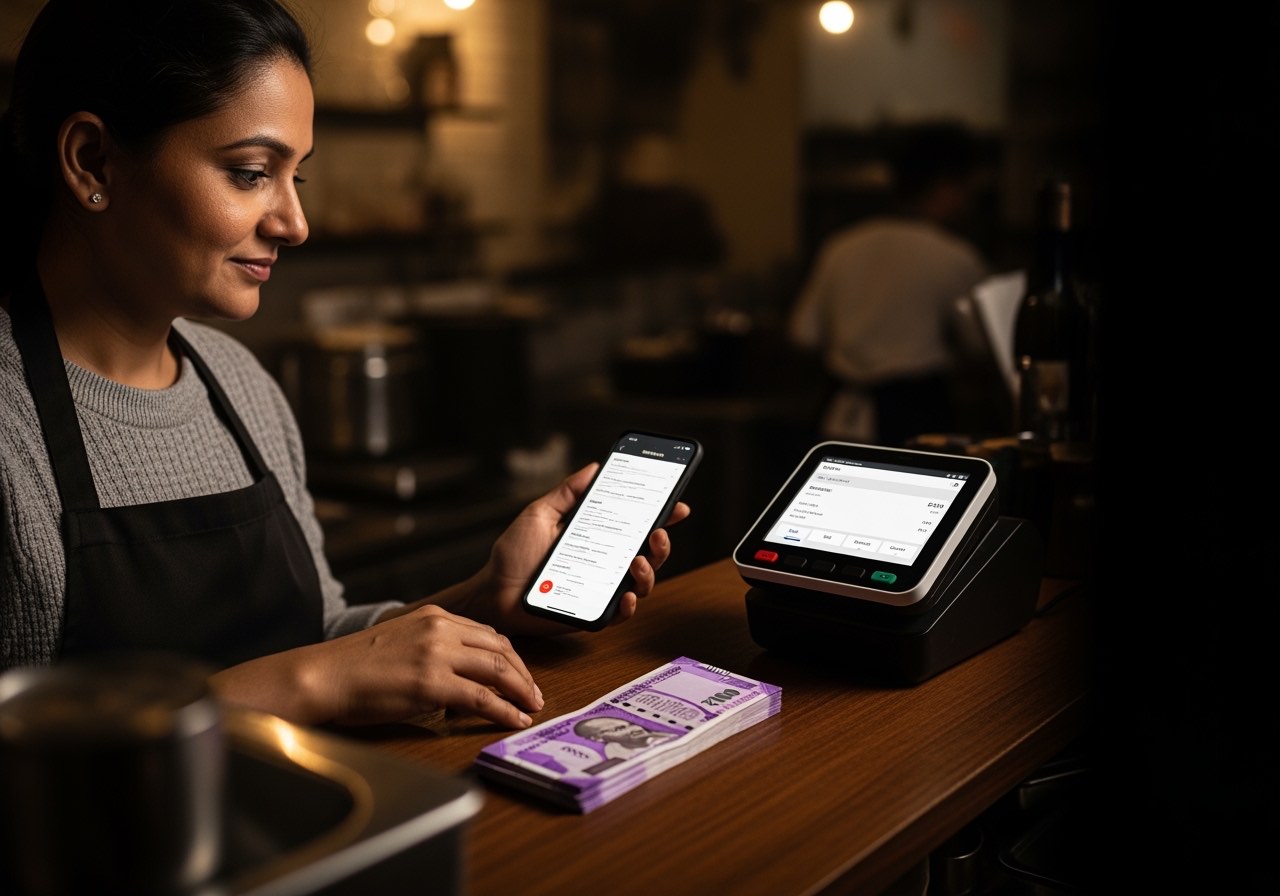
| Feature | Dukaan | Petpooja | Notes / Verdict |
|---|---|---|---|
| Product category | DTC commerce / menu storefront | Restaurant POS + back office | Different categories |
| Customer-facing menu page | Yes (hosted) | No (operator-facing only) | Dukaan wins for direct orders |
| In-store billing (KOT, modifiers, tax) | No | Yes | Petpooja wins |
| Aggregator integration (Swiggy/Zomato) | No | Yes (native) | Petpooja wins |
| Direct ordering (WhatsApp / web link) | Native | Limited / via add-on | Dukaan wins |
| Payment collection (UPI/cards/COD) | Native | Via POS payment terminals | Different shapes |
| Inventory | Basic | Strong | Petpooja wins |
| Multi-outlet | Limited | Yes (paid tier) | Petpooja wins |
| Onboarding effort | Self-serve, 30 minutes | Local installer, half a day | Dukaan wins for self-serve |
| Hardware required | None (your phone is enough) | Tablet/PC + thermal printer + cash drawer | Dukaan wins for zero-hardware setup |
| Marketing tools (offers, coupons, broadcasts) | Strong | Limited | Dukaan wins |
| GST / compliance hooks | Basic invoicing | Strong | Petpooja wins |
| Best for | Direct ordering, off-platform sales | Counter ops + aggregator-driven sales | Different jobs |
Why operators get confused
Both are "restaurant tools you use on a phone or tablet." Both have a menu somewhere in the workflow. Both can collect payments. The confusion is reasonable — but the pricing and effort tradeoffs are very different.
The honest test: stand at your billing counter at 8pm on a Saturday. What's missing? If the answer is "I can't take walk-in orders fast enough, KOT is on paper," you need Petpooja. If the answer is "I'm spending 30% of every Swiggy order on commission and I want a way to push regulars to order direct," you need Dukaan.
What Dukaan does well
- Zero-friction direct ordering channel. A WhatsApp message goes out: "Diwali special menu, order direct via this link, free delivery within 3km." Customers click, pick, pay. No aggregator commission. The math at scale is striking.
- Self-serve onboarding. A single-owner outlet can set up Dukaan in an evening. No installer, no training, no hardware.
- Marketing-led tools. Coupons, festive offers, broadcasts — built into the product, not bolt-on.
- Cost. Free or low-tier pricing makes it a low-risk experiment.
What it doesn't do: replace your in-store POS. It is a channel, not a system.
A grounded use case for Dukaan in restaurants
A 40-cover NCR restaurant with a strong regular base. They were paying 25-30% to Swiggy/Zomato on every delivery order. They set up a Dukaan link, printed it on every dine-in bill ("scan to order delivery direct, 10% off"), pushed it on WhatsApp to opt-in regulars. Within 3 months, ~15% of delivery orders shifted from aggregator to direct. The commission saved per month easily exceeded the entire Dukaan + ad spend cost. The aggregator volume on the remaining 85% wasn't dented because the direct-channel customers were the ones who would have ordered direct if asked anyway. Numbers will vary by outlet — directional only.
What Petpooja does well
- Real POS depth. KOT, modifiers, table flow, tax split, kitchen display — refined over a decade.
- Aggregator integration. Swiggy and Zomato menu push, order pull, settlements — native and mature.
- Hardware ecosystem. Local installers in every Tier-1/Tier-2 city.
- Inventory and recipe management. Strong enough that small chains use it as their primary inventory system.
- Indian compliance and GST. Tuned for the Indian accounting workflow.
See our Petpooja review for the full honest take.
Pricing — verify before purchasing
Different shapes, different conversations. Publicly listed at mydukaan.io and petpooja.com — verify before purchasing.
| Tool | Pricing posture |
|---|---|
| Dukaan | Free tier + paid tiers for advanced features (custom domain, advanced analytics, integrations) |
| Petpooja | Per-outlet subscription + hardware separately + aggregator integration tiers |
Dukaan is opex-light because there's no hardware. Petpooja has a real capex/opex profile because there is. Both run promotional pricing; talk to sales for specifics.
Where each loses
- Dukaan loses when you need real in-store POS — it's not built for billing, KOT, modifiers, or kitchen flow.
- Petpooja loses when your bottleneck is direct customer ordering — its customer-facing menu/order flow exists but is not the focus, and aggregator commissions on delivery orders aren't something Petpooja saves you from.
Who should pick Dukaan
- Restaurants with strong regular base whose bottleneck is aggregator commission, not POS quality.
- Cloud kitchens or home-kitchen brands launching with no physical counter.
- Operators who already have a working POS (any POS) and want to add a direct-ordering channel.
- Single-owner outlets at low volume where formal POS hardware isn't justified yet.
Who should pick Petpooja
- Anyone running real in-store billing — dine-in, walk-in QSR, cafe.
- Restaurants whose primary delivery channel is Swiggy/Zomato (aggregator integration).
- Operators with kitchen-display or multi-counter setups.
- Multi-outlet chains needing consolidated reporting and inventory.
Run both — the pattern that actually works
For many delivery-heavy outlets, the right answer is both:
- Petpooja for in-store billing, KOT, aggregator integration.
- Dukaan as the direct-ordering channel, marketed to regulars with a discount that's smaller than the aggregator commission.
- A daily reconciliation layer (your accounting tool, or Restaurant Daily's reconciliation module) that combines aggregator + direct + dine-in into one P&L.
The combined cost is less than either of them alone at scale, because the commission saved on direct orders subsidises both subscriptions.
Closing recommendation
Dukaan and Petpooja are not competitors at most outlets — they're complementary. If you don't have a POS, pick Petpooja first. If your POS is fine and you want to fight aggregator commission, add Dukaan as a direct channel. Compare them honestly by the bottleneck in your operation, not by feature lists in a vendor pitch deck. Both are mature India-built products doing very different jobs.
Related on Restaurant Daily
One operator playbook a week, in your inbox.
Cash close, petty cash, payroll, compliance, unit economics — sent every Monday morning. No spam, no upsell drip. Unsubscribe in one click.
Sent from noreply@restaurantdaily.ai. We never share your address.
Related reading
Restaurant Daily vs Petpooja — feature-by-feature comparison (2026)
An honest side-by-side of Restaurant Daily and Petpooja for single-outlet and multi-outlet Indian restaurants — POS, daily close, integrations, and who picks which.
Razorpay POS vs Paytm POS for restaurants — MDR, settlements, hardware
Razorpay POS vs Paytm POS for Indian restaurants — MDR rates, settlement cycles, hardware, dispute handling, and which payment terminal fits which outlet shape.
WATI vs AiSensy for restaurant WhatsApp marketing — pricing, templates, deliverability
Honest comparison of WATI and AiSensy for Indian restaurants running WhatsApp marketing — template approval, broadcast quality, automation, pricing posture, and who picks which.
Swiggy partner vs Zomato partner dashboards — what each shows, what's missing
Side-by-side of the Swiggy and Zomato restaurant partner dashboards in 2026 — sales, ratings, ad spend, payout reconciliation, and the gaps both leave for operators.
Tally vs Zoho Books for restaurant accounting in India — which fits which scale
Tally Prime vs Zoho Books for Indian restaurant accounting — GST filing, multi-outlet, CA workflow, and where each fits the size of your operation.