Catering business daily tracking — event-day template covering food, staff, payments
Catering business daily tracking template for Indian caterers — event-day sheet covering food prep, staff deployment, payment milestones, and the four leakage points unique to catering.
Last updated 9 Aug 2026
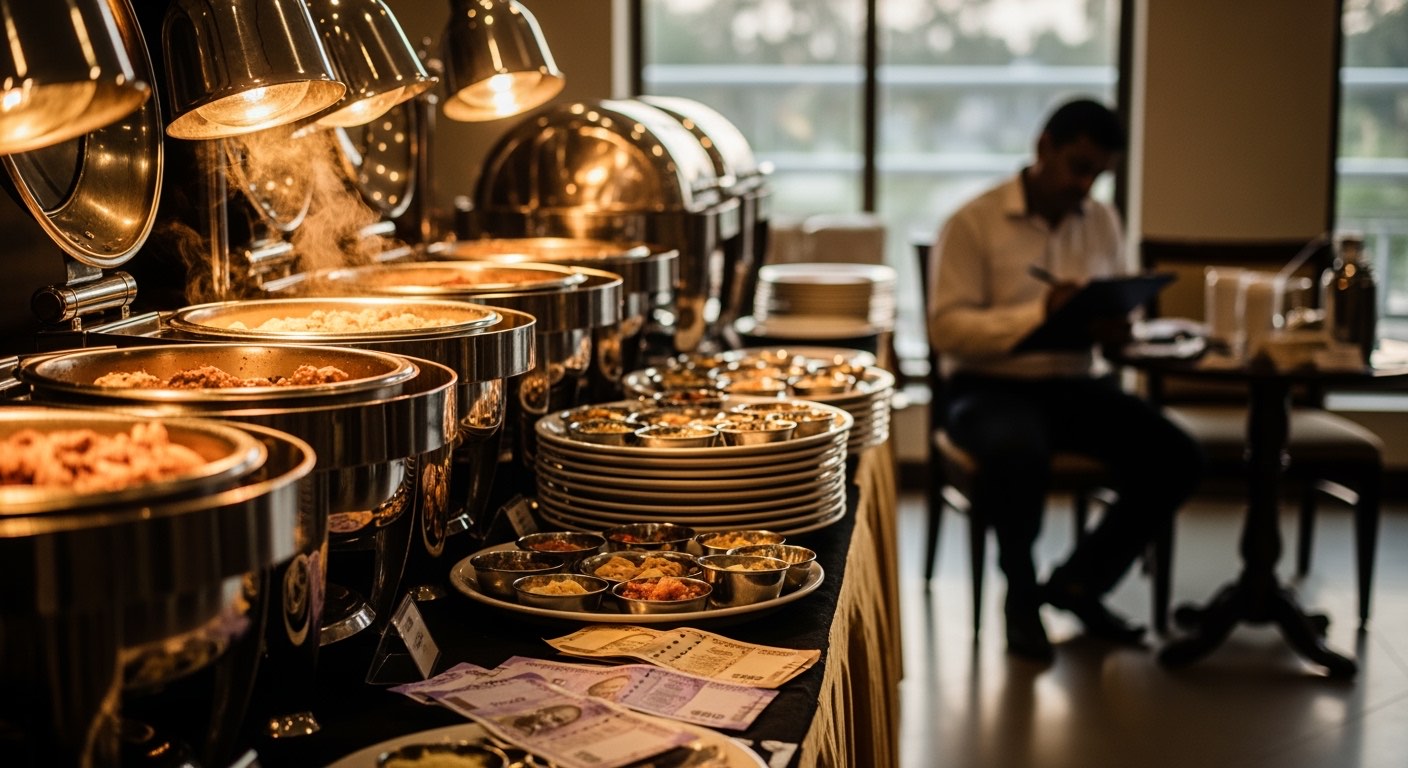
About this piece. A catering business runs on event days, not service hours. Cash and process discipline that works for a fixed-location restaurant — daily DSR, fixed imprest float, one POS — doesn't map cleanly onto a business that prepares for 4 events a week, each at a different venue with different staff and different payment terms. This piece gives you the event-day template Indian caterers need: a single sheet that covers food prep, staff deployment, payment milestones, and post-event reconciliation.
Why catering needs an event-day sheet, not a daily DSR
Three structural reasons:
- Event = revenue unit. A caterer doesn't have "today's covers". They have "Saturday's Khanna wedding, 240 guests, ₹2.4L total". The unit of accountability is the event.
- Payments are milestone-based. 25% advance booking, 50% week-of, 25% post-event. A flat daily cash close doesn't track milestone slippage.
- Staff is event-specific. A daily-wage cook deployed for the Khanna wedding isn't a regular employee. Wage outlay, deployment count, and event-cost allocation all hang off the event sheet.
Without an event-day sheet, the caterer's monthly P&L is a soup of unallocated costs. With it, every event has its own contribution margin within 48 hours of the event date.
The event-day sheet — what's on it
EVENT-DAY SHEET                          Event ID: E-2026-08-15-073

Client name:        ___________________________________
Venue:              ___________________________________
Event date + time:  ___ / ___ / ______   ___ : ___ pm
Guest count (committed):  ____    Guest count (actual):  ____
Menu package (ref):       ___________________________

REVENUE
  A. Quoted total              ₹ _____________
  B. Advance received (date)   ₹ ____________ on ___/___/___
  C. Week-of payment received  ₹ ____________ on ___/___/___
  D. Post-event balance due    ₹ ____________ collect by ___/___/___
  E. Add-ons billed at event   ₹ ____________
  F. Total revenue (A + E)     ₹ ____________

DIRECT COSTS
  G. Raw material (per BOM)    ₹ ____________
  H. Disposables/serveware     ₹ ____________
  I. Daily-wage cook + staff   ₹ ____________
  J. Transport (truck + fuel)  ₹ ____________
  K. Venue charges (if any)    ₹ ____________
  L. Other (gas, ice, etc.)    ₹ ____________
  M. Total direct cost         ₹ ____________

CONTRIBUTION
  N. CM₹ = F − M               ₹ ____________
  O. CM% = N / F × 100              ___ %
  P. CM per guest = N / (actual)  ₹ ____________

LEFTOVER + WASTAGE
  Q. Leftover food returned    ₹ ____________ (at cost)
  R. Wastage at venue          ₹ ____________ (at cost)

POST-EVENT
  S. Client feedback           1 / 2 / 3 / 4 / 5
  T. Repeat-customer flag      Yes / No / Maybe
  U. Issues to resolve         _______________________

Sign-off:  Operations head ____________   Owner ____________
This single sheet — usually A3 if printed, more often a Google Sheet — is the entire post-mortem of one event.
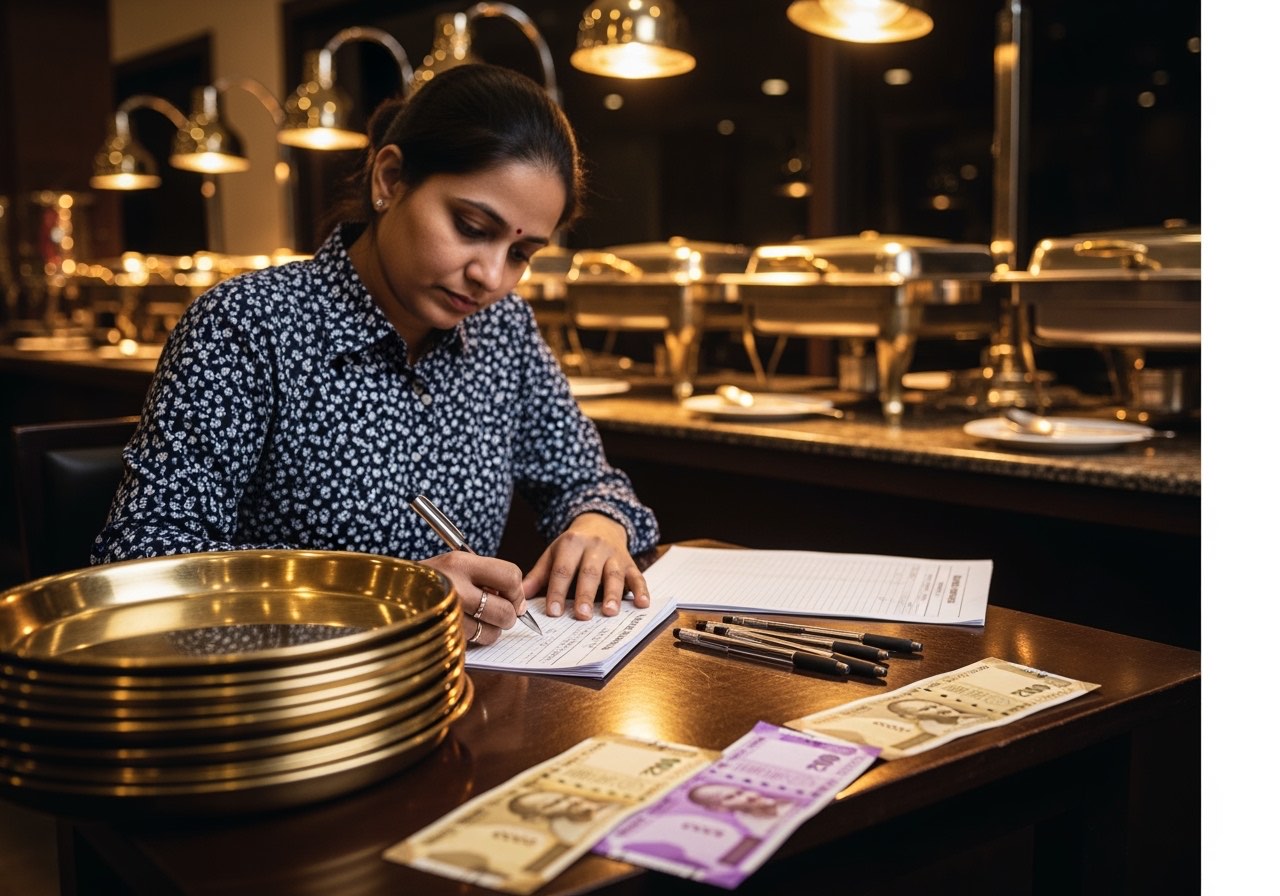
The contribution margin formula for catering
CM₹  = (Total revenue) − (Raw material + Disposables + Daily wage + Transport + Venue + Other)
CM%  = CM₹ / Total revenue × 100
CM per guest = CM₹ / Actual guest count
Catering target CM%: 25–35% for typical Indian wedding/corporate catering. CM% under 18% is bleeding territory — usually because the quote was under-priced or actual guest count was below the breakeven assumption.
| Format | Target CM% | Target CM per guest |
|---|---|---|
| Wedding (200+ guests) | 28–35% | ₹220–₹400 |
| Corporate lunch (50–150) | 22–28% | ₹150–₹260 |
| Private party (20–80) | 25–30% | ₹250–₹450 |
| Mass institutional (500+) | 18–24% | ₹80–₹160 |
The four payment milestones — and why they slip
| Milestone | When | Typical % | Risk |
|---|---|---|---|
| Booking advance | At contract sign | 25–30% | Held hostage if event cancels — refund T&Cs critical |
| Week-of | 5–7 days before | 40–50% | Slippage common; clients delay |
| Post-event balance | T+3 to T+15 | 25–30% | Highest-slip milestone; chase aggressively |
| Add-on billing | Within T+3 | Variable | Often forgotten; must be billed within 72h |
Composite Pune-based mid-size caterer ran 84 events in FY-2025. Average post-event balance days outstanding: 38 days. Industry healthy benchmark: 14 days. The gap (~24 days × ₹X ARR) was working capital tied up — solved by introducing a T+3 invoice rule with clear net-7 terms on the contract. Days outstanding dropped to 19 by FY-2026 Q1. Same revenue, different cash flow.
Daily wage staff — the event-cost allocation discipline
A catering business runs on a mix of full-time staff (cooks, ops manager, accountant) and event-specific daily-wage staff (servers, helpers, drivers, dishwashers). The accounting trap: full-time staff cost gets booked monthly to overhead; daily wage gets booked to the event. Both right.
For each event the daily wage list looks like:
| Role | Count | Wage/day (₹) | Total |
|---|---|---|---|
| Server | 8 | 800 | 6,400 |
| Helper | 4 | 600 | 2,400 |
| Dishwasher | 3 | 600 | 1,800 |
| Driver | 1 | 1,200 | 1,200 |
| Total | 16 | ₹11,800 |
Two rules:
- Daily wage paid same evening, against signed muster. Muster sheet shows date, event ref, name, role, wage, signature. No "I'll pay tomorrow" — labour disputes, EPFO issues, and basic dignity all weigh on this.
- Muster sheet stapled to event-day sheet. Audit trail; also feeds the post-event CM math.
Four leakage points unique to catering
1. Guest count under-actualisation
Quote written for 240 guests. Actual head-count at event = 285. The caterer feeds 285 (because food was already prepped to a buffer) but bills for 240. Loss = 45 guests × per-guest cost. Fix: contract clause for "actual head-count billed at +X% over committed", and an event-day head-count physically taken at first round (can be done by wait staff).
2. Disposable / serveware shrinkage
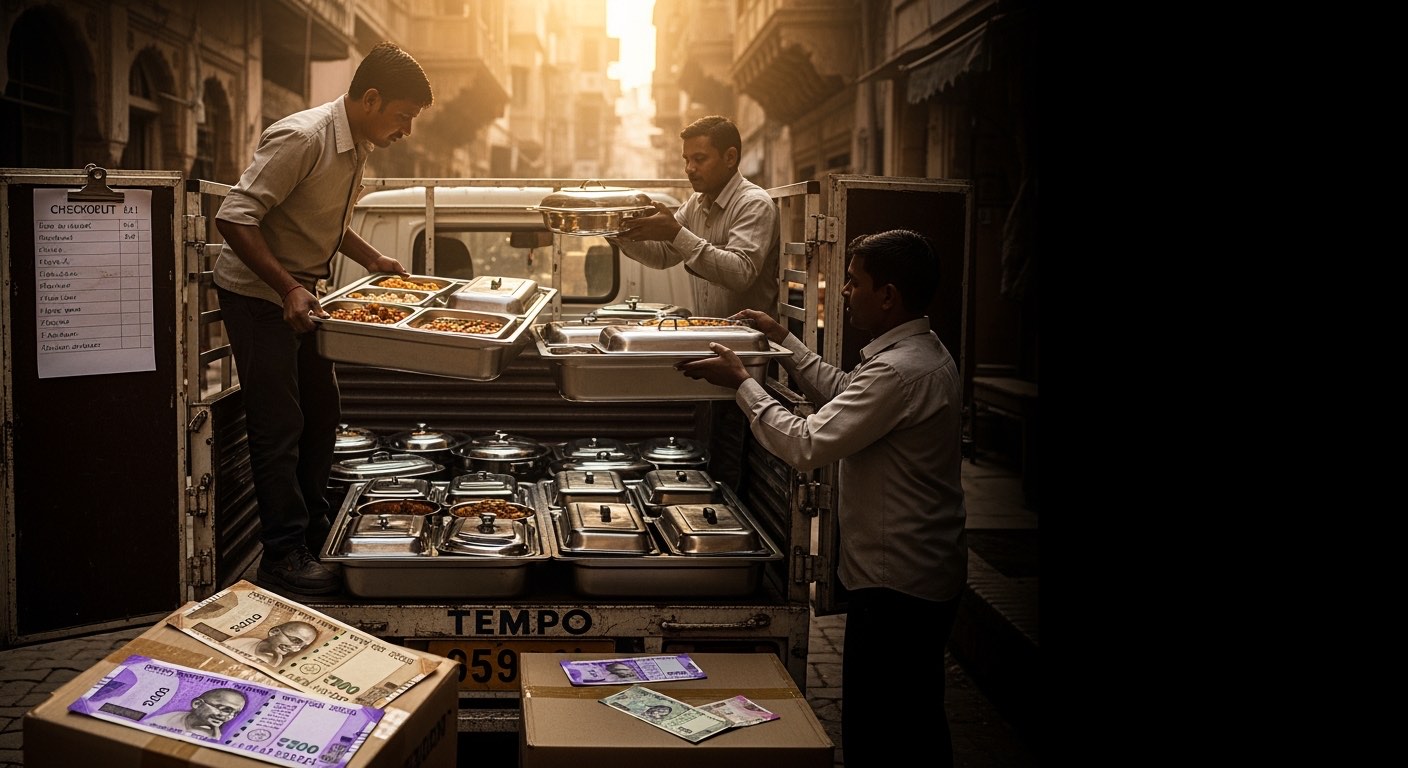
Chafing dishes, serving spoons, cake stands, tablecloths — taken to venue, half come back. Loss spread silently across events. Fix: per-event check-out / check-in inventory list. Driver signs at outbound, ops head signs at return. Variance investigated.
3. Raw material BOM vs actual
Quoted package said "120 kg paneer for 240 guests". Actual paneer used = 138 kg (22 kg over). Either the quote was light or the kitchen over-prepped. Either way it's a margin leak. Fix: post-event raw material reconciliation against BOM. Three events with same SKU running 15%+ over = update the BOM.
4. Transport double-billing or missing
Truck used for two events same day; fuel + driver wage not split, full-billed to event A. Or truck runs fuel paid by personal card, never reimbursed. Fix: transport allocation on event-day sheet; fuel receipts stapled.
Weekly review — Monday morning, 30 minutes
The owner's pulse on catering operations:
- Last week's events × CM% — any below 18%? Why?
- Pipeline of next 14 days' events — any payment milestones slipping?
- Outstanding receivables aging — anything beyond T+15 chased?
- Daily-wage staff utilisation — are the regulars getting enough work to stay loyal?
- Repeat-client rate — last 90 days; below 30% = issue with feedback loop
Five numbers. The pulse is the single decision-making layer that prevents catering businesses from accepting unprofitable events repeatedly.
How catering daily ops differ from restaurant daily ops
| Dimension | Restaurant | Catering |
|---|---|---|
| Revenue unit | Cover / day | Event |
| Cash close cadence | Daily | Per event + weekly roll-up |
| Inventory model | Continuous + replenish | Event BOM + procure-on-demand |
| Staff model | Roster | Core team + daily-wage per event |
| Payment cycle | Same-day cash + T+7 aggregator | Milestone (advance + balance) |
| Customer relationship | Recurring footfall | Episodic; word-of-mouth driven |
Same toolkit, different cadence. The imprest float and PCV format work for the catering office's day-to-day; the event-day sheet handles per-event accounting.
What to do this week
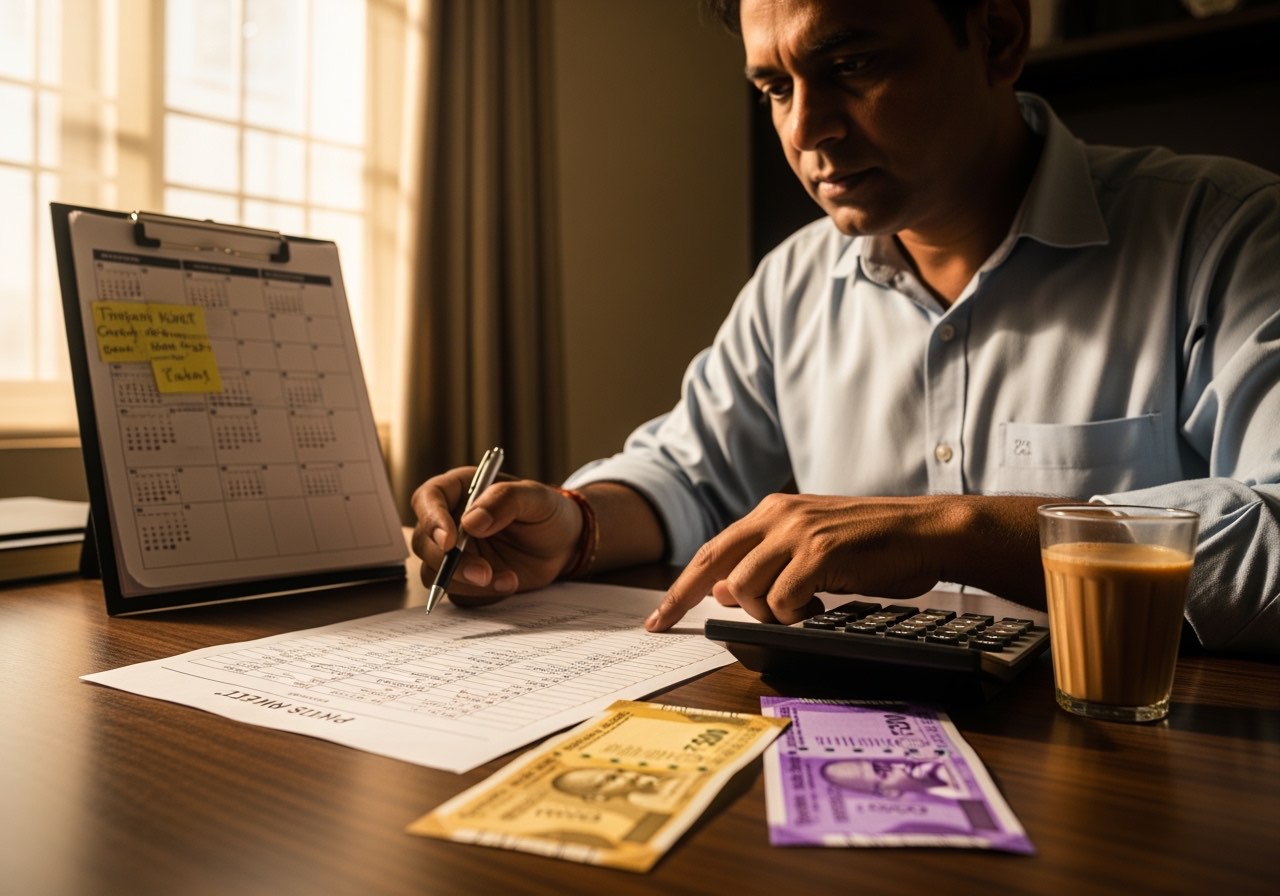
If you're running catering without per-event sheets: start with your next event. Print the template. Fill it the day after. By the end of 4 events you'll have a pattern view — and almost certainly a surprise on at least one event's CM%. That's the start of the loop.
Related on Restaurant Daily
One operator playbook a week, in your inbox.
Cash close, petty cash, payroll, compliance, unit economics — sent every Monday morning. No spam, no upsell drip. Unsubscribe in one click.
Sent from noreply@restaurantdaily.ai. We never share your address.
Related reading
Ghost kitchen multi-brand operations — running 5 cloud brands from one kitchen
Ghost kitchen multi-brand operations in India — how to run 5 cloud brands from one kitchen, allocate cost cleanly, prevent SKU collision, and decide when to kill a brand.
Multi-outlet daily flash report — single-page rollup for area managers
Free multi-outlet daily flash report template for Indian restaurant chains. The 11 fields, the 8am cadence, and the variance flag rules that catch a bad outlet before lunch.
Menu engineering matrix for Indian restaurants — Stars, Plowhorses, Puzzles, Dogs
Menu engineering for Indian restaurants — Stars, Plowhorses, Puzzles, Dogs explained with a free template, worked example, and an action playbook for each quadrant.
Cloud kitchen daily P&L — single-screen template for Swiggy/Zomato-only brands
Cloud kitchen daily P&L template for Swiggy/Zomato-only Indian brands — aggregator commissions, ad spend, packaging, contribution margin, and the brand-level view that owners actually need.
Bakery daily wastage tracking — SKU-level template + how to act on the data
Bakery daily wastage tracking for Indian bakeries — SKU-level Excel template, the four wastage categories, and the weekly review that turns the log into action.