Bar liquor stock daily check — pour cost, BCM tracking, free Excel template
Bar liquor stock daily check for Indian bars — pour cost formula, BCM (bottles closing minus opening) tracking, free Excel template, and the four leakage points behind the bar.
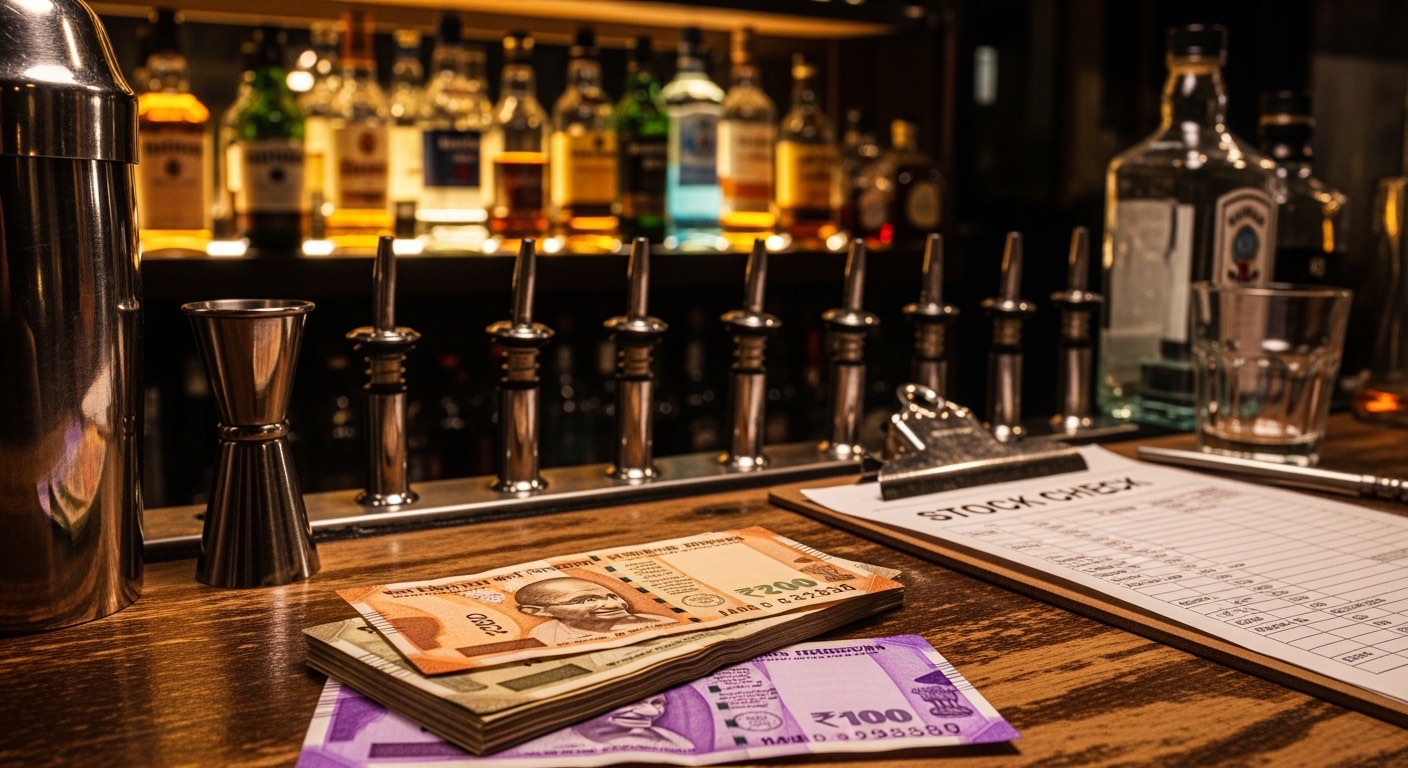
About this piece. A bar in India runs on excise-licensed inventory that is the single highest-margin and single most-leakable line item in the P&L. A 30-mL pour over-poured by 2 mL doesn't sound like much — until you do the daily math across 600 pours and realise it's a ₹2,800 leak per night. This piece gives you the daily check that catches that leak, the BCM (bottle closing minus opening) format, the pour-cost formula, and a free Excel template.
Why a bar needs a daily check, not a weekly one
A restaurant kitchen can survive a weekly stock check because most ingredients have natural usage patterns and visible portions. A bar can't, for three reasons:
- Excise compliance. State excise authorities (especially Maharashtra, Karnataka, Delhi) can demand stock reconciliation against permit-purchase records on any inspection day. "I'll check stock on Sunday" is not a defence.
- Pour variance. A free-pour bartender's 30-mL shot has a real range of 26–34 mL. Across 400 pours/night that's 16 standard drinks of variance — ₹4,000+ on a typical Indian bar menu.
- Theft surface. Bottles are portable, recognisable, and have street value. A daily count is the deterrent itself; bartenders who know counts happen at close don't even attempt.
Public benchmark: industry surveys (NRAI bar segment 2024 + global Sirvo bar pour-cost data) put pour cost at well-run bars at 18–22% of bar revenue. Indian bars without daily checks routinely run 28–34%. The gap — 10 points of revenue — is often pure leakage, not buying inefficiency.
The pour cost formula
Pour cost % = Liquor cost of sales (₹) / Liquor revenue (₹) × 100

Liquor cost of sales = Opening inventory + Purchases − Closing inventory
                       (all valued at cost, per SKU)
A target pour cost depends on bar type:
| Bar format | Target pour cost |
|---|---|
| Premium cocktail bar (craft, fresh juices) | 22–25% |
| Casual restobar (standard pours, beer-led) | 20–24% |
| Classic Indian pub (whisky-led, IMFL heavy) | 18–22% |
| Beer garden / draught-led | 24–28% |
If your bar is running 30%+, the daily check below will show you which SKUs are leaking within two weeks.
The BCM daily check (Bottle Closing Minus Opening)
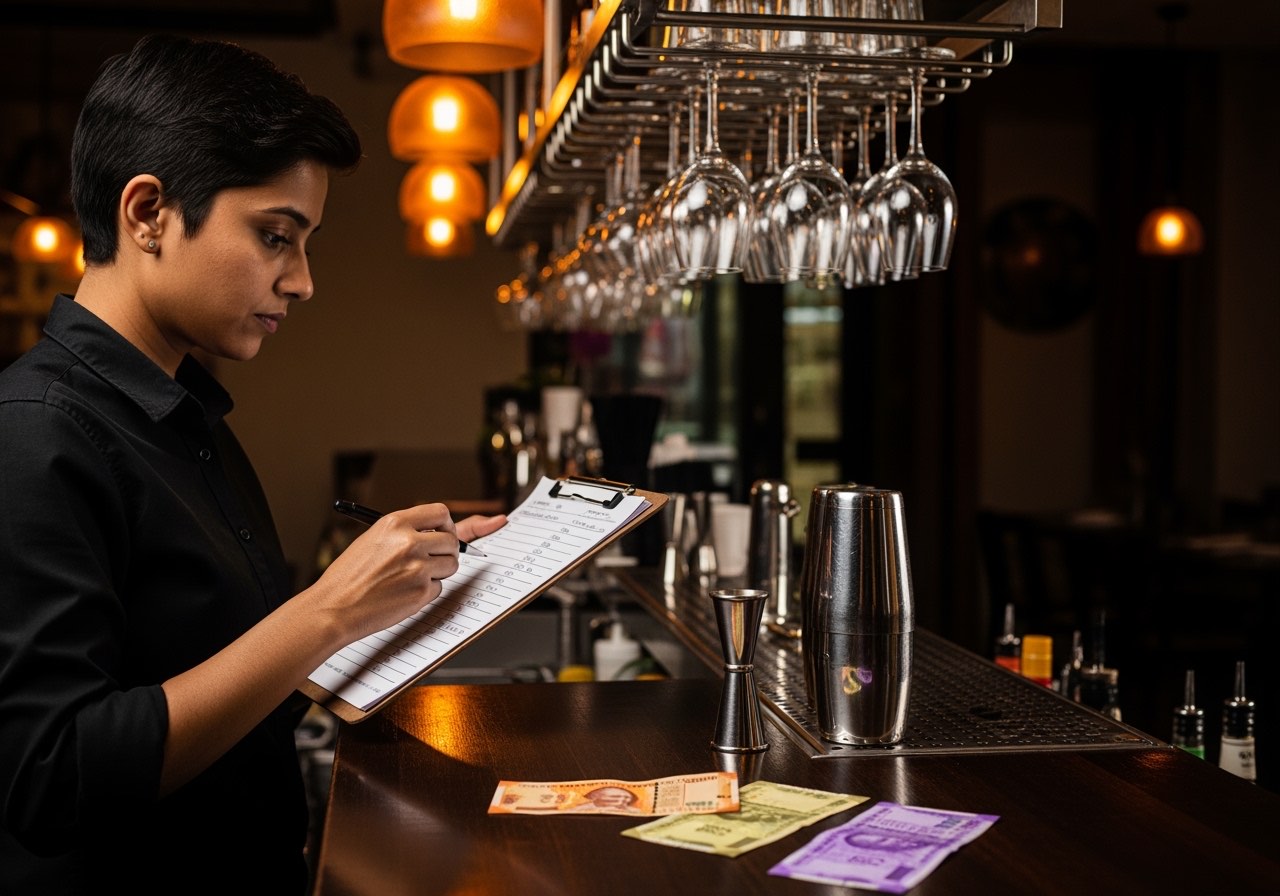
BCM is a simple tenths-of-a-bottle method that takes 12 minutes at close. Per SKU per shelf:
BCM (today) = Opening level (tenths) + Bottles received − Closing level (tenths)
            = Bottles consumed (tenths)

Expected sales per BCM unit = (BCM × 750mL) / standard pour size (30mL)
                            = pours dispensed

Actual pours sold (POS)   = sum of all drinks containing this SKU

Variance = Expected pours − Actual pours sold
Variance > ±5% on any SKU on a given night = investigate. Three consecutive days on the same SKU = systemic.
What goes in the daily check sheet
A bar daily check sheet has 8 columns per SKU:
| # | Column | Source |
|---|---|---|
| 1 | SKU + Brand | Master list |
| 2 | Bottle size (750 mL / 1L) | Master list |
| 3 | Opening level (tenths) | Yesterday's closing |
| 4 | Bottles received today | Receiving register |
| 5 | Closing level (tenths) | Tonight's count |
| 6 | Consumed (tenths) | Auto: 3 + 4 − 5 |
| 7 | Expected pours (30mL) | Auto: 6 × 25 |
| 8 | Actual POS pours | POS report |
A 9th column — Variance (#7 − #8) — is where the eye goes. Coloured red if >±5%.
Premium SKUs (single malts, premium gins, imported) get a 9th physical safeguard: a tally mark on the back-bar register every pour, regardless of POS entry. This is overkill for IMFL whisky; necessary for ₹14,000-bottle scotches.
The closing ritual — 11:30pm to 12:00am (30 minutes)
| Time | Task | Owner |
|---|---|---|
| 11:30 | Last call called; no new drink orders after 11:35 | Bartender |
| 11:35 | Cash + UPI + card mid-bar reconciliation | Cashier |
| 11:40 | Glassware down to dishwash; speed rail wiped | Bar back |
| 11:45 | BCM count starts — speed rail SKUs first | Bartender + manager |
| 11:55 | BCM count — back-bar premiums (witnessed by 2 people) | Bartender + manager |
| 11:58 | Variance row filled; >±5% flagged | Manager |
| 12:00 | Sheet signed by both; locked in safe with cash deposit | Manager |
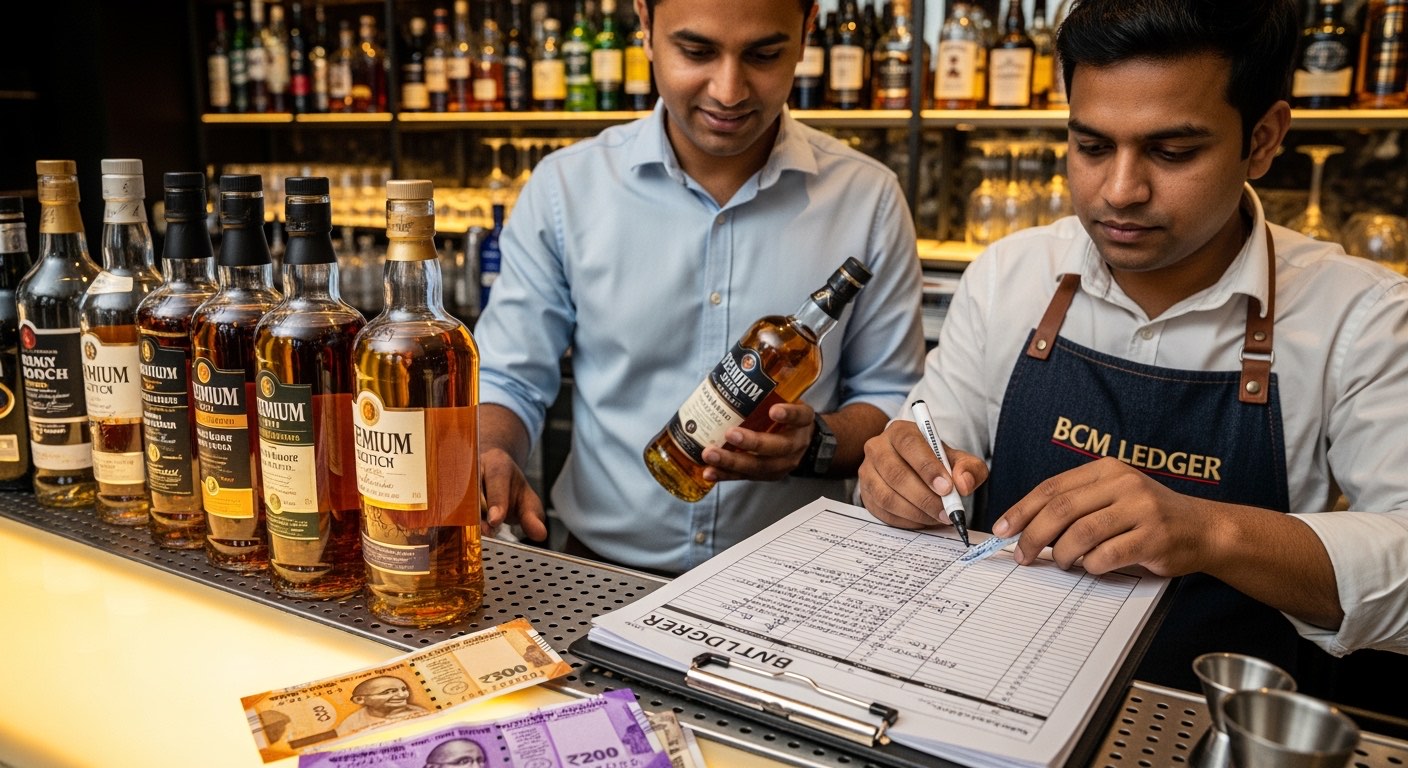
The 2-person rule for premium SKUs is the single biggest theft deterrent. Bartender and manager both initial the closing levels for any bottle ₹3,000+. Disagreements get resolved on the spot by re-counting. This single rule, in two of the operator networks I've sat in on, took bar pour cost from 32% to 23% inside 8 weeks.
Four leakage points specific to bars
1. Free pour drift
A bartender trained to pour 30mL on a 4-count free pour will, after 4 hours of service, reliably drift to 33–35mL. The fix isn't "tell them to pour 30" — it's a jigger. Mandate jiggers for everything except draught beer. Yes, it's slower. Yes, it's cheaper.
2. The "topped-up bottle" trick
Bartender pours 60mL out of a premium bottle to a friend off-POS, then tops the bottle with a cheaper similar-looking spirit. BCM count shows the bottle still at 90% — no variance flagged. Counter-measure: spot-check 3 random premium bottles weekly with a hydrometer. The first time the manager does this in front of the bar team is itself the deterrent.
3. The "lost ticket" comp
Drink made, customer drinks it, ticket gets "voided" or "lost". POS shows no sale; BCM shows consumption. Variance flagged. Counter-measure: every void/comp on the POS requires manager approval with a one-line reason. Daily comp report reviewed at close; >2% of revenue in comps is a yellow flag, >5% is red.
4. Empties not disposed
Empty bottles are evidence. Bartenders who pocket cash on off-POS pours need to make the empty disappear. Counter-measure: empties stored in a locked crate, manager unlocks weekly when excise inspector or scrap dealer comes. Empties count must reconcile to BCM consumption.
The owner's weekly bar pulse
Daily check is operational. Weekly pulse is strategic. Every Monday morning, owner reviews:
- Pour cost % for the week — vs target
- Top 5 SKUs by variance — investigate any > ±5%
- Comp/void % of revenue — vs threshold
- High-margin cocktail mix % — should be 30%+ of bar covers
- Beer : spirits revenue ratio — for restobar typically 35:65
Five numbers. Five minutes. The pulse keeps the bar honest at the strategic layer.
Excel template — what's in it
The free template has:
- SKU master tab — bottle size, cost, standard pour, GL category
- Daily BCM tab — auto-calculated columns, variance flags, manager-sign field
- Weekly roll-up — pour cost %, top variance SKUs, comp %
- POS reconciliation helper — paste POS export, auto-match to BCM expected
Email gate not required.
Where this fits with the rest of bar ops
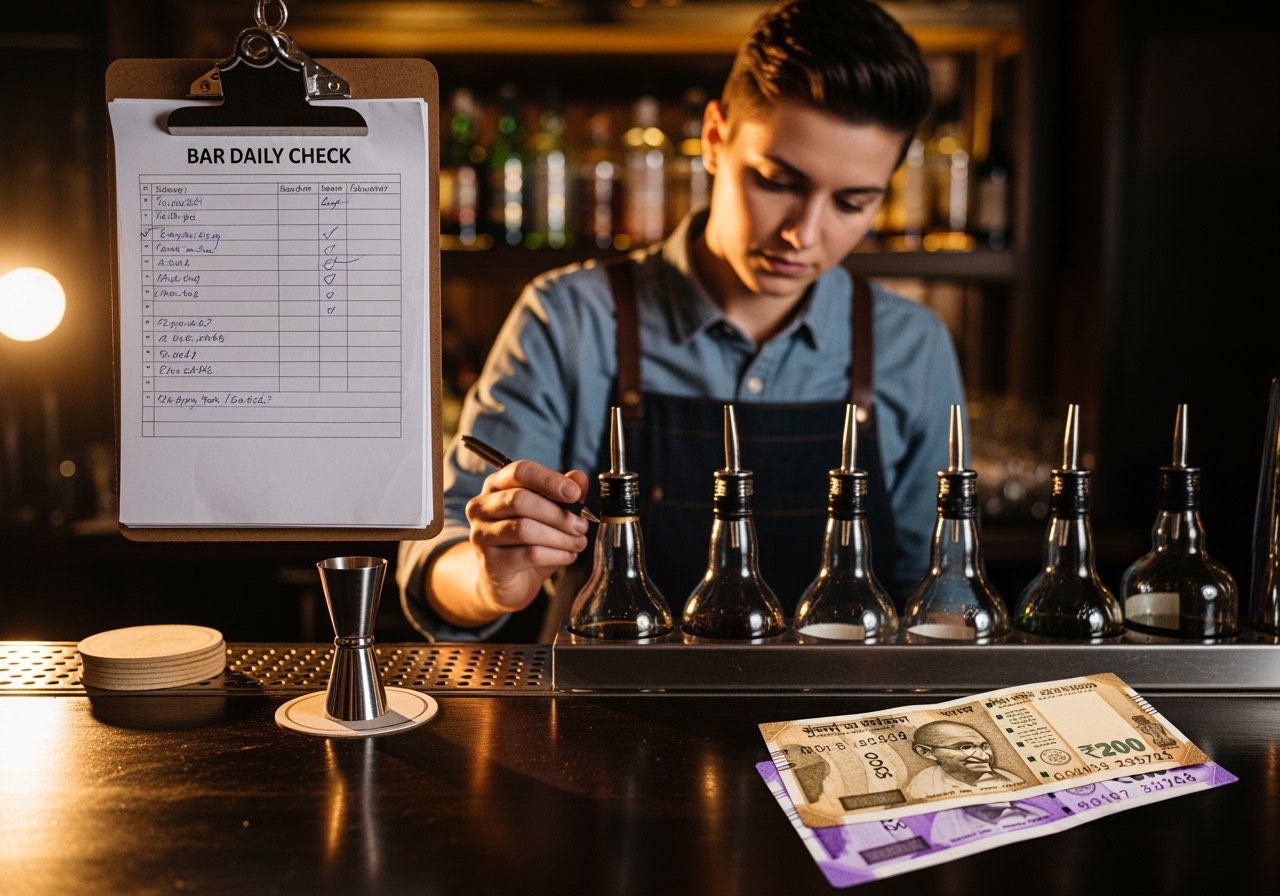
- Daily BCM check — leakage detection at SKU level (this piece)
- Weekly pour cost review — strategic margin tracking
- Monthly excise reconciliation — permit-purchase vs sales declared
- Quarterly menu engineering — drop low-margin/low-volume drinks
Stack the four and your bar runs at industry-best pour cost. Restaurant Daily automates the BCM-to-POS reconciliation; the discipline below works without software too.
Related on Restaurant Daily
One operator playbook a week, in your inbox.
Cash close, petty cash, payroll, compliance, unit economics — sent every Monday morning. No spam, no upsell drip. Unsubscribe in one click.
Sent from noreply@restaurantdaily.ai. We never share your address.
Related reading
Menu engineering matrix for Indian restaurants — Stars, Plowhorses, Puzzles, Dogs
Menu engineering for Indian restaurants — Stars, Plowhorses, Puzzles, Dogs explained with a free template, worked example, and an action playbook for each quadrant.
Signage license for restaurants in India — municipal rules, fees, pitfalls
Signage license for restaurant India — municipal advertisement rules, fees by city tier, common pitfalls in size, illumination, and renewal, plus an inspector-ready checklist.
Catering business daily tracking — event-day template covering food, staff, payments
Catering business daily tracking template for Indian caterers — event-day sheet covering food prep, staff deployment, payment milestones, and the four leakage points unique to catering.
Weights and measures licence for restaurants in India — when it applies
Weights and measures licence for restaurants in India — when it applies, who needs it under Legal Metrology Act 2009, renewal timeline, fees, and inspection checklist.
Cloud kitchen daily P&L — single-screen template for Swiggy/Zomato-only brands
Cloud kitchen daily P&L template for Swiggy/Zomato-only Indian brands — aggregator commissions, ad spend, packaging, contribution margin, and the brand-level view that owners actually need.